
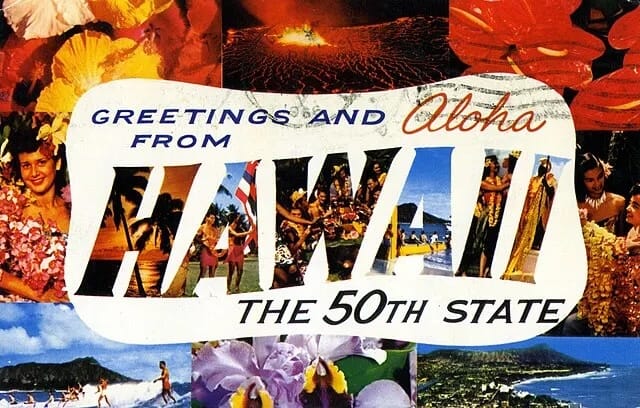
In the history of the United States of America, statehood has often been a messy process. Kansas was called “Bleeding Kansas with competing governments writing competing constitutions. Missouri’s admission nearly broke the Union; the Southern and Northern factions fought over whether Missouri would be a slave state. Utah was blocked for decades because the LDS Church practiced polygamy. Scholars still debate whether West Virginia’s admission was constitutional, given that it had broken away from Virginia without its consent.
Most of those contested admissions were related to slavery, but slavery had been over for almost 30 years when Hawaii was annexed in 1893. Hawaii was the only time in American history when U.S. forces overthrew a friendly, independent nation without presidential approval. A thirteen-member Committee of Safety, mainly comprised of Hawaiian subjects of American descent and American citizens who were members of the Missionary Party, as well as some foreign residents in the Hawaiian Kingdom, conspired with U.S. Minister John L. Stevens to annex Hawaii and make it part of the United States. They were led by Sanford B. Dole, the cousin of pineapple magnate James Dole, founder of the Hawaiian Pineapple Company (later the Dole Food Company).
Hawaii didn’t become a state in an instant. While there were a couple of significant turning points, the process of an independent kingdom becoming a U.S. state took several decades. Hawaii’s downfall began, as these things often do, with the arrival of the white man. Captain James Cook reached Hawaii in 1778 on his third Pacific voyage. Within a few years, European ships were regularly trading with Hawaiians, getting access to fresh water, fruit, and vegetables to replace their depleted supplies after months at sea. Europeans provided iron nails, metal tools, and ultimately knives and firearms, including cannons.
When Europeans first arrived, there was the big island named Hawaii and several smaller islands. King Kamehameha used the weapons provided by the white man to place the entire island chain under his leadership. A decades-long process was completed in 1810. Many previous rulers had attempted unification, but the guns made the difference. Cook and the Europeans tried to impose a new name on the islands, the Sandwich Islands, but it never took.
When Cook’s ships Resolution and Discovery reached Kauaʻi in January 1778, they encountered a thriving, sophisticated Polynesian kingdom with its own political system, religion, agriculture, and inter‑island networks. The people were healthy and well‑fed, skilled navigators and farmers, and living in structured communities. The islands were ruled by aliʻi nui (high chiefs), with complex hierarchies and strict kapu (sacred laws) governing daily life. Cook and his crew were welcomed by the Hawaiians, who were fascinated by the ships, the sails, and the iron tools and nails the Europeans carried. Cook and his crew stayed in Hawaii just over a year during their first visit, exploiting the hospitality of the Hawaiians, including sex with Hawaiian women. Some relationships were likely consensual, while others involved coercion and rape.
Historical accounts describe several moments when Hawaiian leaders stopped sailors from taking women without permission, punished theft or coercion, enforced kapu (sacred restrictions) around chiefly women, and demanded restitution when boundaries were crossed. Still, the Europeans had more weapons, and some Hawaiians believed Cook was associated with the god Lono. That notion was dispelled when a Cook and four British Marines were killed during a confrontation during Cook’s second visit in 1779. The British responded by killing several Hawaiians.
Hawaii got its first permanent white residents in 1790. Neither Isaac Davis nor John Young was American, but it was American actions that resulted in their presence. Simon Metcalfe, born in England but long considered an American, was the captain of the Eleanora when a Hawaiian chief stole one of his skiffs. Metcalfe pretended to forgive the locals and invited them to trade. When unarmed canoes approached, he opened fire with cannons, killing over 100 Hawaiians. This event is known as the Olowalu Massacre.
Metcalfe had earlier whipped a high-ranking chief, Kameʻeiamoku, one of the sacred pio twins and a powerful aliʻi on Hawaiʻi Island. This was a grave insult — a violation of kapu and chiefly dignity. Kameʻeiamoku swore revenge on the next ship to arrive, not knowing it would be Metcalfe’s son.
The Fair American arrived next, and Kameʻeiamoku attacked. It was commanded by 18‑year‑old Thomas Metcalfe, Simon’s son. Kameʻeiamoku and his warriors attacked the ship in retaliation for the whipping and the massacre. All crew members were killed except Isaac Davis, who survived only because he fought bravely and was spared. John Young, from another ship, sought Davis and was detained. Both men, because of their familiarity with European weapons and strategies, became advisors to Kamehameha I and married into prestigious families, living out their lives in Hawaii.
In 1820, the first American Protestant missionaries arrived in Hawaii. Missionaries brought Protestant Christianity, and within five years, many high-ranking aliʻi — including Kaʻahumanu — had converted. Because Hawaiians traditionally followed their chiefs, conversion spread rapidly. The missionaries did some good, bringing the first schools and promoting literacy. They introduced modern medicine, including treatments for sexually transmitted diseases, which Europeans brought to the islands. They also condemned and suppressed many Hawaiian cultural practices, like the hula dance, which until then was danced bare-breasted by the women.
The missionaries promoted Western norms of dress, gender, and sexuality, and helped shift power toward Westernized elites. They created a class of missionary descendants who later influenced the overthrow of the Hawaiian Kingdom. From the first arrivals of Europeans and Americans in Hawaii, they began having mixed-race children who were promoted by the missionaries and themselves as superior to the natives. White businessmen and light-skinned Hawaiians became frustrated by the monarchy and native Hawaiian traditions that limited their business opportunities.
A secret group of primarily American and European sugar planters and businessmen, known as the Hawaiian League or Reform Party, supported by an armed militia called the Honolulu Rifles, carried out the Bayonet Rebellion.
Figures like Lorrin Thurston and Sanford Dole led a group of 3,000 residents. They used smuggled weapons from San Francisco, and among them was a private army of over 250 men.
The armed group confronted King Kalākaua in June–July 1887. They surrounded ʻIolani Palace with rifles and bayonets, issuing an ultimatum demanding that he fire his cabinet. They forced him to accept a new constitution under threat of violence. The King signed it on July 6, 1887 — hence the name “Bayonet Constitution.”
The new constitution stripped the king of most of his authority and gave real power to the cabinet and legislature (controlled by the businesspeople). It imposed property and income requirements that disenfranchised most Native Hawaiians and completely barred Asians from voting. The constitution kept up to 75% of Native Hawaiians from voting by using tried-and-true methods America had used in its own history: income requirements, property requirements, literacy tests, and more. It gave political power almost exclusively to wealthy Americans, Europeans, and a minority of Native Hawaiians. White Americans and Europeans were granted voting rights even without Hawaiian citizenship.
The Bayonet Rebellion happened because U.S. business interests wanted control over Hawaiʻi’s economy and politics, and the king resisted renewing a treaty that would give the U.S. a permanent naval base at Pearl Harbor. The king’s foreign policy favored alliances with Japan and other Pacific nations. American imperial interests were rising in the late 19th century, and the Bayonet Rebellion was the first major step toward annexation.
When Queen Liliʻuokalani ascended the throne in 1891, she inherited a kingdom whose sovereignty had been severely weakened by foreign influence. The Bayonet Constitution of 1887 — forced on her brother King Kalākaua at gunpoint — had stripped the monarchy of authority and transferred political power to American and European businessmen. Her actions to restore power were deliberate, constitutional, and rooted in her duty to her people.
The Queen’s central act of resistance was her attempt to promulgate a new constitution that would restore executive authority to the monarchy and return political power to Native Hawaiians. She meant to reverse the disenfranchisement caused by property and income requirements. Ending the system that empowered foreign businessmen over Hawaiian citizens
Liliʻuokalani did not act impulsively. She met with her cabinet ministers and sought legal and political advice. Her goal was to introduce the new constitution lawfully, not through force. On January 14, 1893, she informed legislators and the public that she intended to introduce a new constitution. She neither mobilized troops nor threatened violence. This peaceful approach contrasted sharply with the armed actions of the groups that opposed her.
When the Committee of Safety — made up of American and European businessmen — moved to overthrow her, she refused to order her guards to fight, knowing it would lead to bloodshed. Her priority was the safety of her people. On January 17, 1893, facing U.S. Marines deployed in support of the coup, she surrendered under protest, stating she yielded her authority:
I, Liliuokalani, by the grace of God and under the constitution of the Hawaiian Kingdom, Queen, do hereby solemnly protest against any and all acts done against myself and the constitutional Government of the Hawaiian Kingdom by certain persons claiming to have established a Provisional Government of and for this Kingdom. That I yield to the superior force of the United States of America, whose minister plenipotentiary, His Excellency John L. Stevens, has caused United States troops to be landed at Honolulu and declared that he would support the said Provisional Government.
Now, to avoid any collision of armed forces, and perhaps the loss of life, I do, under this protest and impelled by said forces, yield my authority until such time as the Government of the United States shall, upon the facts being presented to it, undo (?) the action of its representative and reinstate me in the authority which I claim as the constitutional sovereign of the Hawaiian Islands.
Done at Honolulu, this 17th day of January, A. D. 1893. — Queen Liliuokalani
After being deposed, she petitioned U.S. President Grover Cleveland and submitted formal protests against annexation. More than 21,000 Native Hawaiians signed the Kuʻe Petitions, and she testified and wrote extensively to defend Hawaiian sovereignty.
Americans witnessed during the January 6, 2021, attempted coup that the most fragile moments in governance occur during a presidential transition. Grover Cleveland was the first president to serve non-consecutive terms. He served from 1885 to 1889 and was a friend of Queen Liliuokalani. He was defeated in 1888 by Benjamin Harrison, who favored annexation. On November 8, 1892, Grover Cleveland took back the presidency, with his term scheduled to begin in March of 1893. The overthrow of Queen Liliuokalani took place after Harrison’s defeat but before Cleveland was sworn in. The order to have Marines take part in the overthrow wasn’t given by the Commander-in-Chief, who was still Harrison, and Grover Cleveland, the incoming president, knew nothing about it. The United States overthrew an independent nation upon the orders of basically an ambassador, Minister John L. Stevens, who took his orders from the cousin of the owner of a pineapple company.
Grover Cleveland commissioned The Blount Report (1893). The key findings were that:
- U.S. Minister John L. Stevens abused his authority.
- The landing of U.S. Marines aided the overthrow of Queen Liliʻuokalani.
- The Provisional Government had no popular support.
- The Queen should be restored to her throne.
Cleveland accepted the findings and called the overthrow “an act of war” against a friendly nation.
The U.S. Senate (controlled by pro‑annexation Republicans) authorized the Morgan Report that found:
- U.S. Marines did not cause the overthrow.
- Minister Stevens acted appropriately.
- The Provisional Government was legitimate.
- The Queen’s attempt to restore power was dangerous.
Historians widely view the Morgan Report as politically motivated — essentially a rebuttal designed to protect annexationists and undermine Cleveland’s anti‑annexation stance. Hawaii ultimately became a state in 1959 after spending 61 years as a territory. This occurred after a widely panned state referendum, which reported 94% of voters supported admissions.
As we look at current events and explicit military threats involving Venezuela, Greenland, Panama, Colombia, Nigeria, Mexico, Haiti, and Cuba. It isn’t inconceivable that Donald Trump, or perhaps Elon Musk, Steve Bannon, Pete Hegseth, or Stephen Miller, will decide America needs a 51st state, and start the ball rolling.