
I was in Miami in late February 2026, and while my wife was gambling in the Hard Rock Cafe, I visited the Black Police Precinct and Courthouse Museum in the Overtown District of Miami. It was a Sunday, and the museum was closed. I made a point of visiting the museum the next time I was in Miami, when it was open. That opportunity came a month later in late March. I took a guided tour and left with a history I’d been totally unaware of.
Miami was a segregated city from its inception. In that respect, it was exactly like every major city on Florida’s east coast. What they had in common was that their development was tied to the expansion of the Florida East Coast Railroad, owned by Henry Flagler. Those cities were: St. Augustine, Ormond Beach, Daytona Beach, Palm Beach, West Palm Beach, Fort Lauderdale and Miami.
Later, Flagler’s dominated cities would include Homestead and Key West.
The Black community leaders in those cities decided to press for the creation of a Black police force to meet their needs. The Negro Citizens League, a newly formed Black civic organization, lobbied the City of Miami for Black police representation as the Black population surged during and after WWII.
Don D. Rosenfelder, Director of Public Safety, asked Black community leaders to nominate candidates, a process that bypassed the standard civil service pipeline. Unlike white officers, the first Black patrolmen were not classified as civil service personnel. This meant no job security, no retirement benefits, and no promotional pathway. The first five officers were sworn in as “Emergency Patrolmen.” They didn’t hold the title of “officer” and were only allowed to police Black residents.
The first five Black police officers — sworn in on September 1, 1944 — were Ralph White, Moody Hall, Clyde Lee, Edward Kimball and John Milledge. These men formed the nucleus of what became the only segregated, purpose-built Black police precinct and courthouse in the United States. Several other Black police officers were working within white police departments, including in Jacksonville. But none with their own fully separate Black police station combined in the same building with a courthouse.
As an aside, most of the Black Bahamians who voted for incorporation lived in Coconut Grove and were sold land by white developers not named Tuttle, Brickell, or Flagler. Coconut Grove was annexed by Miami in 1944, but was not included in the area covered by Black patrolmen. White police officers policed Coconut Grove until the 1960s, when the force was integrated.
To become a white officer in Miami, no training was needed. One only had to swear an oath. Black community leaders in Miami demanded more from their officers and secretly trained officers at night to avoid interference from white residents and white officers. The earliest operations, including training, were conducted out of the office of Dr. Ira P. Davis, a Black dentist at 1036 SW 2nd Avenue. This was before the precinct building opened in 1950.
The duties assigned to the first five officers were to patrol a prescribed route between Overtown and Coconut Grove; clear crowded sidewalks; stop gambling and profanity; confiscate weapons; stop and frisk suspicious individuals; reduce violent crime in Black neighborhoods (which dropped by 50% within a year).
They could not arrest white people and were expected to avoid interactions with whites whenever possible.
The precinct later became a nationally unique institution, with its own Black municipal court presided over by Judge Lawson E. Thomas, the first Black judge elected in the South since Reconstruction.
The tour I took was led by a former Black Miami police officer who’d retired from the department over 60 years earlier. He wasn’t among the first five, but he began his service soon afterward. He beamed with pride when discussing the officers’ accomplishments, downplaying the discrimination they faced, especially from white officers, stationed at a white precinct less than a mile away.
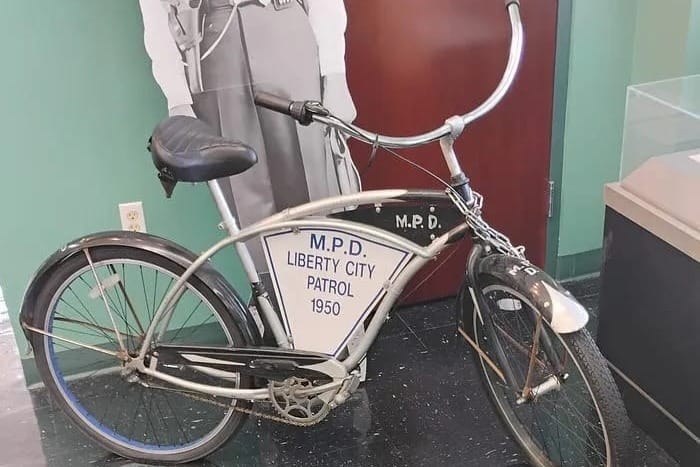
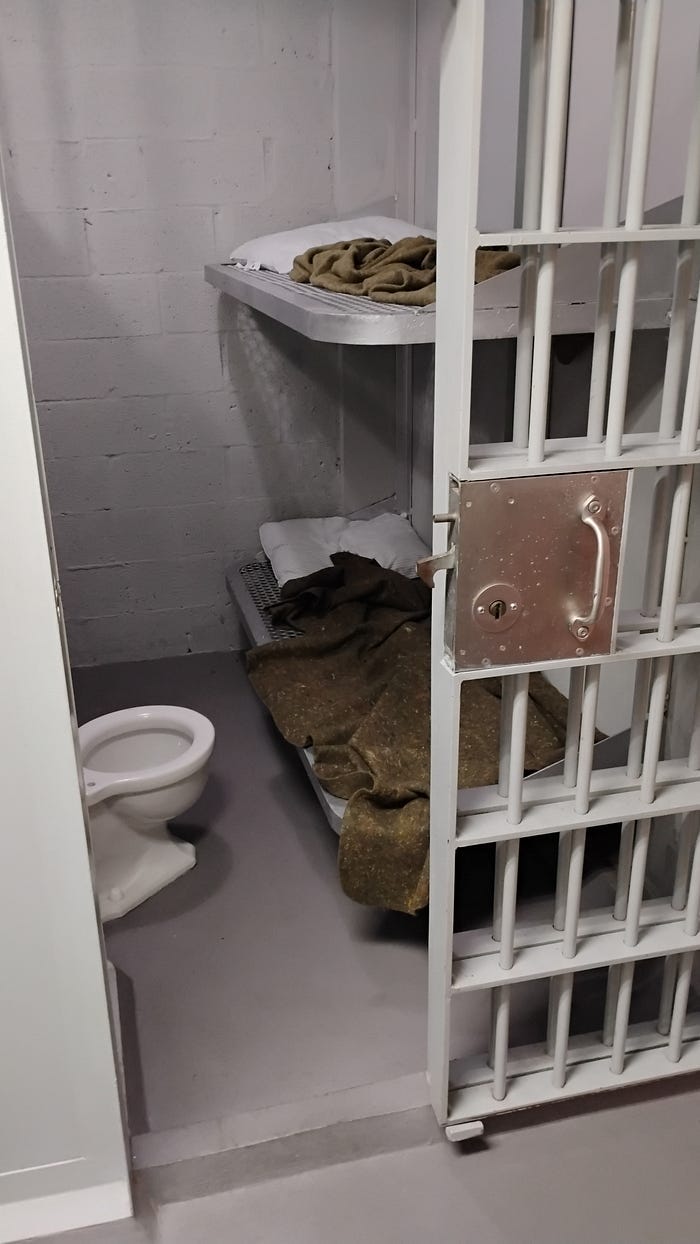
White officers had several patrol cars available to them. Black officers were issued bicycles to cover their precinct. The Black precinct had a few holding cells, but any prisoners had to be sent to the white jail.
When white command officers learned of the training received by Black officers, they created a Police Academy of their own; Black officers were not allowed to attend. When it came time for promotions and consideration for civil service positions, Black officers weren’t eligible because they hadn’t attended the Police Academy. Black patrolmen were assuming the same risks, and like white officers, some were killed in the line of duty. Unlike white officers, for many years, they weren’t eligible for death benefits.
The Black Police Precinct and Courthouse in Miami operated for 13 years — from 1950 until its closure in 1963. It was closed because the City of Miami finally integrated the police department, making a separate Black precinct legally and politically indefensible.
Though City leaders claim no direct correlation, the United Nations Human Rights Committee reviewed Miami’s policing patterns as part of its oversight of U.S. compliance with the International Covenant on Civil and Political Rights (ICCPR).
In its findings, the UNHRC cited racially discriminatory policing, patterns of excessive force against Black residents, failures of accountability mechanisms.
This placed Miami alongside other U.S. cities whose policing systems were found to violate international human rights standards. These are the other cities cited over the years. In case you’re wondering, the United States is still required to report to the United Nations Human Rights Committee. In case you’re wondering, the United States currently doesn’t give a damn about United Nations findings.
1. Washington, D.C.
Visited by UN experts; cited for racial profiling, excessive force, and lack of accountability.
2. Atlanta
Documented cases of discriminatory policing and failures to provide justice or redress.
3. Los Angeles
Cited for systemic racism, police killings, and disproportionate incarceration of Black residents.
4. Chicago
Highlighted for excessive force, racial profiling, and structural failures in accountability.
5. Minneapolis
A focal point of the UN’s investigation following George Floyd’s murder cited entrenched systemic racism. Another investigation is needed after recent I.C.E. and Border Patrol activity.
6. New York City
Cited for discriminatory policing, over-policing of Black communities, and excessive force.
These cities were part of the UN’s official country visit, where investigators visited detention centers, met with civil society and police authorities, and reviewed patterns of killings, profiling, and incarceration. Their unequivocal findings were that systemic racism pervades U.S. policing and criminal justice systems, and the abuses are not isolated incidents but part of a broader pattern.