

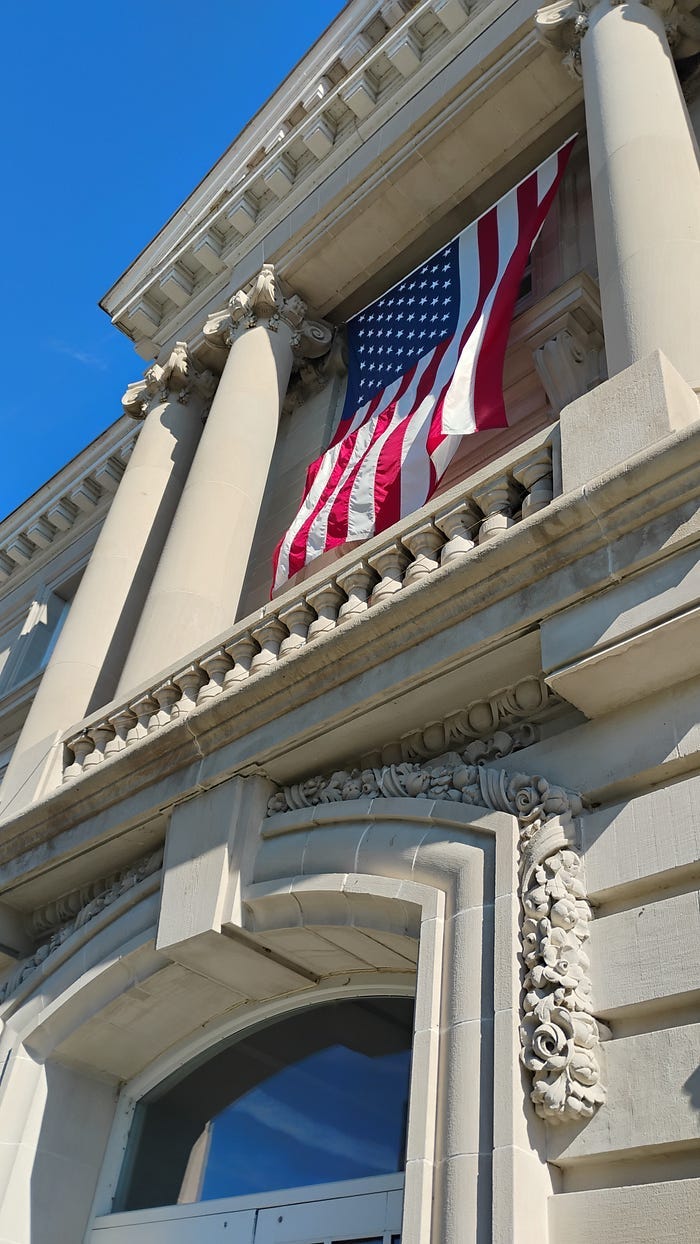
On my last visit to Nashville, Tennessee, I took a detour to Columbia, Tennessee, to see the Maury County Courthouse. The building would have become famous for its appearance in a Jason Aldean music video, “Try that in a small town,” had it not already been famous as the site of multiple lynchings where Black men were taken from the courthouse by mobs and killed. I wrote about the history of the courthouse, little knowing that a couple of the lynchings weren’t officially lynchings after all.
Cordie Cheek was a 17-year-old Black youth from Glendale, Tennessee, who I thought was lynched by a white mob in Maury County on December 15, 1933, after being falsely accused of assaulting a white girl. Despite being exonerated by a grand jury, he was abducted, tortured, and murdered in one of the most brutal and racially charged lynchings in Tennessee’s history.
In late 1933, Cheek was accused of attempting to rape a young white girl in Maury County. Once the honor of a Southern belle was tarnished, it was never going to turn out well for the accused. Cheek was taken to a grand jury in Nashville (Davidson County) instead of Maury County because local officials feared that the white girl who accused him might tell the truth, undermining their case. They sought to avoid scrutiny and potential backlash by shifting jurisdiction. Cheek was accused of assaulting a white girl in Maury County, but the evidence was weak, and the girl reportedly could not confirm his identity.
Maury County officials transferred the case to Davidson County, where Cheek was held in jail near Fisk University, likely to avoid a local grand jury that might dismiss the case. The Davidson County grand jury declined to indict Cheek, citing insufficient evidence. This legal outcome should have protected him from further retaliation. Despite the exoneration, racial tensions remained high.
After the grand jury refused to indict, Maury County magistrate Bert Erwin and two other men abducted Cheek from Nashville, violating legal protocol. They returned him to Maury County and delivered him to a lynch mob, which tortured and murdered him on December 15, 1933, according to official statistics. Cordie Cheek wasn’t lynched because the case fell into a gray zone of documentation. The keeper of these records, the NAACP and Tuskegee Institute, didn’t include Cheek because they wanted all their findings of a lynching to be unassailable.
The NAACP database, which is most commonly used, counts 4,743 official lynchings, including both Black and white victims, between 1882 and 1968. Before the Civil War ended, there were different names for lynchings. They were called summary justice, vigilance committee actions, mob rule, slave discipline, regulator killings, or mob justice. After the Civil War, lynchings existed, but weren’t considered part of the total because the stats were unreliable. The newspapers couldn’t be trusted, the police couldn’t be trusted, and courts couldn’t be trusted to accurately reflect the lynchings taking place across not only the South, but America.
Our official lynching statistics don’t include the first 17 years of activity of the Ku Klux Klan, and the prior 246 years since the first Black people arrived in Jamestown. There were another 106 years before that, when Black people came with Ponce de Leon in 1513, but those records were even shoddier, so I won’t count them either.
How many lynchings took place between 1619 and 1892? Was it hundreds, even thousands? And how many were discounted afterward? Who else besides Cordie Cheek was excluded because of a technicality?
What was behind the conspiracy, I can’t think of a better word, to keep the number of lynching victims limited when it was clearly much higher, perhaps double the artificially low figure of 4,743. I can appreciate the rationale of the NAACP and the Tuskegee Institute to accept lower figures to get Congress, along with state and local governments, to acknowledge that lynchings were taking place at all.
Some members of Congress explicitly denied that lynchings were happening at all, or a big enough problem for Congress to get involved.
“Federal involvement would disrupt the peaceful relations now existing between white man and Negro in the South.” — Rep. Joseph R. Bryson (South Carolina) 1950
Other members of Congress didn’t deny lynching existed, just that it was a federal problem.
“I oppose the enactment of the proposed so‑called antilynching bills… [because] existing state laws provided adequate protection.”-Rep. Charles E. Bennett (Florida) -1950
Southern members of Congress repeatedly argued that lynchings were “exaggerated,” lynchings were “local matters,” lynchings were “responses to crime,” and the federal government had “no authority” to intervene.
In 1916, the NAACP began the legislative push for what would become known as the Dyer Anti-Lynching Bill, after two years of mobilization and political groundwork. Rep. Leonidas C. Dyer introduced his Bill in 1918. At the same time, the Suffragettes were working toward the passage and ratification of the 19th Amendment, which would give women the right to vote. Black women like Ida B. Wells worked tirelessly alongside the white suffragettes in hopes that the white women would support anti-lynching legislation.
On May 21, 1919, the House passed the 19th Amendment. On June 4, 1919, the Senate did so as well. Ratifications began a week later in Illinois, Michigan, and Wisconsin. Texas became the first Southern state to ratify on June 28, 1919. On August 18, 1920, Tennessee became the 36th state to ratify, providing the required three-fourths majority of the states. Women would be able to vote in the 1920 Presidential Election for the first time. The white women got what they wanted and deserted Black women who hoped for their assistance with anti-lynching. The Dyer Bill failed. The first anti-lynching bill passed by Congress was the Emmett Till Antilynching Act. It became federal law on March 29, 2022, making lynching a federal hate crime for the first time in U.S. history.
Lynchings have never been treated with the seriousness they deserve. Not by Congress, not by the states, and not by the institutions that claimed to stand guard over American justice. For more than a century, the country responded to racial terror with denial, delay, and deliberate undercounting. Even the official definition of “lynching” was narrowed until thousands of killings slipped through the cracks, not because they were any less brutal, but because acknowledging them would have forced the nation to confront the scale of its own violence.
The NAACP chose a strict definition because it had to. Southern lawmakers denied lynching existed at all, and Congress refused to act unless the evidence was airtight. But that defensive posture came with a cost: the historical record is smaller than the reality. The numbers are conservative, not because the violence was rare, but because the truth was politically inconvenient.
And that is the final indictment. Lynchings were never important enough for America to count honestly. The country debated definitions, jurisdiction, and states’ rights while Black families buried their dead. It took until 2022, more than a century after the first anti‑lynching bill, for the United States to finally pass a federal law naming the crime for what it was.
The record we have is incomplete because the nation chose incompleteness. The numbers are low because the country needed them to be low. And the gap between what happened and what was counted is not a historical footnote; it is the clearest evidence of how little Black life was valued in the eyes of the law. Lynching wasn’t just a crime. It was a message. And the refusal to count it honestly was a message too.