
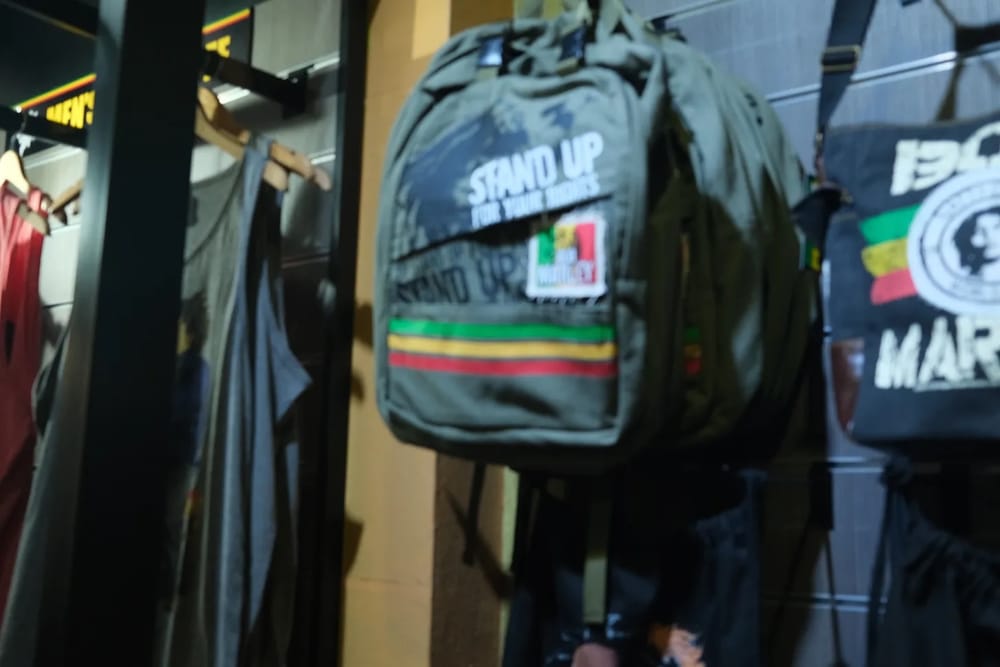
The one moment inside the Marley Museum that stood out to me included a style of backpack I found in my father’s room of tossed belongings after his death. It was a Marley brand backpack, and it was the first item on the right as you entered the gift shop after the 90-minute tour. The tour guide led the group in Anancy-style call-and-response, fully embodying the trickster role. She could recite facts about his 33 million records sold, his 7 boys and 4 girls by 8 different women, his crowd sizes in Berlin and Trinidad, while weaving a narrative about the first reggae superstar. He was what we love in our symbols, becoming all things to all people before quickly leaving this Earth at 36. The tour guide does not linger on the short, plain tragedy of his epic life, felled by cancer that had spread everywhere and that we could do nothing about. But she lingers, understandably, in the grooves of his myth in almost the same way he would strum the curves of a guitar string to produce irrepressible riffs. And yet. I couldn’t help but be skeptical of my own sentimentality toward the world’s greatest ever celebrity Rasta man.
I am inclined, of course, to feel suspicion of Rasta because, in my mind, it fueled and attached itself to my father’s endless delusions, his poverty vow, his anti-everything stance, and his various paranoias about a world dead set against Black survival. While he was both right and righteous, he also lived the strangest paradox of Rasta aura, driven by ultimate coolness, reasoning that shot you into the cosmos, and a ganja allure that could make anyone’s ideas seem like the most ephemeral, beautiful cloud of smoke.
But Bob Marley was what almost every single other Rasta not named Marley wasn’t: a billionaire.
In the gift shop of the museum bearing his name, there was my father’s backpack. The one that reeked of his pheromones, and the unique stench of alcohol and days-old sweat that lingered in the car ride back with me as the steward and collector of his paltry inheritance. There are Marley papers at the point of sale near the register. It went down for a moment as I purchased my 40-dollar t-shirts, imprinted with Marley’s undeniable facial silhouette on the front and back. That was the entire store, a tribute to the iconography of a lost soul that visited us so that we could fall in love with a dream figure. The shortest, and perhaps most bizarre moment of the trip happened inside the refurbished Tuff Gong studio with the 24-track recording board. In it, there was a small booth where they projected an AI hologram of Marley in a plume of smoke. For 12 seconds, he strolled up to the mic and then disappeared before a “Soon Come” banner floated into the space. I didn’t want a Bob Marley phantom generated for my visit, and wouldn’t have requested one if that were an option, but here it was. No sound, no face, just a 5’5 larger-than-life Rasta strut and the pixelated version of his apparition for me and some Italian tourists with two small children. Their translator, a woman with Gucci leather skin and a knee-length “Jamaica” tube dress had explained to them what the tour guide meant when she said that Bob “had only one queen but many princesses.” That was also the fringe benefit of Rasta lifestyle, an implied polygamy that could last long enough to conceive, as my father and the various mothers did. I had come to Jamaica to meet my father’s remaining wealth, his children, and only understood in part that he’d conceived all of us intentionally as a salute to a lifestyle that romanticized breeding and some style of philandering. Although, in that era, it wasn’t with tourist women for visas — and sometimes it was, of course — but my dad chose his time on the island as a paean to Old Testament values. I could only see that we were here, not that we had established some value to him.
As for HIM, His Imperial Majesty Emperor, Haile Selassie I. Ras Tafari Makonnen. Ruler of the only permanently independent African nation. He was another symbol. That’s all we get are symbols. My father, while never a good parent, succeeded at becoming a symbol. He represented, to one brother, coaching and sports and leadership and discipline and poverty and rigidity. To me, he represented artfulness, of dodging, of womanizing, of terror, of paranoia. To my sister, he represented antagonism, of womanhood, of closeness, of questioning. To my middle brother, he represented Blackness, iconoclasm, and being nationless. I am not sure he represented any or all of those things.
Marley’s museum ignited in me a greater curiosity to watch the Kevin McDonald documentary of the same name. After my brother recommended it as the key treatment of his life, I sat in his living room, and absorbed the myth in file footage and carefully curated photographs. While I don’t love hagiographies, and how so many celeb documentaries celebrate the overwhelming influence and effects of fame, I was here to be mesmerized. The film seemed to answer the question: how do we put all of Jamaica into one man? And made you feel good about it. Particularly during one part of the climax. Bob is on stage for a concert where he hopes to unite the two major political parties after having complained about being politicized and an attempt was made on the singer’s life. The two opposing leaders, at his command, were hauled on stage and shared a stiff handshake across his small body. Bob’s amazing performances reminded me of Hanif Abdurraqib’s A Little Devil In America, in which the writer details the religious experience of Black performances captured on screen. Marley and Manley and Seaga is one such performance, set to background music that is distinctly “kinky” and riding the off-beat, his body convulses at the thought of this impromptu unity. Maybe not thought. His body shakes on the pulse of his unifying power. The two men, very light in skin color and wardrobe, are a world apart from this religious encounter. They deal in the hard truth of the world underneath the reggae, where people trade votes for food and their loyalty for a chance to live by some gun. I think Bob understood this and played up the Episcopal shakes of his performance for the sake of a game that had no actual soul.
When I asked my siblings questions about my father later that night, like what they’d hoped to forget about him or discard from his life’s patterns, we were still in the grips of the Rasta mystique. We couldn’t make heads or tails of his mental status. The man who had lost two messiahs in one lifetime (Marley, Selassie) might have pulled the few threads keeping him together. His parents were no heroes. His women loved him but not each other. His wealth and his art couldn’t feed him, much less anyone else. So we kept coming back to one word: enigma. Our father died a hopeless mystery. At one point, we speculated whether he had died or not. I was the only one to posit that it didn’t matter because no one would be coming to claim him if he were alive anyway. His ideas might go with him. Like Rasta, the Marley icon and the lost father, are a wispy memory still floating in the ganja-roasted air. If we were supposed to have something to hold, it would be here in a museum. It is not. The Marley legacy, the Jamaica Tourism Board, the airport, the colors and all of the attendant symbols of Jamaican lore seem to soak up everything in their path, leaving no individuals. Just locks and spliffs and irie vibes set to the hum of a disappearing mountain sunset. I wish I knew more about the space between the lines of the myth.