
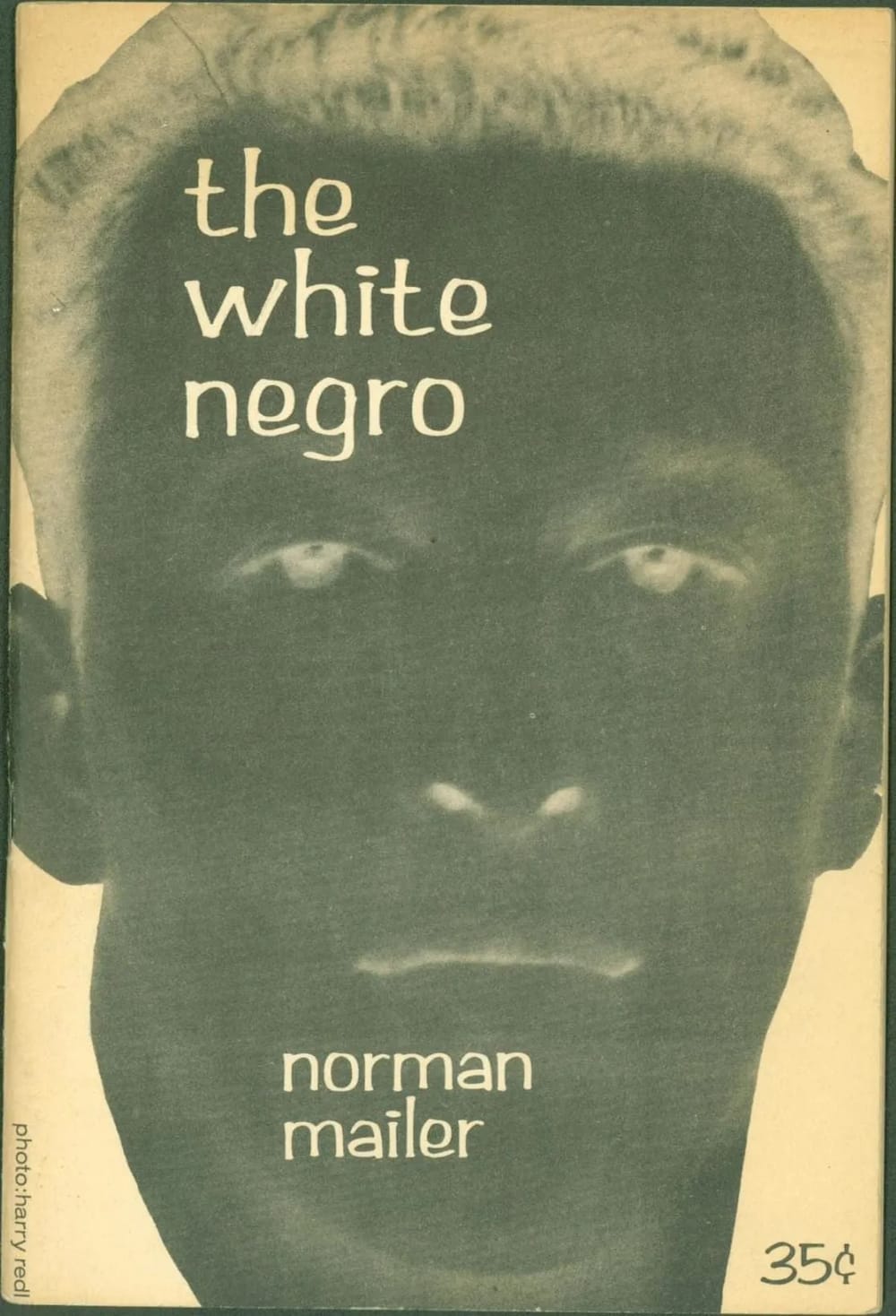
In his infamous essay “The White Negro” (1957), novelist and essayist Norman Mailer tried to explain the appearance of the “the hipster” on to the cultural scene of the 1950s. This was a subset of young white males, American existentialists as Mailer would have it, who came of age in the post-World War II era, and primarily in American cities. Notable about these young men was that they found the style of Black men — how we talked, how we dressed and what we listened to — alluring and dangerous. If the cultural appropriation of Black life and culture could be traced, at least, to Blackface minstrels in the early 19th century, The White Negro that Mailer conjured, was a more intellectual iteration of the phenomenon.
As Mailer’s contemporary Ralph Ellison recalled in his collection, Going to the Territory (1986) about his his interactions with the shite men he served with in the Merchant Marines in the 1940s, “Something here that you are saying, a certain rhythm is your speech, I first heard in my particular community. A certain way you swing your shoulders, or your legs, when you walk (especially Southern boys), you have gotten a lot of that from us.”
It was specifically in the style and persona of Black Jazz musicians of the late 1940s and 1950s that these young white men sought to embody freedom — a freedom from boredom and mundaneness of white American life; not quite a freedom from the tenants of white supremacy that allowed the privilege to be bored. That some of these musicians were struggling with addictions to heroin seemed beyond the point, as was the actual lives of these Black men that might have led them to such addictions in the first place.
Elvis Presley was of course ground-zero in this theater of culture bandits — because there were and would be many more such bandits — as the most visible and well-compensated white man who could, to paraphrase Ray Charles, “shake his ass” like Black people. But there were others including Jazz musician Chet Baker, Rock-and-Roll star Jerry Lee Lewis and, arguably, even Marlon Brando and James Dean, presenting so-called American Cool; all seemed some whitewashed version of Richard Wright’s Bigger Thomas, who might be recalled as the singular imaginary “super predator” of the 1940s.
According to Mailer, this generation of young white men were, in some respects, traumatized by the threat of Atomic and Nuclear annihilation in the aftermath of the US bombings of Nagasaki and Hiroshima. This was the first generation of Americans to grow up with bomb shelters, and within a hyper-protective state, they were also lulled into a stupor by the blandness of their everyday lives. Of course, underlying those fears were the possibilities of what retribution — as opposed to reparations — might look like in the coming years, from abroad, but also from home.
Mailer imagined Black folk, Black men really, as the promise of salvation for these young white men, with the caveat that young white men tap into the “psychopath in oneself”. The psychopath Mailer conjured within was the “Black Man” in them — hence the title “The White Negro” — where Mailer argues “it is no accident that the source of hip is the Negro for he has been living on the margin between totalitarianism and democracy for two centuries.”
More to the point, in Mailer’s view, young white men were between and betwixt a coming totalitarian state, and an ever-evolving anti-democratic government, where book bans and “red scares” (the rabid fear of Russian influence), presented as protections of “freedom,” were the norms. As an award-winning epitome of the alpha-male among post-War II American writers — in many ways he defined toxic masculinity well before the term was an in-style pejorative — Mailer’s pronouncements may have been controversial, yet in some ways a reasonable assessment of the state of American culture.
If the forefront of this manufactured war was on the cultural front, then white Americans were losing that war; their children were already gyrating to the Black music that they called “Rock and Roll” as bombs exploded abroad, and democracy eroded courtesy of The House Committee on Un-American Activities and McCarthyism. Some of those white youth would be singing Civil Rights anthems like “We Shall Overcome” alongside Black marchers in the mid-1960s. The “Bloody Sunday” march over the Edmund Pettus Bridge in Selma, Alabama, as well as the murders of James Chaney, Michael Schwerner, and Andrew Goodman, and Viola Liuzzo, were a harbinger that there would be risks.
What Mailer, and white men of that generation found so damn appealing, like that mousse gel they could rinse out of their hair at night, was the risk. Black men, as it were, lived forever on the edge, with little choice but to live in the moment. Mailer admits as much writing that “Any Negro who wishes to live must live with danger from his first day, and no experience can ever be casual to him, no Negro can saunter down a street with any real certainty that violence will not visit him on his walk.”
What Mailer saw as an adrenaline rush for white men was an everyday reality of, per Mailer, “a life of constant humility or ever-threatening danger.” To be sure this was not the first, nor the last time, that Black men would serve as collective “magic Negros” for what ails White men in America. What might have been a revelation for White America in Mailer’s essay — the very claim Richard Wright made in creating Bigger Thomas — was understood as fact for many Black men.
For centuries Black men lived at an intersection of survival and death virtually every moment of their lives, whether the threat be from standard-issue anti-Black violence or the random violence that festers among folk forced to live on top of each other with little resources. Mailer’s White Negro could never consider the questions that the late Aime Ellis asked with regards to Bigger Thomas (and later Biggie Smalls), “What does it mean for poor urban black men to conquer their fear of the always impending threat of death? What does it mean for these black men to understand death as liberating, emancipatory, and empowering?”