
A conspiracy does not require every actor to have full awareness of every detail, every participant, or every step taken by others. It requires agreement among two or more people to achieve a common goal. Sometimes participants see only their own part of the plan.
Sometimes conspiracies involve unlikely bedfellows. On July 28, 1967, California passed the Mulford Act. Republican Governor Ronald Reagan worked with Republicans, Democrats, and the National Rifle Association (NRA) to push through the Act, after the Black Panthers showed up at the State Capitol, legally exercising their 2nd Amendment rights.
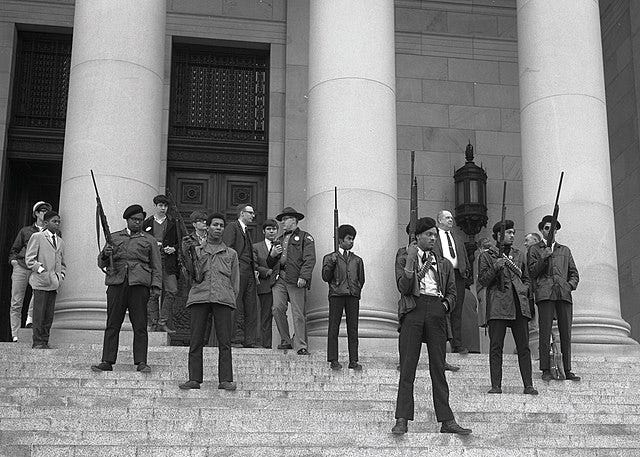
Republican Governor Ronald Reagan strongly endorsed the bill, arguing that there was “no reason” for citizens to carry loaded weapons in public.
“I see no reason why, on the street today, a citizen should be carrying loaded weapons. Guns are a ridiculous way to solve problems that have to be solved among people of goodwill. The Mulford Act would work no hardship on the honest citizen.” — Ronald Reagan
The NRA cooperated with lawmakers by not opposing the bill, by supporting its intent, and by participating in the broader 1960s push for gun restrictions targeting Black armed activism.
Three Democrats co-sponsored the bill. In 1967, the California Assembly was controlled by Democrats (42–38). The bill passed by a 70–5 margin, meaning that the vast majority of Democrats voted for the bill. Most bills passed in California become law the following January 1st, unless the urgency clause is separately passed with a two-thirds margin in each house.
An urgency clause is a section added to a bill declaring that the measure is “necessary for the immediate preservation of the public peace, health, or safety.” This declaration must be written directly into the bill and must include a statement of facts explaining why the immediate effect is justified. The Black Panthers were seen as such a menace that white power brokers of all stripes joined forces to pass a law that would only ever be used against Black people. Not just Black Panthers but any Black person with a gun. No white person was ever charged with violating the Mulford Act.
On May 2, 1967, almost three months before the Mulford Act became law, seventeen Black Panthers were arrested on their ride home from the Capitol at a gas station. Two other Black men who happened to be at the gas station and were not Black Panthers or carrying guns were also arrested. All 19 were charged with conspiracy. That was how the Mulford Act would later be implemented in practice. Any Black man with a gun could be arrested, and police could claim they were Black Panthers. The same amount of evidence was required then as Kristi Noem needs to label someone today a domestic terrorist.
A few other Black people in history struck fear in white America that crossed many lines. Martin Luther King is seen as a hero today. Throughout the mid-1960s, Black Americans had much more favorable views of King than white Americans did. In the May 1963 Gallup survey, for example, 92% of Black Americans but only 35% of White Americans had a favorable opinion of the civil rights leader. Around four-in-ten white adults (41%) held an unfavorable view of King in May 1963, rising to 69% by August 1966.
White public opinion toward Malcolm X was overwhelmingly negative throughout his public life. While no major national poll asked directly about him by name, the broader polling environment shows how his positions were interpreted. Contemporary news coverage routinely described him as “dangerous,” “racist in reverse,” or “a demagogue.” His speeches were covered as spectacles rather than legitimate political interventions. In white public discourse, he was framed as the antithesis of King.
Fred Hampton was not well known among white Americans before he was killed in December 1969. He had been on the radar of J. Edgar Hoover’s COINTELPRO program, which infiltrated his Chicago circle of Black Panther members and arranged his assassination by Chicago police. Hampton was taken out because of his potential. Hampton formed a Rainbow Coalition a decade before Jesse Jackson that included the Illinois Black Panther Party, the Young Lords (Puerto Rican), the Young Patriots Organization (poor white Appalachians), the Brown Berets, Rising Up Angry, and others.
Hampton’s Rainbow Coalition promoted class solidarity, anti‑racism, and direct action to pressure local government. They provided free breakfasts, health clinics, daycare, prison busing, anti‑eviction work, and ambulance services. He promoted Socialism, community self‑determination, and multiracial working‑class unity. Fred Hampton was a dangerous man, and many people wanted him gone.
Jasmine Crockett demonstrates the kind of potential that stands in the way of others. Republicans were united against her because she made them look bad and spoke truth to power. She was quick and confronted her challengers. White Democrats were wary of her as well. She was also a Black woman, which generates a special kind of fear when stepping outside of her role. In her first month in Congress, Crockett threw down the gauntlet, announcing her intentions.
“I’m not here to make friends; I’m here to make change.”
Kamala Harris was beloved by Democrats when she sat on the Senate Judiciary Committee and eviscerated Republicans during hearings. When she wanted to become President, their support wavered. When Jasmine Crockett ran for the United States Senate, she too found less support than she imagined.
“I’m not asking for a seat at the table; I brought my own chair.”
It was expected that Republicans would oppose her. They would be against any Democrat, but Crockett enraged them with her pointed criticism. When they attacked her, she pushed back hard, making them regret trying her. You can look up FAFO in the dictionary and see Crockett’s picture.
“Bleach blonde bad built butch body”
You’d think that Democrats would have thrown their support behind someone with Crockett’s name recognition, who had a realistic chance to win a statewide office, not done in Texas since 1994. Instead, they hedged their bets, throwing unprecedented support to an unknown state senator who was a former teacher who wove religion into his speeches. Hispanic Democrat Colin Allred had announced his intention to run, but dropped out of the race when it became clear Jasmine Crockett would enter the fray.
Allred saw himself losing badly in a Primary where Talarico was outraising him and Crockett had the name recognition. Allred chose to run for reelection to Congress in the newly redrawn 33rd Congressional District. One of his stated goals was to avoid a runoff for the U.S. Senate seat, increasing the possibility of flipping the seat. When interviewed about the Crockett/Talarico race, Allred said he wanted to be impartial but, when pressed, gave the advantage to Talarico.
The message many white Democrats put out about Crockett was that she couldn’t win against a Republican, even though polls suggested she would beat Ken Paxton in a general election. Talarico’s messaging is that he would be more attractive to Republican (white) voters, while Crockett said she’d grow the Democratic base. The message of “winnability” was pushed by mainstream Democrats and Democrat-leaning media. I watched as guests and moderators on talk shows hinted that Talarico was the one who could win, though Crockett had more experience and name recognition. Could it be that the Democratic Party, which has leaned so heavily on the votes of Black women, turned on one when it counted most?
It wouldn’t be the first time, as Kamala Harris could attest to. Even Black Democrats like James Clyburn turned on Black candidates Cory Booker and Kamala Harris in the South Carolina primary, favoring Joe Biden, whom he had supported after previously vowing to remain neutral. While Clyburn was happy to support Harris as the Vice Presidential nominee. He chose to support the white man, despite his age and questions about his mental fitness. Politics makes for strange bedfellows.
James Talarico needed help with name recognition, and boy did he get it. James Talarico taped a 15‑minute interview with Stephen Colbert on The Late Show on February 16, 2026. According to Colbert, CBS lawyers blocked the interview from airing on broadcast TV, citing new FCC guidance about equal‑time rules for political candidates. Colbert went on air and told viewers the network had barred him from showing the interview.
CBS denied “blocking” it, saying they only provided legal guidance. But the damage was done. Colbert posted the interview online, where it exploded. It garnered 9 million+ YouTube views, millions more on TikTok and Instagram, and raised $2.5 million for Talarico in 24 hours. Not only that, every network ran stories for days, showing parts of the Calarico interview, saying how unfair CBS was to Talarico. He, in turn, was interviewed by multiple networks, giving Talarico millions of dollars' worth of free advertising.
Democrats kept pumping the message that Crockett, a Black woman, couldn’t win. No major white Democrats endorsed Jasmine Crockett. They didn’t endorse Talarico either, but he racked up endorsements from local Democratic Clubs and progressive organizations like the Progressive Change Campaign Committee. Rep. Greg Casar, chair of the Congressional Progressive Caucus, praised Talarico as “the future of the Democratic Party.”
The last blow came on election night. Attorney General Ken Paxton led the charge to keep Dallas Democrats from voting for Crockett. The same Paxton that polls suggested Crockett would beat will be in a runoff with incumbent John Cornyn for the Republican nomination. Still, his antics helped rid himself of the woman who might beat him for the Democratic nomination by keeping thousands of her voters from voting.
Democratic voters in the Dallas area were blocked or confused during the 2026 Senate primary because of a sudden rule change that eliminated countywide voting in two major counties. This caused widespread misdirection, long lines, and voters being turned away at the polls.
A last‑minute change in primary voting rules in Dallas County and Williamson County created mass confusion. Since 2019, voters in these counties have been allowed to vote at any polling place in their county. For the 2026 primary, the Republican Party in each county revoked countywide voting and returned to precinct‑only voting. Many voters were unaware of the change. As a result, an unknown number of voters were turned away and directed to a different polling location.
The rule change applied to both parties, but Democratic voters in these counties were disproportionately affected because many were accustomed to countywide voting and arrived at the wrong polling place. Some voters had already cast ballots in multiple special elections in recent months, adding to the confusion.
As Texas Attorney General, Paxton oversees the state’s legal posture on election law. While the articles do not show him issuing a directive about precinct voting, the Texas Supreme Court, a Republican‑controlled body whose legal positions often align with the Attorney General’s office, played a decisive role in limiting voting access on Election Day.
The Texas Supreme Court, at the request of Paxton, blocked a lower court order that would have kept Dallas County polls open two extra hours. The Court ordered ballots cast after 7 p.m. to be segregated, creating uncertainty and preventing many votes from counting. Thousands of votes were lost in Dallas County and hundreds in Williamson County.
Crockett repeatedly told supporters that the primary results could not be trusted until the Dallas County situation was resolved. She emphasized that the rule change and court intervention had directly harmed voters:
“We don’t have any of the results because there was a lot of confusion today.”
While Crockett is considering her legal options, Democrats are lining up behind Talarico, happy to get the candidate they really wanted. If Crockett thought any of them would back her fight against voter suppression. She has another think coming.
“Senator Talarico has a nice ring to it. And we’re all‑in to make it a reality.” — Sen. Adam Schiff (D-CA)
“James is a good man and he’ll be a great Senator. Texas, let’s do this.” — Sen. Chris Coons (D-DE)
Democrats will step to the microphones, telling us what Crockett did wrong in her campaign and how she got beaten by a candidate who was a better fit for Texas. Others will pigeonhole her as an angry Black woman. Jasmine has every right to be angry, and she’s young. She will not be the one thing so many hope she’ll become: silent. Jasmine Crockett will be back, and I hope she remembers all those who weren’t for her. She and Kamala Harris should start a club.