
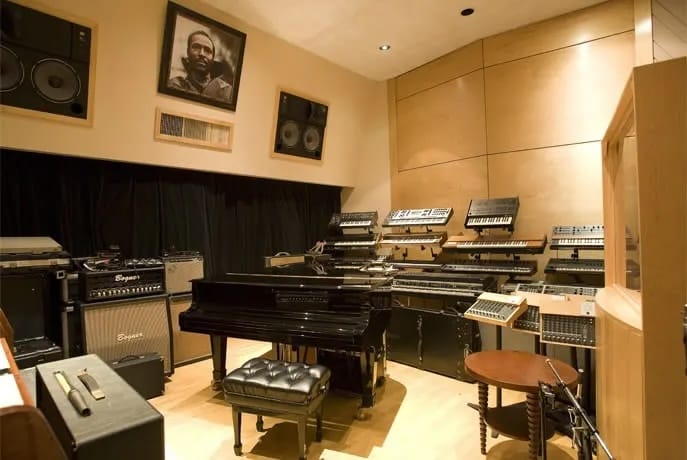
In April of 2011, Aubrey Drake Graham went into the studio to record the lead single to his second studio album Take Care. Produced by Noah James Shebib, the song’s title “Marvin’s Room” was a bit of a curiosity. “Marvin’s Room,” was in fact, recorded in Marvin’s Room, a refurbished recording studio that was built in 1975 by the late Marvin Gaye. Though Gaye was forced to sell the studio in 1979 because of debt, the studio was purchased and restored by former record company executive, John McClain in the late 1990s and since that time has been a recording home for the likes of Usher, Mariah Carey, Yolanda Adams, Lenny Kravitz, Mary J. Blige; Luther Vandross recorded some of his final sessions at Marvin’s Room.[1]
There’s no small irony that Marvin Gaye was shot to death by his father Marvin Gay, Sr. in “Marvin’s room,” the literal location in his parents’ home (which he built for them) where he lived in the year before his killing. After a period of exile in Europe, Gaye lived in his parents’ home, in part, because he no longer had the studio, which for periods during the late 1970s, was his home. As David Ritz writes, “In addition to a spacious control room and a studio large enough to contain Marvin’s eighteen-piece band during rehearsals” there was “a loft bedroom with a one-way window looking into the studio below.”[2] Gaye’s second wife Janis Gaye recalls, “This was always like a second home for Marvin, me and the kids.”
Some of Gaye’s landmark artistic achievements were realized in Marvin’s Room, including I Want You (1976) and Here, My Dear (1978). Beyond the emotional, Marvin’s Room was a space where Gaye constructed a layered and complex soundscape. According to longtime Motown archivist Harry Weinger, “I Want You is Marvin’s many voices, and that’s where he really developed that ability to overdub himself in all the different harmonies…There are four, five, maybe six voices and they are all Marvin.”[3] Among the voices, were those of Marvin channeling the spirit of Frank Sinatra.
In April of 1955, some twenty years before Gaye opened Marvin’s Room, Frank Sinatra released In the Wee Small Hours, an album of torch songs and ballads. The songs were written by Tin Pan Alley veterans including Hoagy Carmichael, Richard Rodgers and Lorenz Hart, Cole Porter, and even Duke Ellington, who is represented with “Mood Indigo.” The album was disparaged at the time as “Ava’s songs,” in response to the breakup that Sinatra was going through with his second wife, the actress Ava Gardner. But as Matt Micucci writes, In the Wee Small Hours, “marked the beginning of Sinatra’s ‘mature’ singing style, defined both by a depth of expression and rhythmic experimentation.”[4]
Sinatra’s desire to bring some gravitas to his music — he openly admitted his debt to Billie Holiday — would have more ramifications for popular music than introducing the so-called pop “concept” album.[5] According to music critic Stephen Holden, with In the Wee Small Hours, “Sinatra gave men license to cry without shame.”[6] Sinatra partnered with arranger, orchestrator and composer Nelson Riddle during the period, and that partnership proved invaluable to Sinatra’s artistic ambitions at the time.
Marvin Gaye was 16 years old, and still six years away from his debut album for Motown, The Soulful Moods of Marvin Gaye (1961), when Sinatra released In the Wee Small Hours. Nevertheless, Gaye admitted to David Ritz, “My dream…was to become Frank Sinatra. I loved his phrasing.”[7] The allure of Sinatra and the torch songs that he made famous in the late 1950s and early 1960s can be heard on Gaye’s first recordings for Motown. In an arena that included Nat King Cole and a young Johnny Mathis, the results were decidedly underwhelming.
After commercial breakthrough with That Stubborn Kinda Fellow (1962), which generated three top 15 hits including the title track and “Hitchhike”, Gaye returned to Sinatra, and In the Wee Small Hours in particular, on his third album When I’m Alone I Cry (1964). Gaye is more assured on Sinatra’s “I’ll be Around”, which Sinatra first recorded in 1943 and later in 1955, and indeed the subtle but substantial differences in Sinatra’s performances of the two versions — the sweetness of the first version versus the longing of the second — might have been a signpost for Gaye.
1965 proved an important year in Gaye’s commercial development. Gaye’s single “How Sweet It Is to be Loved by You” became his highest charting Pop single in January of 1965 (peaking at number three). By the end of 1965, Gaye also released his tribute to Nat King Cole, who died in February of 1965 at age 45. Two of Gaye’s singles from 1965, “I’ll Be Doggone” and “Ain’t that Peculiar,” which both appear on Moods of Marvin Gaye (1966), were the first Gaye’s singles to top the Rhythm & Blues charts, and both were top ten Pop hits. Moods of Marvin Gaye (1966) contained six singles (released through 1966), five of which were top ten Rhythm & Blues hits. Marvin Gaye had become a Soul hitmaker, and much of what one hears on that album is Gaye’s signature vocal style.
Overshadowed in the commercial success of Moods of Marvin Gaye, were two outliers on an album of Soul “bangers.” Written by Willie Nelson in 1960, “Night Life” was a hit for fellow Country singer Ray Price in 1963. The assertiveness that Gaye projects on Moods of Marvin Gaye — this sense that he could sing anything — is at the forefront of his performance of “Night Life”. Gaye closes Moods of Marvin Gaye with a four-plus minute rendition of “One for My Baby (and One for the Road)”, a song written by Harold Arlen and Johnny Mercer, and initially performed by Fred Astaire in 1943. Sinatra first recorded the song in 1947 and reprised it for the 1954 film Young at Heart. Like his performance of “Night Life”, Gaye pushes boundaries not heard on his previous efforts at singing standards and torch songs.
What was also clear is that Motown still had no interest in enabling Gaye’s desire to be a Pop balladeer, especially since Gaye had established himself alongside Soul Men like James Brown, Otis Redding, and Wilson Pickett, and as an artistic heir to the late Sam Cooke. Though Gaye did not record a solo album between 1966 and 1968, he was in fact working on album length material with composer and arranger Bobby Scott.
Gaye began working with Scott as early as 1966; the aforementioned “Night Music” was arranged by Scott. In Scott, Gaye found his Nelson Riddle, in what was a departure from Motown’s practice of working with in-house producers. The Bobby Scott sessions are extraordinary; had Gaye the benefit of working with Scott’s arrangements earlier in his career, he might be remembered as one of the last greats of what was a dying tradition of Pop standards. Yet the stakes had changed, even for Gaye, and in the end, he and Scott agreed to scrap the project.
The early 1970s proved a major transition period for Gaye. His popular recording partner Tammi Terrell died of a brain tumor in 1970. As well, Gaye was deeply impacted by the Vietnam War, and the increasing tenor of the Civil Rights and Black Power era; Gaye began to look inward. This period of interiority ushered in the most sustained period of creativity in Gaye career, in which a succession of commercially and artistically successful recordings — What’s Going On (1971), Let’s Get It On (1973) and I Want You (1976) — help establish Gaye, not just as a pop star, but one of the iconic geniuses of late 20th century Black music.
Whereas What’s Going One offered Gaye’s very personal and spiritual view on social and cultural issues such as the Vietnam War, the environment, urban life and religion, Let’s Get It On and I Want You found Gaye exploring the emotional contours of sex and eroticism, largely related to the end of his marriage to Anna Gaye and his burgeoning relationship with Janis Hunter.
After recording his rendition of “Ava’s songs”, Hear, My Dear — royalties of which were used as part of his divorce settlement with Anna Gaye — Gaye returned to the Bobby Scott sessions through 1977 and 1978. With his divorce finalized and his fraying relationship to second wife Janis, Gaye achieved some of the emotional gravitas that he believed he needed to record the Scott charts. “In the midst of one of my worst depressions over Jan, I went into my studio and recorded them” Gaye tells Ritz, “I had the tracks for years, but it took me only a single night to sing all those songs…and a lifetime of pain to gain the wisdom.”[8]
Yet Gaye’s emotional maturity and his willingness to explore the interiorities of his domestic life, only tell part of the story; just as significant were advancements in recording technology. Armed with a sense of interiority, perhaps literally cultivated in “Marvin’s Room,” Gaye finished the seven tracks from the Bobby Scott sessions. A stunning achievement vocally, technologically and artistically, the album was not released during Gaye’s lifetime.
Gaye’s relationship with Motown and its founder — Gaye’s one-time brother-in-law– faltered, largely because of Gaye’s desire to trample the commercial boundaries set for him. From Motown’s vantage, Gaye, who scored only his third number one pop hit with the Disco-tinged “Got to Give It Up” (1977) — perhaps the most well-known throwaway of Gaye’s career — was not in the position to be “experimental” in a vocal genre that was commercially dormant for a decade. After the ill-fated In Our Lifetime (1981) — released against Gaye’s wishes — Gaye separated from the label.
After Gaye’s death in 1984, versions of the Bobby Scott sessions surfaced on the compilation Romantically Yours (1985), and at least two Motown box sets, The Marvin Gaye Collection from 1990, and The Master: 1964–1984 (1995). The best representation of the Bobby Scott sessions was Vulnerable, released in 1997, which included the seven tracks from the Scott session, and three alternate takes. Released almost 15-years after his death, Vulnerable was treated more as an afterthought, than the revelation that it was. As Ritz acknowledges, “In singing achingly slow ballads — ’Why Did I Choose You?’, ‘She Needs Me,’ ‘I Wish I Didn’t Love You So,’ and ‘I Won’t Cry No More’ — [Gaye] achieved the mastery of Sinatra’s Wee Small Hours or Billie Holiday’s Lady in Satin.”[9]