
Perhaps I’ve forgotten some of the things I was afraid of early in life. Let’s eliminate things like worrying about how well I did on a test or looking around to find a parent temporarily out of sight. I felt safe in Minneapolis when walking six blocks to elementary school, and taking the city bus across town from 7th to 12th grade. I was unaware of Field Elementary’s history, which, just a few years before I attended, was the scene of major battles over integrating the school. I didn’t know that city bus routes reinforced the segregation imposed, not by Jim Crow but by redlining, which had a similar effect.
I grew up playing with the white kids living on my block: Mark, Danny, and Lyle, not knowing that my family couldn’t have moved to 42nd Street just a few years earlier due to redlining or used an FHA loan to purchase that home. As a youth, I was protected from concerns about physical harm. It helped that I was taller than most kids, reaching my full height of 6’6” by age seventeen. In high school, I played four sports and was an unlikely person to approach to do harm.
The first time I remember feeling fear was as a spectator at a football game when I was in eighth grade. My school, which was grades 7 through 12, had an away varsity football game at Edison High in Northeast Minneapolis, which was almost exclusively white. Edison students threw rocks at our bus, and Black students were called “nigger.” After the game, cars followed our bus across town, honking with people yelling at us from their windows. By the time we got back to our school, it was dark, and we didn’t know what was going to happen.
During my last few years in high school, I was worried about being drafted into the Vietnam War. People I knew in high school had died in Vietnam, so the war was a real fear. The draft ended the year before I graduated, so that fear went away.
I lived on the opposite side of town from where riots had taken place after the assassination of Martin Luther King, Jr., and didn’t have fear of violence reaching my home. I did see the fear in my mother’s face when she ran down the alley behind our home to get me from Mark’s house, where I was playing basketball. Without explanation, she insisted I come home right then. We went home and watched parts of America burn on television. If I had to pick the age I first felt fear for my safety because I was Black, it would be age thirteen at that football game.
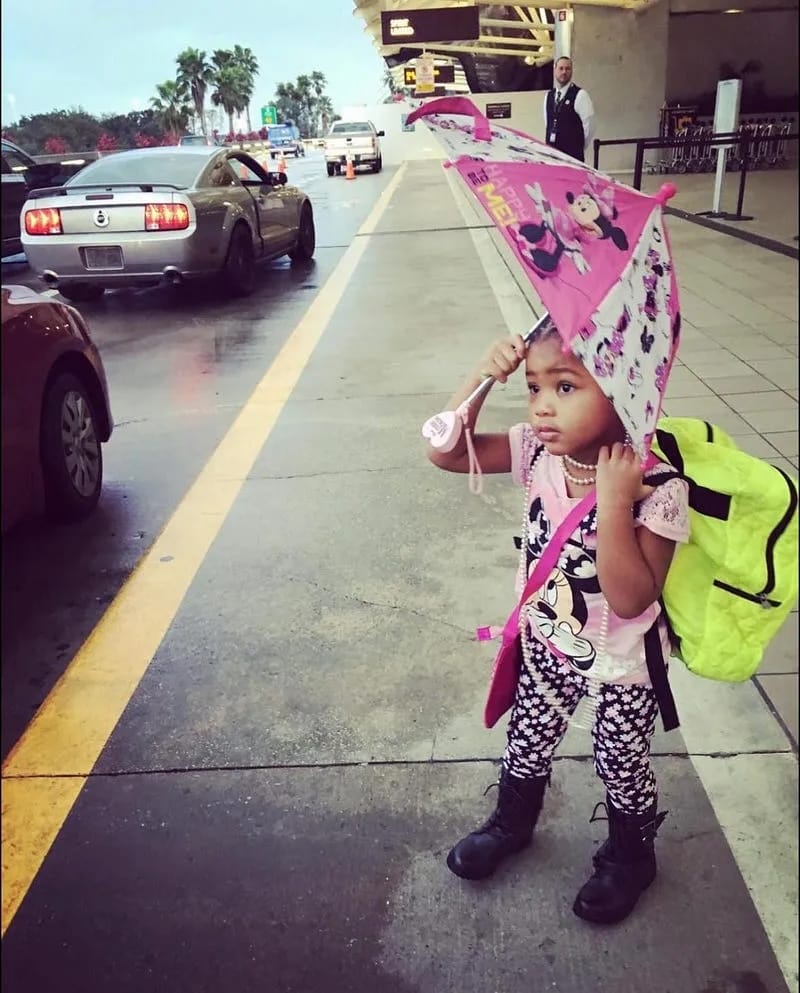
The young girl in the cover photo is one of my granddaughters. She was days shy of her third birthday and preparing to board a flight to New York with a caregiver. She was fearless at the time and unconcerned about being away from her mother, only looking forward to the trip ahead. Like her mother and grandfather, Jordin grew tall and wasn’t often physically picked on. Unlike her grandfather (me), one of her spiritual gifts is empathy. She is deeply concerned about others’ pain. This granddaughter frequently asks me questions about life, and I try to answer them.
Last year, when Jordin was barely twelve, she mentioned a friend at school who was Haitian. It was during the height of Donald Trump’s war against Haitians in Ohio, where he accused them of eating people’s pets and wanted them out of the country. Jordin’s friend worried that the government would come take her father away. She felt her friends’ fear and took it as her own. The first time she felt fear based on race and ethnicity was at age twelve.
I look at America today, wondering about the children who didn’t get a grace period of even a dozen years. Brown children are being separated from their parents at any age, some too young to be aware of what was happening. A ten-year-old Black boy in Amite County, Mississippi, was run over and killed by a white driver, high on weed, who left the scene as the boy lay dying. A Mississippi jury found him innocent of two charges. The driver said he left the scene to call 911, but he never called 911. In the last moments of his life, that boy felt fear at age ten.
The current wave of fear sweeping across America isn’t limited to immigrants. American citizens of a suspicious complexion are likely to be stopped and arrested, even deported, if the government decides they don’t believe you. Can a Hispanic person or a Somali-looking person go to a Home Depot, Target, or a grocery store, with no concern that ICE may come for them? Help me reconcile the Castle Doctrine (Stand Your Ground Laws) with an ICE internal opinion that they can enter your home without a warrant if they suspect someone is there with a deportation order? There is nowhere that children of any age are safe if they aren’t an acceptable color. ICE has detained Native Americans in Minneapolis whose only crime is not presenting as white.
Though most of my focus to this point has been on racism and the racist enforcement of immigration policies. Imagine the experiences of LGBTQ children at whatever age they allow their sexuality to become known. Often, the fear isn’t of how they will be treated by strangers but by their parents and family.
What of women of any color who might be sex-trafficked and then ignored, as in the cases of Jeffrey Epstein’s victims? Wealthy men in particular have used young girls for their pleasure, leaving behind broken girls often blamed for their circumstances. I ask you to consider two of Donald Trump’s best friends with constant access to young girls and who were known to have sex with them. John Casablancas of the Elite Modeling Agency partied with Donald, surrounded by young girls. Jeffrey Epstein and Trump held private “Calendar Girl” competitions at Mar-a-Lago. Trump owned Trump Modeling Agency, which hired women and girls across age groups. A thirteen-year-old has accused Trump, but that case never made it to court.
Children have been exploited throughout American history, whether for sex or their labor. Child labor laws have become increasingly under fire as the work currently performed by immigrants still needs to be done. America hates immigrants so much that the cost to our children is ignored.
Fear in America has never been evenly distributed. Some children get a handful of protected years before the world announces itself; others are confronted almost immediately, their innocence interrupted by someone else’s suspicion, someone else’s power, someone else’s story about who they are allowed to be. I was lucky enough to reach thirteen before I learned what it meant to be targeted for the color of my skin. My granddaughter’s friend didn’t make it that far. The boy in Mississippi never reached adolescence at all.
What stays with me now is not only the fear itself, but the way it travels — across generations, across neighborhoods, across borders, attaching itself to anyone whose existence can be questioned on sight. Yet fear is also a teacher. It tells us where the fractures are. It tells us who is still unprotected. And it tells us what kind of country we are becoming when children learn to brace themselves before they learn to dream.
If there is any hope, it lies in refusing to accept fear as an expected inheritance. It lies in insisting that every child — Black, brown, immigrant, native‑born — deserves the grace period my granddaughter once had, the one I briefly enjoyed, the one too many never receive. America has never lacked the ability to change. The question is whether we have the will to make safety something every child can count on, not a privilege granted by luck, geography, or complexion.