
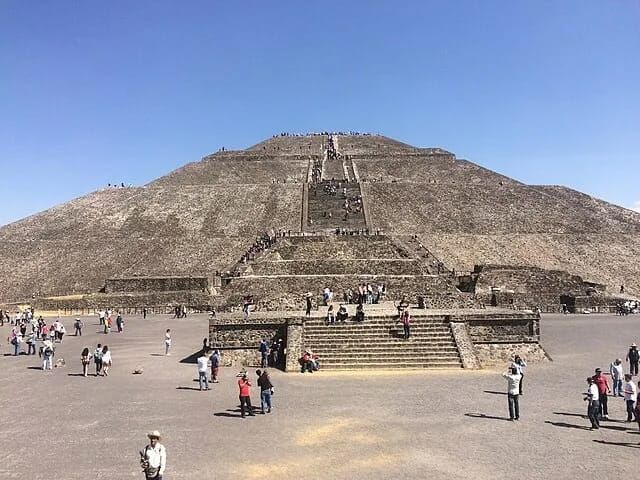
With all the recent talk of wiping out the entire civilization of Iran. It’s a good time to remember that it wouldn’t be the first time a whole civilization was wiped out. Here are 12 examples, plus an example of removing parts of the population and trying to erase their collective memories of their origins.
1. Ancient Egypt → Conquered repeatedly (Assyrians, Persians, Greeks, Romans)
Ancient Egypt did not collapse in a single moment but was progressively dismantled through a long sequence of foreign conquests. The Assyrians, Persians, and later the Greeks under Alexander the Great each replaced native rule with their own administrative systems, weakening Egypt’s political autonomy. By the time Rome annexed Egypt in 30 BCE, the pharaonic state had been hollowed out, its priesthood subordinated, and its ruling class replaced by foreign elites. Egypt’s cultural identity persisted, but its political sovereignty was extinguished.
Rome’s conquest marked the end of Egypt as an independent civilization. The Roman administration reorganized Egypt as a grain‑producing province, suppressing native institutions and integrating the region into imperial economic networks. Over time, the hieroglyphic script disappeared, temples were closed, and Christianity replaced the old religious system. What survived was memory — not a functioning Egyptian state.
2. Sumer (Mesopotamia) → Destroyed by Amorites and later absorbed by Babylonians
Sumer, one of the world’s earliest urban civilizations, was gradually destroyed through waves of invasion and absorption. The Amorites overran Sumerian cities, and the political centers that had defined Sumerian life were absorbed into the expanding Babylonian state. As Babylon consolidated power, Sumerian city‑states lost autonomy, and their institutions were replaced by Babylonian governance.
The most decisive loss was cultural. The Sumerian language, once the foundation of administration, literature, and religion, fell out of everyday use and survived only as a scholarly language before disappearing entirely. By the second millennium BCE, Sumer as a distinct civilization no longer existed; its people and culture had been fully absorbed into the broader Mesopotamian world.
3. Hittite Empire → Destroyed by Sea Peoples (c. 1200 BCE)
The Hittite Empire collapsed abruptly around 1200 BCE during the wider Late Bronze Age crisis. The Sea Peoples — a confederation of maritime raiders — attacked Hittite territories, destroying cities and severing trade networks. Combined with internal instability and famine, these assaults led to the Hittite state's disintegration. The capital, Hattusa, was abandoned and burned.
After the collapse, the population dispersed into smaller Neo‑Hittite states that lacked the cohesion and power of the former empire. These successor states were eventually absorbed by Assyria, erasing the last political remnants of Hittite civilization. What survived were fragments of culture, not a functioning empire.
4. Assyrian Empire → Destroyed by Babylonians and Medes (612 BCE)
Assyria, once the most feared military power in the Near East, was destroyed in 612 BCE when a coalition of Babylonians and Medes captured and burned Nineveh. The coalition systematically dismantled Assyrian cities, targeting the administrative and military infrastructure that had sustained the empire. The destruction was so thorough that Assyria never re‑emerged as a sovereign state.
The population was deported or absorbed into the new imperial systems of Babylon and Media. Assyrian culture, though influential, ceased to exist as a living political identity. The empire’s collapse was not a decline but a deliberate eradication by its rivals.
5. Carthage → Destroyed by Rome (146 BCE)
Carthage’s destruction in 146 BCE remains one of history’s most complete examples of civilizational annihilation. After the Third Punic War, Rome razed the city, burned it to the ground, and enslaved the surviving population. The Carthaginian state was dissolved, its navy destroyed, and its political institutions eliminated.
Rome then rebuilt the site as a Roman colony, erasing Carthaginian identity from the region. Punic culture survived only in scattered communities and inscriptions. As a sovereign civilization, Carthage ceased to exist the moment Rome decided it should.
6. Classical Greece (city‑state era) → Destroyed by Macedon, then Rome
Classical Greece ended not because Greek culture disappeared, but because the political system that defined the civilization — the independent polis — was destroyed. Macedon first subdued the city‑states, ending their autonomy. Rome later absorbed Greece entirely, reorganizing it into provinces and eliminating the political independence of Athens, Sparta, and other poleis.
Greek culture survived and even flourished under Rome, but the civilization as a political form was gone. The city‑state system, which had produced Greek philosophy, democracy, and art, never returned. What endured was cultural influence, not civilizational sovereignty.
7. Judean Kingdom → Destroyed by Babylon (586 BCE)
The Babylonian conquest of 586 BCE destroyed the Judean Kingdom as a functioning state. Babylon razed the First Temple, executed or exiled the ruling elite, and deported large segments of the population. The monarchy was abolished, and Judea was reorganized as a Babylonian province.
The exile created a profound cultural rupture. While Judean identity survived through religious tradition and community memory, the political civilization that had sustained it was extinguished. The destruction of the temple and the loss of sovereignty remain foundational examples of cultural and political erasure.
8. Achaemenid Persia → Destroyed by Alexander (330 BCE)
Alexander the Great’s conquest of Persia in 330 BCE dismantled the Achaemenid administrative system that had governed a vast multicultural empire. Persian satrapies were reorganized under Macedonian control, and Greek elites replaced the ruling class. Key cities were burned, including Persepolis, symbolizing the end of Achaemenid authority.
Although Persian culture persisted, the empire itself was eliminated. The political structure that had unified the Near East under Persian rule was replaced by Hellenistic kingdoms, marking the end of Persia as a sovereign imperial civilization.
9. Indigenous Caribbean civilizations (Taíno, Kalinago) → Destroyed by Spain
The arrival of Spain in the Caribbean triggered one of the fastest civilizational collapses in human history. The Taíno and Kalinago were devastated by disease, forced labor, enslavement, and violent displacement. Within decades, their populations plummeted by more than 90 percent. Entire communities vanished before they could adapt or resist.
The destruction was demographic, cultural, and political. Spanish colonization replaced Indigenous governance with European rule, seized land, and imposed Christianity. The civilizations that had flourished in the Caribbean for centuries were effectively erased, surviving only through descendants and cultural memory.
10. Aztec Empire → Destroyed by Spain (1521)
The Aztec Empire fell in 1521 when Spanish forces, aided by Indigenous rivals, captured Tenochtitlan. The Spanish dismantled the imperial structure, executed leaders, and destroyed temples and administrative centers. Disease had already weakened the population, making resistance impossible.
After the conquest, Spain imposed a new political, religious, and economic order. The Aztec capital was rebuilt as Mexico City, and the empire’s institutions were replaced by colonial governance. The civilization’s cultural legacy endured, but its political existence ended abruptly.
11. Inca Empire → Destroyed by Spain (1533)
The Inca Empire collapsed after the Spanish captured Atahualpa in 1532 and dismantled the imperial administration. Civil war, disease, and Spanish military tactics accelerated the empire’s fall. The Inca road system, bureaucracy, and labor networks were repurposed for colonial extraction.
Spain imposed forced labor, Christianity, and new political structures, erasing the Inca state. While Andean culture survived in modified forms, the empire itself — one of the most sophisticated in the world — was extinguished within a generation.
12. Many North American Indigenous nations → Destroyed by U.S. expansion
U.S. expansion destroyed several Indigenous nations through warfare, forced removal, starvation, and the systematic seizure of land. The Beothuk of Newfoundland were wiped out through disease, displacement, and violence. The Yahi of California were destroyed by settler encroachment and resource loss. Many Mississippian polities had already been weakened by disease when U.S. expansion completed their erasure.
Not all Indigenous nations were destroyed, but several ceased to exist as functioning societies. Their political structures, land bases, and cultural systems were dismantled, leaving only fragments of memory and descendants fighting to preserve what remains.
13. The Attempted Removal of a Civilization From Enslaved People in America
Enslavers in the United States used a deliberate, multi‑layered system to sever African people from the identities they carried across the Atlantic. The first tactic was forced renaming: individuals were stripped of their African names and assigned European ones, often chosen to signal ownership or erase lineage. This was paired with language suppression, as enslavers forbade African languages and punished those who attempted to teach or speak them. By eliminating the ability to communicate in familiar tongues, enslavers disrupted kinship networks and made collective resistance more difficult. A third tactic was the intentional mixing of people from different ethnic groups, ensuring that those who shared a language or cultural background were separated on plantations. This fragmentation was designed to prevent the formation of unified communities and to weaken any sense of shared identity.
Additional strategies reinforced this cultural severing. Enslavers imposed Christianization under coercive conditions, not as spiritual guidance but as a tool to replace African religious systems and cosmologies with a worldview that justified bondage. They also enforced prohibitions on drums and other traditional instruments, knowing that music and rhythm were central to communication, ceremony, and resistance across many African societies. Finally, enslavers used family separation — through sale, inheritance, or punishment — to break generational continuity and prevent the transmission of cultural memory. Together, these methods formed a coordinated system of cultural erasure, designed not only to control enslaved people physically but to dismantle the social, linguistic, and spiritual foundations that connected them to their homelands and to one another.