
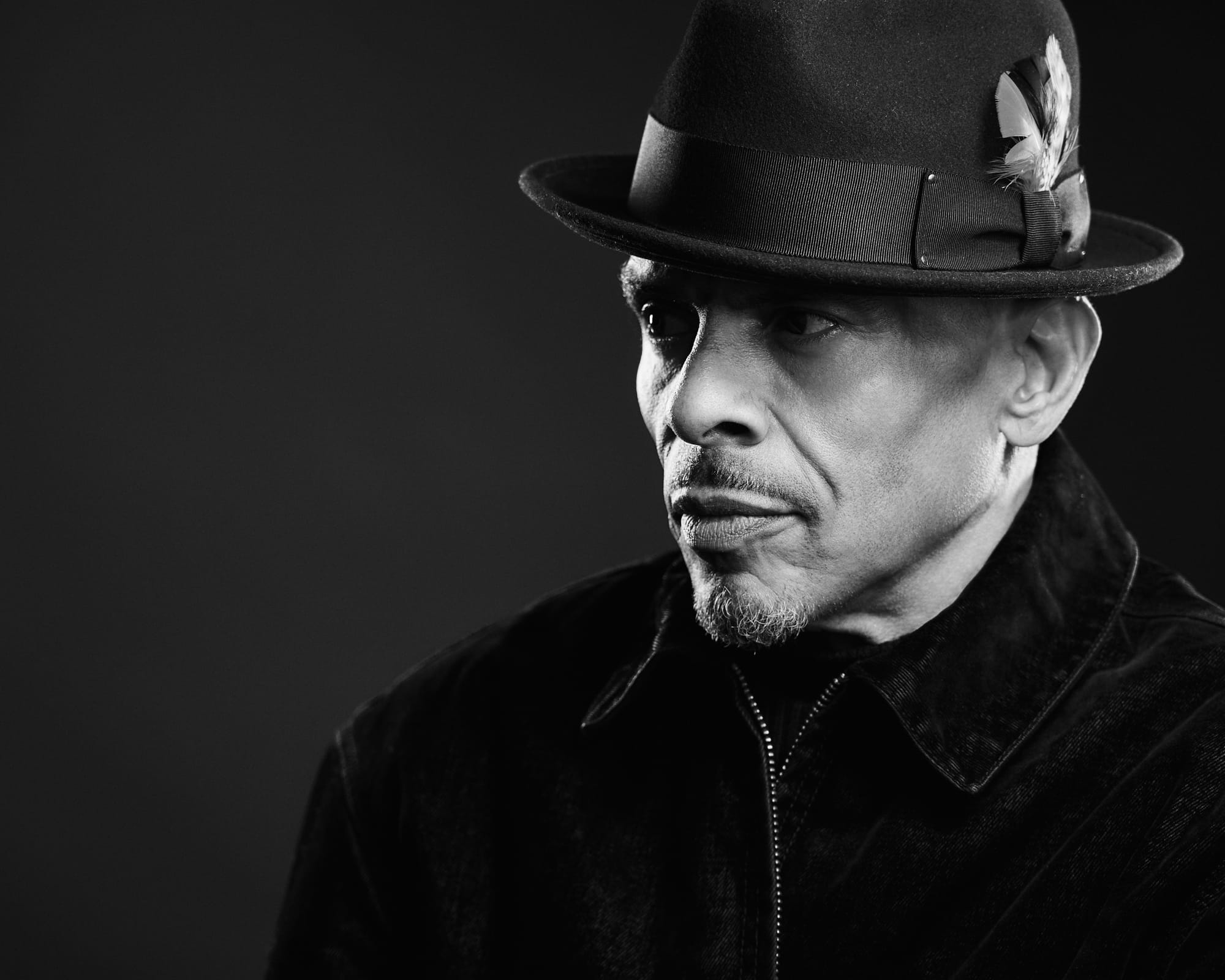
You Didn’t Expect to Hear From Christopher Williams. God Did.
The man Wesley Snipes called ‘pretty’ in New Jack City has traveled an ugly road, including kidney failure that left him in a coma. He believes music healed him.
Christopher Williams is no Ken Doll.
The light-skinned, curly haired, baritone from the late 80s bristles at the notion he was a sex symbol in his early career. While undeniably handsome, he contends that the pretty boy label stemmed from penny-pinching marketing.
“When you look at the business side of it, they could use that and not really spend the money to market me,” Williams explains. The 58-year-old Bronx native has transitioned from a fuller face to more angular features. “That's why in the second chapter of my career, when I have these conversations, it's like, wow, I didn't know he had a journey like that. I didn't know Ella Fitzgerald was his aunt. I didn't know he thought like that.”
There are layers to Mr. Williams, a gifted voice who made his mark with hits like “Promises, Promises,” “Dreamin’,” and “Every Little Thing.” He has business bones, a talent that the late Andre Harrell recognized and encouraged him to develop. A deeply spiritual man, Williams often ties his insights back to the Black utopian land of Kemet. Perhaps it was this spirituality that pulled him back from the brink after suffering kidney failure and slipping into a coma in 2021.
Williams describes his coma as a state of utopia, though the nightmare began when he regained consciousness almost 30 days later in the hospital. His team of Jamaican nurses — whom he affectionately calls his angels — kept his spirits high while he physically struggled to get close to the sound of music. He played songs by Fred Hammond, Marvin Sapp, and Pastor Jason Nelson, convinced of their healing powers. “I needed to hear victorious words,” he recalls.
One night, as hope was low, he called his favorite angel, nurse Michelle, for support. Instead of plugging into his pity party, she helped him rediscover his resilience, encouraging him to be ok with crawling toward recovery before he could stand and walk out of the hospital.
He indeed made it out. On this journey, Williams rekindled his love for music and reconnected with Vince Herbert, the wunderkind producer known for guiding artists like Lady Gaga and Tamar Braxton. It was Williams who discovered Herbert as an ambitious teenager. Together, they crafted Williams’ lead single “Good Enough” and are diligently working on War & Peace, his first full album since 2001.
A television show built around his New Jack City character, Kareem Akbar, is also in the works with Jermaine Dupri handling scoring duties.
Seated comfortably in a quaint New Jersey studio, clad in a brown lumberjack leather jacket and a cozy black cap, Williams speaks with LEVEL on a range of topics, particularly one he knows intimately: survival.
My natural mother was a fighter and a bank robber. Unfortunately she got to the place in life where she had given up, honestly. And I didn't make it in time to save her. I was able to meet her and I got to know my mom, thank God. It taught me a lesson. When I started becoming successful I thought if I got her an apartment, a car, started to begin the road to recovery, [she would heal] but she had been so deep in it that her heart was broken. According to her, I was her only love child, but she was dating a Caucasian man who she loved. She said my dad was a phenomenal human being, but in the '60s, that was taboo and her heart was crushed over it.
Our parents did more with $10 than we could do with $10,000.
If Teddy Pendergrass hadn't had his brakes cut, he would have been the greatest melanated male artist until Michael Jackson came to full term. If you look at his audiences, there was no color code. What Berry [Gordy] was pushing from the Motown era had became effortless with Teddy Pendergrass. They had somehow broken the color barrier with this man because most of his all-female audiences were populated with Caucasian people.
A lot of us don't feel good [about ourselves]. You ever notice how these people get the Academy Awards and with all that, they still feel like if Massa doesn't put his feet on me on the porch, I don't feel good? I could have a billion dollars. I could be box office every July 4th, but if Massa doesn't put his crusty feet on me and I can't sit on his porch, I don't feel good. There's a level of porch monkeyism that's given to us and it's like a maze trying to get out of it. Once you get a little exhausted, you could be like, okay, I give into the system.
Stacey Dash would never vote for a Democrat. And part of it is because I don't think people realize, one, she's an individual. We're different. We love our son, but she has her own mindset. And I can't, nor do I want to take part of it, control of it, take credit for it or dismiss it. That's Stacy's views. And I'm sure it has to deal with how she was raised. It's like with my path, how I think it has to deal with how I was raised. People probably think that her message comes across crazy because Stacy's popularity and her career really spawns from us supporting her. But like I said earlier, a lot of times we don't feel good enough.
Relationships are hard because women are beautiful to me. It's like going to the botanical garden in the Bronx or one of the most greatest botanical gardens, and you get to pick one flower.
My time at Death Row taught me to love music, definitely not to become enamored with the music business.
Being in a coma feels like utopia. I've heard people describe it as dark. It was utopia. The nightmare started when I woke up.
When I was sick I would have the nurses put the [mattress] down on the side of the bed. At night when everybody left, I would bust the alarms on my beds and flip out, like pancake. I'd flip down and would practice crawling every night for six months until one day I made a crawl and I was able to raise myself up and didn't feel the pain. I didn't feel the weight of it. That was a breakthrough.
I didn't know how to be a father. I gave, but I didn't know what being a father was. I had seen what [my father] Norman Page had tried to teach me about being a father, but again, the way I'm made and created and how I think, I undervalued family because I had never had experienced it. But once I experienced it, especially when I got to know...My son is my best friend. He's like my dad almost, but my daughters grew me up. When I finally started experiencing what it is to be a girl dad, that's what grew me up.
When Akbar comes back home from serving his federal time, he's going to change the perspective of how we see oneself first and how we see others. I plan on taking a pop culture situation to entertain people and hopefully give people hope that one day we may really live in harmony.
My last dream was about Halle Berry [laughs].