

I primarily teach freshmen high school students, and any attempt to get them to write feels akin to trying to bathe a feral cat. This isn’t just limited to writing essays; even taking notes can be considered torture, at least from their perspective.
The struggle becomes even greater when it comes to writing essays. My students are determined to ignore the rubric and prompt, opting instead to write about any topic that piques their interest. They often finish in just five minutes and turn in their work with a sense of pride, leaving me with the impression that their ignorance is truly genuine.
Imagine if that kid argued I was taking away their right to free speech. Imagine I was put on leave for not giving a good grade to an essay that failed to follow the prompt and rubric. I hope this sounds ridiculous.
Unfortunately, this is a real-life situation, except instead of dealing with a 14-year-old, we are talking about a junior in college.
Samantha Fulnecky is a psychology major at the University of Oklahoma. In her lifespan development/psychology course, she was asked to submit a paper responding to a scholarly article on gender typicality, peer relations, and mental health during early adolescence.
Fulnecky responded with what looks like a rushed response that doesn’t sound like the work of a student who actually read the article. As a teacher, I’m used to these vague responses because the child is attempting to get out of as much work as possible.
Fulnecky received a zero and complained that the trans teacher assistant who graded her paper failed her because she cited the Bible and the assistant disagreed with Fulnecky’s beliefs.
In response, the University put the teacher on leave to review the situation.
This is Fulnecky’s essay.
You can find the rubric here.
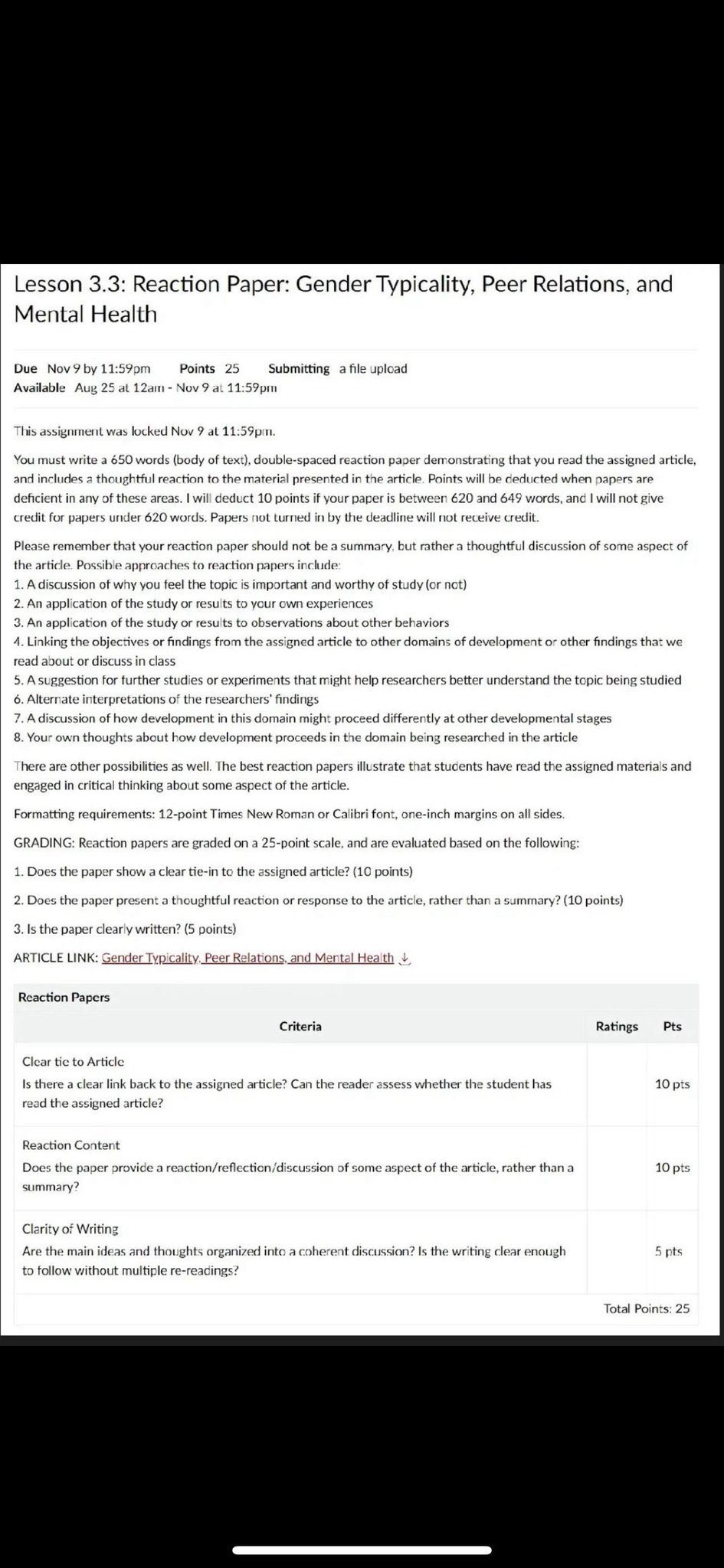
You can find the original assigned article here.
I was not able to find a free version of the original article, but I think we can arrive at a relatively generous grade with the information that we have. I will even work under the assumption that this is a high school student and that the Bible is a suitable source for a psychology paper on social constructs.
As a high school teacher, I would not format my rubric this way; however, it clearly states that points will be deducted if the essay is deficient in any of the listed areas.
The piece starts more like a quick response on a class blog than an actual essay. There is no introduction. It is difficult to follow her line of thinking if one starts from the assumption that she will be responding to the initial article. Outside of the first lines, there isn’t an actual reference back to the article. To be clear, the first sentence of the prompt asks the student to demonstrate that they read the article. For many teachers, this is enough to give a student a zero and keep moving. Depending on where we are in the school year, I would also give a student a zero in this situation, with the option to rewrite the paper while following the prompt.
This does not mean that they cannot argue for bullying using the Bible, but they need to do so by referring back to the article and citing real evidence, even if it is from the Bible.
Shockingly, I noticed Fulnecky didn’t really cite the Bible despite what the headlines claim. She vaguely mentions Genesis once, but this isn’t considered citing in an academic paper. For example, when she mentions that God created man in His own image, she could have cited the Bible to support this claim. Even if she is paraphrasing, a citation would strengthen her claim.
Even without bringing in outside resources, she could have responded to specific aspects of the article. Instead, the article comes off as if she read half of the abstract.
The structure of this essay is also poor. I warn my students if they turn in a block of text, I will not grade it. You should have an introduction paragraph, clear body paragraphs, conclusion paragraphs, topic sentences, and so on. Fulnecky would have received a zero at 14 for turning in an essay to me structured this way.
Fulnecky writes,
“ It is frustrating to me when I read articles like this one and discussion posts from my classmates of so many people trying to conform to the mundane, so they don’t step on people’s toes. I think that is a cowardly and insincere way to live”
This is a place where Fulnecky could have went back to the original article, but she can’t because she hasn’t read it. Instead, she brings in her peers. It is hostile toward them in a way that is frowned upon in academic settings. I am always trying to create an environment that is free and open to ideas, even if we disagree with them. I wouldn’t deduct points for the hostility, but I would discuss it with my student to make sure that they are doing okay. I would deduct points for again failing to refer back to the article.
Fulnecky goes on to say that society pushes the narrative that there are multiple genders, which implies she believes there is only one. Of course, this isn’t what she means, but it shows how quickly she wrote on a topic that she is seemingly passionate about because she definitely didn’t want to take the time to actually engage with the article.
If we look at the rubric, I would say Fulnecky possibly earned a few points for not summarizing the article (because she didn’t even read it.) If we really stretch, we could argue that her response is at least in the ballpark. She doesn’t really engage with the idea that being gender typical increases popularity, while falling outside of gender norms leads to bullying. I’m not sure she understands that being trans isn’t the only way to fall outside of being gender typical. She does make an argument, a weak argument, on why bullying is okay if people step outside of gender norms because God said so. I guess that is worth a point or two.
The most innocent reading is that Fulnecky just wanted to finish this assignment quickly. A less generous reading is that Fulnecky wanted to finish this assignment quickly while getting a rise out of their trans teacher.
It turns out that Fulnecky is part of a political family and has connections to Turning Point USA, Charlie Kirk’s transphobic organization. It is believed Fulnecky went to Turning Point before appealing her grade, and based on what we know about the group, likely went to them when she learned she had a trans instructor. I’m drawing some conclusions here, but I know how these groups tend to move.
Whatever the case may be, this is not an academic assignment concerned with engaging with a text. I can’t help but consider what this means for teaching in the future. When I teach To Kill a Mockingbird, gender norms come up in our discussion. It is a major theme in the story. As these groups become bigger snowflakes, I imagine I will receive some backlash for a prompt asking my students to engage with this text.
We have to speak out against stuff like this. I already feel like so many parents view me as the enemy when all I want to do is help their children gain the ability to think critically.
There may be some worry that Fulnecky’s instructor was biased, but after reading the paper and looking at the rubric, there isn’t a genuine case for this.
The instructor’s feedback probably took more time to write than Fulnecky’s paper.
“Please note I am not deducting points because you have certain beliefs, but instead I am deducting points for posting a reaction paper that does not answer the questions for the assignment, contradicts itself, heavily uses personal ideology over empirical evidence in a scientific class, and is at times offensive.”
They go on to encourage Fulnecky to use more perspective and empathy in their work, but to also continue to be critical if she disagrees, but to do so with scientific methods aligned with the goals of this class.
This is such a fair response. I’ve had 14-year-olds claim freedom of speech when they turn in a bad essay, but I always point back to the rubric. They can say whatever they want if it is the right time and place, but if you are attempting to earn a grade or a paycheck, it is necessary to follow the guidelines. I have these expectations for freshmen.
We shouldn’t need to have this conversation about a psychology major nearing the conclusion of her college career.
This post originally appeared on Medium and is edited and republished with author's permission. Read more of LG Ware's work on Medium.