
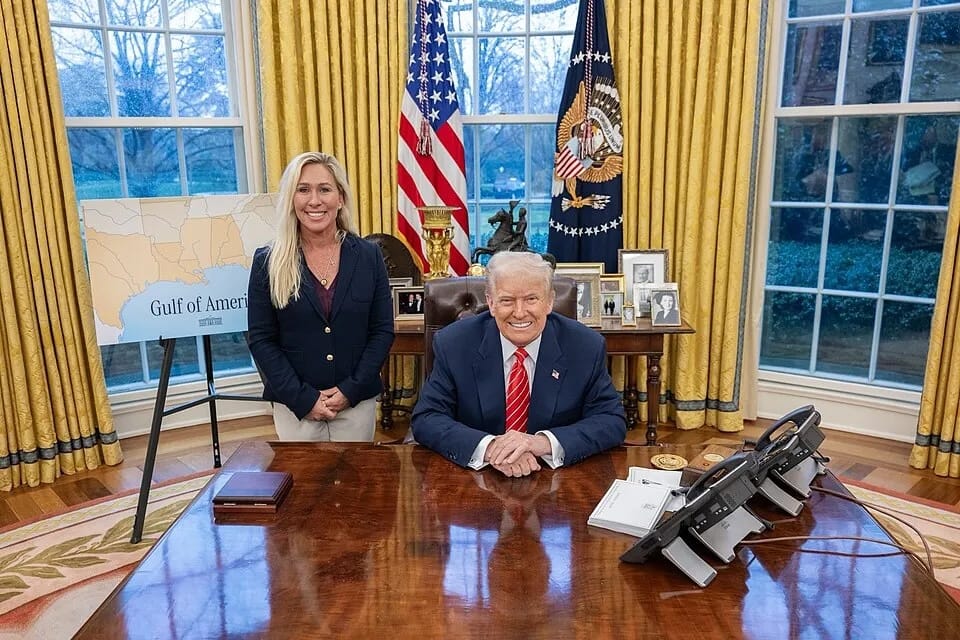
On November 18, 2025, Marjorie Taylor Greene participated in a bipartisan press conference with Epstein survivors intended to pressure Congress to release the Epstein Files. Greene and others indicated that the survivors might publicly name their abusers should Congress not act. Shortly afterward, Donald Trump called Greene in her office. She took the call on a speakerphone in front of her staff. Trump tried to convince Greene to stand down in pressing for the release of the files. The call didn’t go well. One of the final things Trump shouted at her was, “My friends will get hurt!”
Trump's remark, "My friends will get hurt," underscores how Epstein operated unchecked. Many of his associates were aware of his inappropriate behavior with underage girls but remained silent. To be clear, there is no legal scenario in which Epstein, then 52 years old and charged in Florida in March 2005, or any of his associates, could have sex with a 14-year-old-girl—some of his victims as young as eleven—without it being considered rape.
Contributors to Epstein’s Birthday Book, compiled by Ghislaine Maxwell for his 50th birthday, two years before his first arrest, were categorized into groups: Friends, Business, Brooklyn, and Family. It’s possible to have had a business relationship with Epstein without knowing of his habits. Maybe some of those who grew up with him in Brooklyn didn’t know, or his family members. But regarding those friends, was it possible to be close to Epstein, spend time at his penthouse, which often had young girls running around, and remain oblivious?
The book lists several people as Epstein’s friends, including: Donald Trump, Bill Clinton, Alan Dershowitz, Leslie Wexner, Lord Peter Mandelson, Leon Black, Ghislaine Maxwell, and Jean-Luc Brunel.
I’m not saying all of Epstein’s friends were pedophiles, though Brunel suffered a similar fate as Epstein, allegedly commiting suicide in jail while facing charges including rape of a minor. Maxwell was convicted on five federal charges tied to Epstein’s sexual abuse of minors. Virginia Giuffre accused Dershowitz until a $75 million lawsuit resulted in her saying, “she may have been mistaken. Leon Black is facing charges of raping a girl when 16 at Epstein’s New York townhouse. Donald Trump has been accused in civil lawsuits of sexual misconduct involving minors, with none resulting in charges. Women have accused Bill Clinton, but with no known instances involving minors. Prince Andrew was not a contributor to the book, but his ties to Epstein and young girls are well established.

Epstein wasn’t hiding what he was doing. Among his recruiting methods was the use of the MC2 Model Management, which he funded and which Jean-Luc Brunel operated. Some of Epstein’s good friends owned modeling agencies as well, including John Casablancas (Elite Model Management) and Donald Trump (Trump Model Management or T Management). Trump’s agency handled girls as young as 14 up to its Legends Division, representing supermodels who’d had long careers. While Epstein was insistent on women under 18, Trump had no such limitations.
Casablancas was Trump’s best buddy before he started hanging with Epstein. Casablancas was accused more than once of sexually assaulting minors and impregnating one of his 15-year-old models. Trump has never been accused of sleeping with his models, but was accused of groping a model while Epstein watched. Modeling agencies run or financed by Epstein, Brunel, Trump, and Casablancas held competitions all over Europe, with the winners coming to New York to meet their sponsors.
Trump told Marjorie Taylor Greene that he was concerned his friends might be harmed. While I think Trump is far more concerned about what additional information will come out about himself, covering up for friends is precisely how we got to this point.
Sex trafficking is often imagined as something that happens in shadows — a hidden underworld, a secret network, a crime committed by monsters who lurk far from polite society. But history tells a different story. The exploitation of young girls has rarely been a matter of darkness. It has thrived in broad daylight, protected not by secrecy but by the silence, complicity, and social insulation of the powerful. Friends let friends rape little girls. Trafficking requires infrastructure: money, access, introductions, transportation, housing, and the ability to operate without scrutiny. None of that happens without the implicit consent of others.
From the Gilded Age industrialists to twentieth‑century modeling impresarios to Jeffrey Epstein — a pattern emerges. These men did not hide. They operated in plain sight, surrounded by people who chose not to see.
Wealthy men throughout history have used their status to normalize behaviors that would be unthinkable for others. They built social circles that insulated them, institutions that protected them, and reputations that discouraged questions.
In the early twentieth century, industrial magnates kept “chorus girls” and “protégées,” many of them teenagers, in arrangements that were widely known but rarely challenged. Newspapers hinted at scandals but avoided naming names. Society pages praised the same men for their philanthropy. The public saw what it wanted to see.
The pattern repeated itself in the fashion and entertainment industries. Modeling agencies recruited girls as young as thirteen and fourteen, sending them across continents with little oversight. Wealthy patrons funded these agencies, attended their parties, and mingled with the girls. Everyone understood the power imbalance. Few intervened.
Epstein is often described as a “mysterious financier,” a lone predator who built a secret empire of abuse. But the truth is more uncomfortable: Epstein’s crimes required a network. He needed pilots, assistants, recruiters, house managers, bankers, lawyers, and social connectors. He needed people to open doors for him, to vouch for him, to invite him into elite spaces. He needed institutions willing to overlook red flags because he donated money, offered introductions, or projected an aura of wealth.
Epstein’s homes were staffed. His planes were staffed. His social calendar was full. He attended dinners, fundraisers, conferences, and private gatherings with some of the most powerful people in the world. Many of them later claimed they “had no idea” what he was doing. But Epstein’s behavior was not subtle. He traveled with young girls. He surrounded himself with teenagers. He openly described himself as a talent scout, a mentor, a benefactor. The question is not how he hid it. The question is why so many people choose not to see.
Throughout history, wealth has functioned as a cloak—not to hide wrongdoing, but to render it socially acceptable. During the Gilded Age, powerful men kept “ward girls,” “companions,” or “household protégées,” often teenagers from low-income families. These arrangements were understood as part of the social order. The men were praised for their generosity. The girls were blamed for their vulnerability.
In the mid‑twentieth century, Hollywood studios controlled the lives of young actresses, many of whom were minors. Studio heads arranged housing, travel, and publicity — and sometimes exploited the girls directly. Everyone in the system knew. Few intervened.
In the modeling industry, agency founders and wealthy patrons often blurred the line between professional mentorship and personal access. Girls were flown to foreign cities, housed in cramped apartments, and introduced to powerful men. The industry normalized the presence of teenagers in adult spaces. It normalized the idea that beauty was a form of currency. It normalized silence.
Crimes committed in darkness can be uncovered. Crimes committed in plain sight become part of the landscape. When exploitation is normalized, it becomes harder to name, harder to challenge, and harder to stop.
The exploitation of young girls is not sustained by monsters hiding in shadows. It is sustained by ordinary people who choose not to see — by social circles that value proximity to power more than the safety of children, by institutions that prioritize donations over ethics, by communities that believe wealthy men are above suspicion. Every time someone looks away, the system strengthens.
To confront trafficking, we must confront the culture that enables it. That means: Believing young people when they speak—questioning the behavior of powerful men, even when it is uncomfortable, demanding transparency from institutions that accept money from wealthy donors. Recognizing that exploitation often hides behind philanthropy, charm, and social status. Understanding that trafficking is not a crime of darkness — it is a crime of privilege. At this moment, the Department of Justice is redacting the names of Epstein’s and Trump’s friends despite a law that says otherwise. We must not allow the cover-up to continue.
Epstein’s story is not an anomaly. It is a warning. The next predator will not hide in the shadows. He will stand in the light, surrounded by people who choose not to see. Epstein is dead, but at least 28 women have publicly accused Donald Trump of some form of sexual misconduct, assault, or rape in reporting and legal filings since the 1970s, some of them young girls, and he is the President. The question is whether we will continue to look away — and whether friends will continue to let friends rape children.