
In 1972, the first year for which data is available, female coaches accounted for 90% of the coaches on women’s teams. Women’s college sports were governed by the AIAW, a women-run organization where females held most coaching and administrative roles.
That same year, Title IX was signed into law, prohibiting sex discrimination in any program or activity receiving federal funding:
“No person in the United States shall, on the basis of sex, be excluded from participation in, be denied the benefits of, or be subjected to discrimination under any education program or activity receiving Federal financial assistance.”
Before Title IX, women’s sports received little funding, few scholarships, and minimal institutional support. After Title IX, participation by girls and women in sports increased dramatically. Title IX professionalized women’s sports, increasing salaries and prestige. The money attracted male coaches to the sport, and by the time Geno Auriemma was hired at UConn in 1985, women were being pushed out by men with perceived stronger resumes. Women lost access to graduate assistantships and were less likely to be hired as assistants. They were mentored less by athletic directors and were less likely to be promoted. When Geno was hired, less than half of women’s college basketball coaches were women. That percentage continues to fall and now hovers at 40% women.
Geno was not decorated when he was hired at UConn. The team had one winning season in its history. In fact, Auriemma shared a rotary phone with the track coach. Black players were essential to his rise, helping ascend his bottom‑tier program to the most dominant dynasty in women’s college basketball. Without the Black stars who anchored his championships, elevated his national profile, and legitimized UConn as a powerhouse, the dynasty would not have happened in the form we know.
The dynasty begins with a Black superstar: Rebecca Lobo got the headlines, but Nykesha Sales changed the program. People often credit Lobo as the face of UConn’s first title run, but the sustained rise of UConn depended heavily on Sales, a Black player whose scoring, athleticism, and versatility made UConn nationally feared.
Sales was UConn’s all‑time leading scorer until 2020, the first Black UConn player to become a national star, and the bridge between the Lobo and Sue Bird era. Sales made UConn cool and nationally marketable. Without Sales, UConn’s early momentum does not carry into the 2000s.
The most dominant stretch in UConn history (2000–2004) is impossible without Black players. Swin Cash set the cultural tone for UConn’s toughness. Asjha Jones was key to UConn’s matchup nightmares. Tamika Williams was the best field‑goal percentage shooter in NCAA history. These three Black women formed the core of the 2002 undefeated team, widely considered one of the greatest teams ever assembled.
The Maya Moore era (2007–2011) is the turning point of Geno’s national mythology. Moore is the most important player Geno Auriemma has ever coached. She is the greatest winner in women’s basketball history and the face of UConn’s 90‑game win streak. Moore made UConn a cultural phenomenon. Her excellence elevated the entire sport.
Even the Breanna Stewart era is impossible without Black co‑stars. In the Stewart‑led four‑peat (2013–2016), the engines were Black players. Moriah Jefferson was the fastest guard Geno ever coached and a defensive nightmare. Morgan Tuck was the stabilizer, creating matchup problems that made UConn unbeatable. Stewart was the headliner, but Jefferson and Tuck were the pillars.
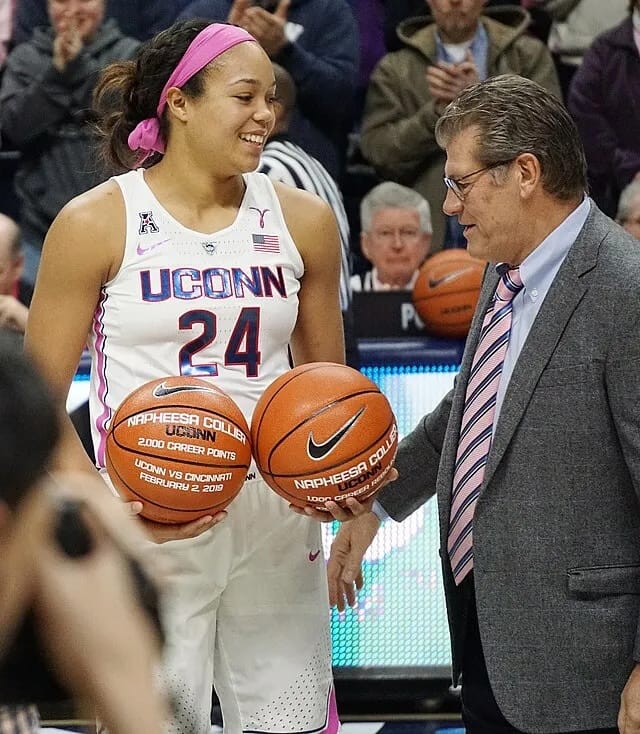
Recent stars who kept UConn relevant include Napheesa Collier, a National Player of the Year; Crystal Dangerfield, an elite point guard; Azzi Fudd, one of the most hyped recruits ever; and Aaliyah Edwards, one of the most dominant post players of the 2020s. Each era of UConn dominance has been anchored by Black talent. But despite Auriemma’s dependence on Black athletes, the question remains: Does he respect Black women? Or women at all?
“You coach Black women, and now they get to see how you treat them when it doesn’t go your way.”-HBCU Commissioner Jacqie McWilliams‑Parker
With less than a second remaining in regulation, Auriemma had to be restrained by assistant coaches after he got in the face of the Black female coach of the University of South Carolina in the Final Four Semifinal match between UConn and South Carolina. It isn’t an exaggeration to say Staley’s team smothered UConn the entire game, brutally ending Geno’s 54-game winning streak, including last year’s National Championship.
There is no active coach in women’s college basketball who has beaten UConn more times in the NCAA Tournament than South Carolina’s Dawn Staley. The late Pat Summitt of Tennessee beat Geno’s teams five times in the NCAA Tournament. Geno didn’t get along with Summitt either. He somehow kept arguably the best player in the world at the time, Candace Parker, off his 2016 Olympic team. Auriemma never took responsibility, saying, “The committee made the decision, not me!”
Geno started complaining about Staley well before the end-of-game confrontation. In a mid-game interview, he whined about how she allegedly spoke to the referees and complained that one of his players had a jersey torn, for which no foul was called. The video shows the player tearing her own jersey in frustration. When Geno rushed Staley before the game ended, he claimed to be upset because Staley didn’t shake his hand at the start of the game. Video shows Staley shaking the hands of Auriemma and every member of his staff before the game. When the 6'1" Auriemma bum-rushed the 5'5" Staley, perhaps he expected her to back down? Instead, she got back in his face, later saying:
“I will beat Geno’s ass!”-Dawn Staley
After twice refusing to retract statements he made during the game and afterward, Auriemma issued an apology for his behavior, never once mentioning Staley’s name. Auriemma was slammed for his weak and seemingly insincere apology.
“There’s no excuse for how I handled the end of the game vs. South Carolina. It’s unlike what I do and what our standard is here at Connecticut. I want to apologize to the staff and the team at South Carolina. It was uncalled for in how I reacted. The story should be how well South Carolina played, and I don’t want my actions to detract from that. I’ve had a great relationship with their staff, and I sincerely want to apologize to them.” — Geno Auriemma
While there are comments throughout the sports world about Geno’s outburst, disrespect, and physical confrontation of a Black woman, not a single Black former UConn player has rushed to his support. The only person offering support thus far is the UConn men’s coach, Dan Hurley, who says Geno deserves “the benefit of the doubt.”
Let’s see how it plays in the living rooms of top Black recruits when Geno tries to explain to their mothers and fathers how he will stand up for them. They’ve seen who he is; believe him.