
Boomers love wrestling.
Standing firm, a white woman defiantly raises her middle finger in the air. Short and elderly, she bears a striking resemblance to Phillip Drummond’s second housekeeper, Adelaide Brubaker, from the classic sitcom “Diff’rent Strokes”
"That's bullshit," the woman yells, using all the volume she can muster. “Fuck you, Gunther!”
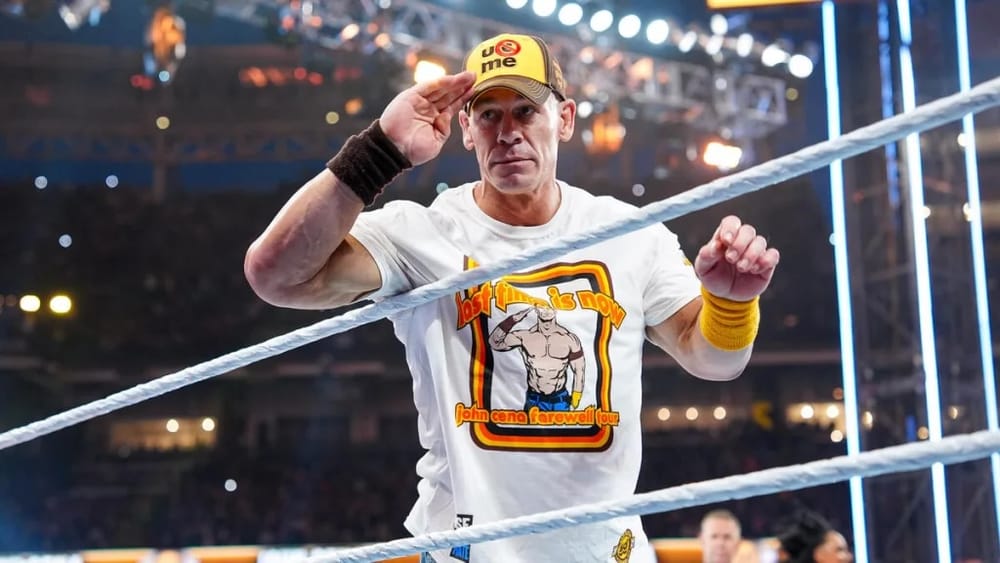
Adelaide’s WWE-loving doppelgänger was just like most of the 20,000 fans who packed Washington, D.C.’s Capital One Arena on December 13. We were there to witness John Cena's final appearance in the squared circle.
I’m a sports fanatic, but when all my favorites—Michael Jordan, Kobe Bryant, Derek Jeter—played their final games, I watched on TV. I missed the thrill of experiencing those moments in person. So when Cena announced in January that 2025 would be the final year in wrestling, I couldn't miss the big matches on his farewell tour—especially not the grand finale of his legendary, two-decade-plus career.
Cena began his WWE journey nearly 25 years ago. Over the past two-plus decades, he has built a Hall of Fame-worthy career while becoming one of Hollywood’s most active and successful stars. His character, “The Peacemaker” (Warner Bros.), has played a pivotal role in both Zack Snyder's and James Gunn's DC Universes. Additionally, he has starred in several films that have become hits both in theaters and on on streaming platforms. Cenea has secured numerous endorsements and voiceover work for Fortune 500 companies such as McDonalds, Experian Boost, Neutrogena, Honda and Hefty. The West Newbury, Massachusetts native also takes pride in his debut—and only—rap album, You Can’t See Me (2005), which went platinum.
“He was part of the era that made wrestling culture,” said famed sports broadcaster Kenny “The Jet” Smith in early December at DJ Khaled’s We The Best Foundation Golf Classic in Miami. “Not just pop culture—but hip-hop culture. Typically, hip-hop goes mainstream. Mainstream doesn't go hip-hop. He was the first [wrestler] to take mainstream hip-hop.”
“I think John Cena is ill,” added Jadakiss, who was also enjoying himself on the green, that day. “He loves hip-hop. Even in the movie The Marine, they were playing Lil Flip’s ‘Sunshine.’ He loves hip-hop—you gotta know that.”
When Cena first appeared on WWE television in 2002, no one could have anticipated that he would have become the defining superstar of his generation—or that the WWE would eventually recognize him as their GOAT. Before he had millions chanting “You Can’t See Me,” before blockbuster films, and before he became the corporate face of WWE, Cena found an unexpected creative outlet. It was hip-hop culture—filtered through his own lens and voice—that transformed him from a directionless rookie into the most magnetic act in wrestling.
Cena didn’t merely reference hip-hop; he immersed himself in it, even adopting the nickname “The Doctor of Thugganomics.” His promos became freestyle battle raps—sharp, biting, rhythmic, and rooted in the confrontational cadence that defined classic cipher culture. He used punchlines as body slams, slang as signature moves, and crowd participation as his finishers. Wrestling fans had never seen a superstar weaponize language this way.
“He could freestyle,” affirms respected radio and podcast host Bootleg Kev. “Then he goes on to be one of the greatest mic workers of all time. I think he solidified that against The Rock two years straight leading into WrestleMania 28 and 29. When they were cutting promos on each other, I think he got the best of The Rock. So you have to go back to hip-hop because I feel cutting promos and rapping is in the same spirit. It’s shit talking. That is a perfect correlation. Cena is one of the best of all-time on the mic, top five or top three.”
Cena’s wordplay, humor, and timing turned routine segments into must-see performances that energized arenas and circulated among fans like mixtape freestyles. He even dissed stars outside of WWE, all in the name of landing good punchlines.
“He came at me and Hov one time,” Fabolous said with a smile. “I would’ve smoked John Cena—are you kidding me? But John Cena had an amazing career. He’s one of the top dogs. He’s been able to pivot and do so many things outside of the wrestling ring.”
Visually, Cena layered his persona with unmistakable identifiers. He bounced to the ring in current and throwback Mitchell & Ness jerseys and matching fitted caps. He wore an oversized padlock chain as a necklace like Treach from Naughty By Nature and paired his gear with Reebok Pumps. And then there were the jean shorts—or “jorts”—that have stayed with him all these years later.
“I wasn’t a big John Cena guy, but I’m a big M.O.P. fan, and he had M.O.P. ad-libs on his ring-entrance theme,” added Bootleg Kev said. “But initially, you don’t know if this guy is really into the culture or not. Vince McMahon was dressing up so many gimmicks at the time. So putting out a white boy and making him rap, it was like ‘does this guy really like hip-hop?’ WWE is known to dive into sensationalism, and at that time it was very much the 50 Cent, G-Unit era—the Nelly era—baggy clothes, headbands, all that. But John actually delivered. They put a real album out. He was running around doing promo. It was a cool project. I’m a Gang Starr fan, and John Cena put out an album with Freddie Foxx, a.k.a. Bumpy Knuckles, all over it—Jake One production. I thought it was dope.”
Cena’s connection to hip-hop didn’t originate as a marketing strategy; it was rooted in genuine admiration. He grew up in a mostly white, small town in New England and gravitated toward the lyricism, charisma, and competitive spirit of ’90s rap—a natural kinship for a future performer who would make his name in arenas built on verbal warfare. It wasn’t until a serendipitous moment on a WWE European tour that hip-hop officially entered his onscreen identity. During a long bus ride, Cena began freestyling to entertain wrestlers and staff. WWE creative caught wind, Stephanie McMahon saw him rapping backstage, and she suggested he do it on television. In that moment, Cena’s career trajectory shifted forever. Hip-hop didn’t just fast-track his ascent—it saved his career.
“[I] debuted on TV in Chicago in 2002 and totally shit the bed,” Cena said on actor-comedian Andrew Santino’s Whiskey Ginger podcast. “I did all the stuff right in the ring, but had nothing here. People didn’t know who I was. They couldn’t connect to John Cena coming out in different tights and boots every time. So I was about to get fired.”
Cena went on to explain that a leisurely freestyle cipher with fellow WWE superstars while traveling was the catalyst that changed his life.
“I was on my final overseas tour in the UK,” he added. “On the tour bus, some of the guys were freestyling. I waited for my turn and just did the best I could—and ripped. In the front of the bus was Stephanie McMahon. She was head of the writing team. She said, ‘How did you remember all that?’ I explained the concept of freestyle, and she said, ‘Make something up about me right now.’ I did—and she said, ‘Do you want to do that on TV?’”
Soon after, Cena was coming to the ring showing off a side of his real-life persona that instantly connected with audiences. He wore jerseys, rocked Reebok Pumps, rapped his own theme song sampling M.O.P., and before he ever threw a move, the arena was already electric. He used bravado, timing, and humor to verbally dismantle opponents. It resonated. Cena became a top villain, but his popularity couldn’t be denied. WWE turned him into not just a face—but “The Face That Runs the Place,” the main attraction they could hang their collectives hats on. Cena eventually won championship gold; he made the emblem on a spinner, just like 50 Cent had the spinner G-Unit chain. He also took Tony Yayo’s dance—shielding his face with his hand—and made it his own.
“That dance was created ’cause I was in the clubs while I was on the run for a gun case,” Yayo explains. “That dance was really created when I was joking around with 50 Cent’s son, Marquise. We were in the crib; he was a little kid, but he knew I was on the run. He was like, ‘What you gonna do, man? How you gonna hide your face?’ G-Unit was just blowing up. I was young, living in the moment, didn’t want to go to jail, and I created the dance. I was thinking, ‘How can I cover my face?’ That’s how that dance was actually made—to cover my face.”
When Cena adopted it as his signature “You Can’t See Me” move (audiences everywhere actually yell those words in unison when he does it), various athletes from all sports began doing it through the years as a celebration a way to give John his flowers.
“John Cena doing my dance was big for me,” said Yayo, who has a new podcast called The Real Report with co-host and G-Unit member Uncle Murda. “John Cena is one of the guys that paved the way for the new generation of wrestling. When we were kids, we idolized all the old-school wrestlers. We looked up to them, then we took a break, and then here comes Stone Cold, The Rock and John Cena.”
Unlike many of the greats—such as Shawn Michaels, The Undertaker, Triple H, Stone Cold Steve Austin, and “Nature Boy” Ric Flair— Cena announced his retirement in January and went on a year-long farewell tour to say goodbye. While the first half of his run was polarizing, to say the least because he was a bad guy, Cena once again used hip-hop to kick-start momentum. Travis Scott was in the ring with him in February when he made one of the biggest heel turns of his career, attacking Undisputed Champion Cody Rhodes. Months later, Scott was also present at WrestleMania when Cena won his historic 17th World Championship. Ric Flair’s 16 title reigns had been the standard for decades until it was eclipsed by Cena.
When it was announced that December 13 would be his final match, John was stern and unwavering in his promise that there would be no swerve.
“I am not coming back,” he said on The Pat McAfee Show. “I understand you only have the data before me—no wrestler retires. What I urge fans to do is watch and give yourself the closure that you need. If you’re not ready to take that on, you may not get the closure you want.”
“John’s never gonna wrestle again,” Cena’s one-time bitter in-ring rival Seth Rollins, a former multi-time world champion, said recently on the Mohr Stories podcast. “I do mean that. There is no amount of money… That is the voice of Honda. He is good. He’s Mr. Hefty Bag. When John sets his mind to something, he will not break it.”
And while die-hard Cena fans traveled to D.C. a couple of weeks ago, we prepared for the end.
You could overhear fans online talking about their favorite John Cena moments. One of mine is his surprise return at the 2008 Royal Rumble in Madison Square Garden. Cena had suffered a serious neck injury just weeks before, with reports suggesting he would be out of wrestling for nearly a year. I was at the Garden with my brother Ari, and when his music hit, the eruption from the crowd was the loudest I’ve ever heard at MSG in the post-Hulk Hogan era. I’ve attended Knicks games and countless concerts—from Michael Jackson to Stevie Wonder to Jay-Z—but nothing compared to the roar when Cena entered as a surprise entrant. He’s had so many moments, great matches, and opponents, so man eras that’s it impossible to choose just one. When WWE was struggling in late 2011 and 2012, Cena was credited with saving the company and filling seats as it headed towards a resurgence.
Cena wasn't cheered throughout his entire career; there were plenty boos. Many fans grew frustrated with his numerous victories, leading naysayers to mockingly label him “Super Cena,” claiming he was only popular with kids and women. Numerous times, the crowd's reaction was so polarizing that deafening chants of “Let’s Go Cena!” were immediately countered by equally loud cries of “Cena Sucks!” It was a constant battle between both sides of the arena.
His final opponent on December 13 was another former champion: the aforementioned recipient of granny’s F bomb, Gunther. Known for his brutal and precise strikes—clotheslines and karate chops—he had earned the nickname “The Ring General.” Gunther is the bad guy the crowd hates but respects. He’s so skilled at his craft that he’s a villain who wins without resorting to cheating, often beating his opponents into submission rather than simply pinning their shoulders to the mat.
But not Cena, right? Surely the man whose mantra is “Never Give Up,” and who has never quit in a match would never wave the white flag in his final bout. Think about all the little kids who look up to him. Matter of fact—forget them kids. What about adults like me who’ve been rocking with him for decades? What about those of us who have traveled from city to city—Los Angeles, Indianapolis, Las Vegas, New Jersey, and back to Indianapolis—just to witness this farewell? You can’t let us down, John. I went to D.C. wanting to see Cena's deliver the equivalent of Jeter hitting a home run in his final game. I needed to see his 60 point, Mamba-out moment.
To be fair, Cena out on a strong match on December 13. He went toe-to-toe with Gunther, who is roughly the same weight but three inches taller and ten years younger. The crowd was on its feet for the ring entrances and throughout the match as John executed signature moves like the F-5. There were several moments when it felt resoundingly clear that he was on the verge of victory.
However in the end, Gunther locked Cena in a sleeper hold, and despite his best efforts to power through and escape for several minutes, a smile crossed John’s face as he fought against it—and then he did the unthinkable: he tapped out.
Fans immediately began booing. But we weren’t booing John; we were criticizing WWE’s decision to have him quit in his final fight. It’s a time-honored tradition that a wrestler on his way out loses to his final opponent as a way of “doing the honors” or “doing the favor,” ensuring the victor gains momentum and bragging rights to build future stories.
That’s all well and good—but having Cena tap out is an right up there with the poorly executed Game of Thrones finale.
“If John Cena had just won the match, you wouldn’t be asking any questions about it," Seth Rollins told Fox News Digital in a recent interview. "No one would be saying the name Gunther. At the end of the day, it’s always about what’s next, and John understood that better than anybody. The business rolls on."
Cena said his grin before tapping out was reminiscent of Obi-Wan Kenobi in Star Wars who gave a look of adoration to Luke Skywalker before Darth Vader struck him with his light saber.
"Everything I preach about is story and drama and having a conversation with the audience,” he told current WWE Champion Cody Rhodes on an episode of Rhodes’ What Do You Wanna Talk About podcast. “The ones I love are in the front row, I know my colleagues are watching on the monitor back there. We're just in a sleeper hold, but we're having that conversation with the audience. So, as I essentially take my last breath, I have struggled. That whole day with so many unbelievably vulnerable, meaningful conversations, and then you realize I've connected with everybody I love, physically I feel great, I think it's time to take that last breath...this person died peacefully."
Even though we’ve had a chance to say goodbye to John Cena, this isn’t the end. While he promises that his wrestling days are behind him after December 13, Cena still has plenty of wiggle room to make occasional returns to WWE. Reports indicate that he signed a five-year “Legends” contract with WWE, ensuring his continued association with the only company he’s ever worked for. Cena can make a surprise appearance at any time—whether saving a good guy from ambush, interfering in a match, or simply stepping into the ring to cut promos and engage with the crowd. It will be exciting to see how he continues to build his legacy.
“I love it,” says DJ Khaled of Cena's transition. "It’s about cracking all the codes. We all should be focused on doing new things and conquering new goals. Develop new dreams and conquer those too.”