
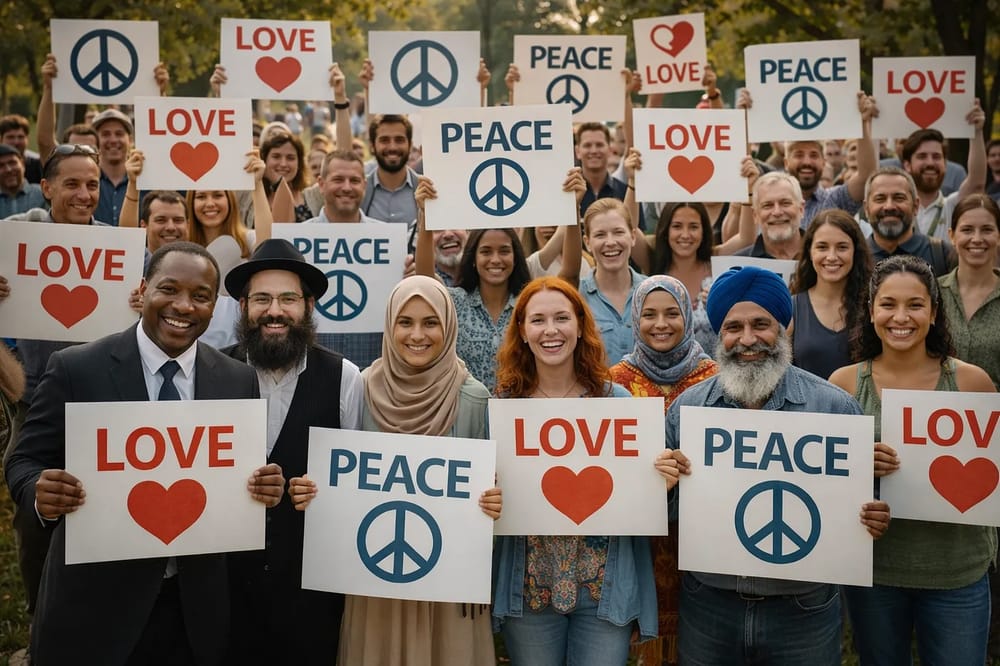
For some, Dr. King is a symbol of a dream where we all just get along. Black kids playing with white kids. Where we judge each other not by the social construct of race and instead just see the deep humanity in everyone. Content of character.
For others, Dr. King was far far more.
He was and remains an inspiration for active resistance. Someone who, if you read more than a few of his nicer quotes, advocated for widespread structural changes. Racially and economically.
But what often gets lost with his breadth of advocacy is that Dr. King was on to something larger that seems to have been lost today.
He uniquely was able to hold space in his heart and mind for more than person or group at a time. Dr. King found it easy to love Blacks, Jews, Asians, Arabs, white folks and every one else at the same time. He knew that he could advocate for changing unjust racist systems while simultaneously working for economic justice for poor white communities.
He deeply understood that multiple things can be true at once.
And that lesson is what’s sorely needed today. The ability to hold lots of truths and lots of space for multiple things and people.
Dr. King practiced what I’ve come to think of as moral spaciousness.
He refused to shrink the world into a single grievance, a single villain, or a single righteous cause. He understood that justice collapses when we force people to choose between compassion for one group and compassion for another.
This wasn’t theoretical for him. It showed up in how he spoke, where he went, and who he stood next to.
King could condemn white supremacy and supremacist systems without collapsing all white people into enemies. He named racism as a moral disease of America, while still insisting that poor white farmers in Appalachia were also victims of an unjust economic order.
When he launched the Poor People’s Campaign, he didn’t divide suffering into racial silos. He linked Black sharecroppers in Mississippi, Latino farmworkers in California, Native Americans dispossessed of land, and impoverished white coal miners into a single moral claim. A society that allows any of these conditions has failed all of them.
He could stand against antisemitism while marching arm-in-arm with Jewish allies, understanding Jewish trauma without weaponizing it against others.
He could oppose violence abroad while rejecting hatred toward ordinary people caught inside those systems.
He spoke out against the Vietnam War not because he hated America, but because he loved human life too much to accept its casual destruction. American or Vietnamese.
King understood something we seem to forget. Empathy is not a finite resource. Caring deeply about one injustice doesn’t require emotional austerity toward another. Justice isn’t a zero-sum moral economy.
Today, we’re constantly pushed to narrow our vision.
Social movements are framed as mutually exclusive. If you speak about racism, you’re told you must be silent about some other injustice. If you talk about Palestine, you’re pushed to ignore antisemitism. Or if you talk about Israel, you’re nudged to ignore Palestinian suffering.
If you express concern for civilians on one side of a conflict, you’re expected to deny the humanity or real concerns of civilians on the other.
Dr. King rejected this logic entirely.
He believed that refusing to hold multiple truths at once wasn’t clarity. It was moral laziness. Simplification feels powerful because it gives us certainty, but certainty is often the enemy of justice. King chose complexity because complexity reflects reality.
He taught that you can fight unjust policies and still see the humanity of the people trapped inside them. You can name harm without turning pain into permission for cruelty. You can demand accountability without abandoning compassion.
That kind of holding space is hard. It requires discipline. It requires slowing down when outrage is rewarded. It requires resisting the comfort of moral camps where belonging is purchased by repeating the right slogans and denouncing the right enemies.
King modeled a different path. One where justice was expansive, not brittle. Where solidarity was additive, not competitive. Where love wasn’t sentimental, but fierce enough to include everyone it was tempted to exclude.
We don’t have to choose between racial justice and economic justice, between one community’s safety and another’s dignity, between truth-telling and empathy. Dr. King showed us that the work isn’t always choosing sides. It’s widening the circle.
And in a moment where public discourse rewards division and punishes nuance, that may be the most radical lesson he left us.