
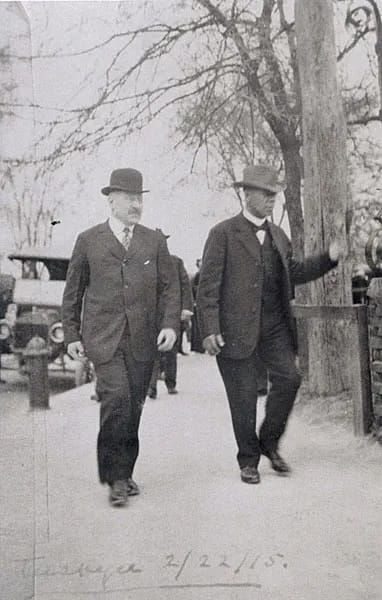
The relationship between Julius Rosenwald and Booker T. Washington is one of the most consequential and still underappreciated examples in American history of what can happen when people intentionally expand their circle of trust across race and lived experiences.
It wasn’t inevitable. It was chosen.
Booker T. Washington, born into slavery and later the founder of the Tuskegee Institute, had become the most influential Black leader in America by the early 20th century. He pragmatically focused on education, economic self-sufficiency, and institution-building for Black Americans in the brutal aftermath of Reconstruction.
Julius Rosenwald, the son of Jewish immigrants, was the president of Sears, Roebuck and Company. He was wealthy, socially conscious, and deeply shaped by Jewish ethical teachings about obligation, dignity, and justice. Though he cared, he didn’t know many Black people and he wasn’t immersed in Black America’s realities.
The relationship between Rosenwald and Washington began around 1911, when Washington invited the socially conscious Rosenwald to the Tuskegee campus in Alabama. Crucially, this wasn’t a fundraising pitch. Washington showed Rosenwald the school, introduced him to students and teachers, and spoke candidly about the conditions Black Americans faced in Southern communities.
Rosenwald was deeply affected. not just by the poverty he witnessed, but by Washington’s clarity, discipline, and refusal to sentimentalize suffering.
The two got to know each other authentically and began what would become a lifelong close friendship.
And in that relationship, they listened to and learned about each other and their communities.
And that listening changed everything.
What followed was real partnership and collaboration.
Washington, for his part, addressed antisemitism directly, speaking about discrimination against Jews:
“The Jews have suffered perhaps more than any other race in history… yet they have held together, preserved their ideals, and contributed immeasurably to civilization.”
For Rosenwald’s part, he became an integral piece of uplifting Black communities in the South.
Washington had a vision to help millions of Black children in the Jim Crow South desperate for education in a system where white-controlled school systems refused to build or fund schools for them. Rosenwald had the resources and organizational expertise.
Instead of top-down charity, Rosenwald would provide massive funding for school construction so long as Black communities also raised money and contributed labor, land, or materials. This model created ownership, dignity, and leverage, not dependency.
The result was the Rosenwald School Program, one of the most transformative educational efforts in American history.
Between 1912 and 1932, Rosenwald and Washington built over over 5,300 schools, shops, and teacher homes. Those schools educated over 600,000 Black children. At its peak, one-third of all Black children in the South were educated in Rosenwald schools.
These schools were more than just educational houses. They became community centers, civic hubs and symbols of self-respect in places designed to deny it.
Rosenwald schools dramatically increased literacy rates, narrowed Black–white educational gap and vastly improved lifetime earnings and health outcomes for the people who attended.
The children who attended his schools became teachers, ministers, farmers, nurses, and small-business owners. They raised children who went on to college for the first time. And they helped build stable Black middle-class communities under Jim Crow.
John Lewis, Maya Angelou and Medgar Evers all attended Rosenwald schools.
The impact lasted generations.
Washington and Rosenwald weren’t naïve about race. They lived in a violently segregated America. Their friendship didn’t t erase that difference. Instead, it worked through it.
Washington trusted Rosenwald enough to be honest.
And Rosenwald respected Washington enough to follow his lead.
That combination is rare.
Rosenwald ultimately gave away most of his fortune during his lifetime, believing wealth carried moral obligation, not entitlement.
Washington, for his part, understood that progress requires alliances. Not saviors or symbols, but partners willing to act. He believed in mutality.
Their story shows something we too often forget today.
Transformational change rarely comes from people talking only to people who look like them or think exactly like them.
It comes when trust crosses lines. It comes when listening replaces assumptions and biases. When resources meet lived experience. And when moral imagination expands beyond one’s own community.
Rosenwald didn’t abandon his Jewish identity to help Black America. As a committed Jew, he deepened it. And Washington didn’t dilute Black self-determination by partnering with a white-skinned philanthropist. He strengthened it.
Their relationship reminds us that expanding our circle of friends doesn’t weaken our commitments. It clarifies and solidifies them.
And sometimes, when that circle expands just enough, it produces impactful change.