
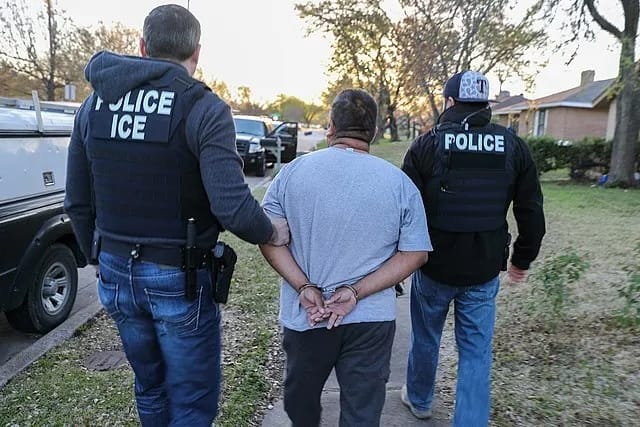
Comparing Immigration and Customs Enforcement (ICE) to American slave patrols starts with a core understanding of their missions. The primary function of slave patrols was to capture and return enslaved people who had escaped. They rode nightly to hunt for runaways, track escape routes, and return people to enslavers.
The primary function of ICE is to capture and return undocumented immigrants within American borders. They ride day and night to hunt for the undocumented, track escape routes, and return people to their own country, or any country that will house them.
Slave patrols enforced order through surprise raids, whippings, interrogations, and breaking up gatherings. Their presence was meant to instill fear and prevent resistance. They were responsible for enforcing laws restricting movement, assembly, literacy, possession of weapons, and travel without written permission. They acted as the state's enforcement arm for racial hierarchy.
ICE enforces order through surprise raids, physical abuse, interrogations, and breaking up protesters/gatherings. They often restrict movement, assembly, travel, possession of weapons, and employment. They act as the federal government’s arm for racial hierarchy.
Slave patrols didn’t only target enslaved people. They demanded papers from free Black residents, searched homes, and arrested people based on suspicion alone.
ICE, thanks to Supreme Court Justice Brett Kavanaugh, has leeway to conduct immigration stops based on “apparent ethnicity,” speaking Spanish or English with an accent, or being present at certain workplaces. Kavanaugh said that ethnicity alone isn’t enough, but when combined with other factors, it is “common sense” to consider it. Every brown person in America has reason to fear ICE presence. Brown American citizens have been deported. Dulce Consuelo Diaz-Morales, a 22-year-old woman from Maryland, was detained by ICE for 25 days, arrested in Baltimore, and transported first to Louisiana and then Texas. Her attorney provided a U.S. birth certificate, immunization records, and multiple affidavits confirming she was born in Laurel, Maryland. American citizen Renee Nicole Good, a white woman alerting people to ICE’s presence, was shot dead on January 7, 2026.
To be a member of a slave patrol, you had to be white, often a landowner or taxpayer. Some states required members to be eligible for the militia. Black men were sometimes forced to accompany slave patrols to track runaways, guide patrols through swamps or woods, carry lanterns, or act as informants. Some states imposed rotating slave patrol service on all qualifying white men, though some were able to pay another to take their place.
ICE agents are a majority of white men (55%) and close to 20% Hispanic and 15% Black. About 62% of agents are men and 38% women. One might wonder if brown and Black agents would have problems carrying out enforcement on racial minorities, often exactly like themselves in terms of where their parents hailed from. Much like police officers have a blue line of solidarity among themselves, ICE agents have a black mask line. Once they suit up with their vests, firearms, and masks, they share a common identity, including loyalty to fellow officers. They believe only other agents fully understand the job's risks and regard people of color as potential enemies. ICE agents of any color become de facto white supremacists once they put on their masks. How they live with themselves when they go home to their families is beyond me.
In the history of American slave patrols, only a few individuals have been punished for excessive force, mostly related to destruction or property damage. William J. Flournoy killed an enslaved man in Georgia in 1852. Flournoy was fined and made to compensate the owner. His crime wasn’t the killing of a man but property damage. An unnamed South Carolina patroller was fined and temporarily removed from duty for excessive whipping and unauthorized violence. A Louisiana patroller was convicted of manslaughter in the 1830s. After shooting and killing a Black woman and being convicted, he served no jail time but did have to pay the owner for his loss. There is no documented case of a member of a slave patrol ever going to prison for any offense involving the killing of a slave.
In a CBS interview after the shooting death of Renee Nicole Good, White House Border Czar Tom Homan made the following statements:
“I have not seen ICE act out outside of policy.”
“I haven’t seen one ICE officer found guilty of anything inappropriate.”
When asked if he’d ever seen any examples of clear, excessive force, he replied:
“No”
Donald Trump has already told an egregious lie that anyone who has seen the video of the shooting knows to be a lie when he said Renee Nicole Good, “violently, willfully, and viciously ran over the ICE Officer, who seems to have shot her in self-defense.” No ICE officer has gone to jail for excessive force or mistreatment of immigrants. Tom Homan didn’t go to jail for accepting $50,000 in cash for the promise of steering contracts in the future. There is almost no chance that the officer who shot Good multiple times will go to jail, no matter what an investigation finds. The yet-to-be-identified ICE Agent could be charged in State court, but the case would likely be moved to Federal court and then possibly dismissed by the Attorney General or preemptively pardoned by the President. Trump has already demonstrated he didn’t need an investigation to decide his innocence.
One last area of comparison: Members of slave patrols didn’t wear masks. Not that there’s anything good about them, but they rode openly, were known in their communities, operated under court appointment, and were often required to report their names in court records.
ICE agents typically do not identify themselves when operating in and around courthouses. They don’t use name badges; instead, they use only badge numbers or agency identifiers. They often work in communities outside their own and wear black masks to conceal their identity (and instill fear). ICE agents are not required to list their names in court documents.
Fear is not stated as an official objective of ICE. Still, ICE operations consistently produce fear, and federal officials are fully aware of that effect, even if they do not publicly describe it as a goal. At least the slave patrols were honest about who they were and how they carried out their duties.