
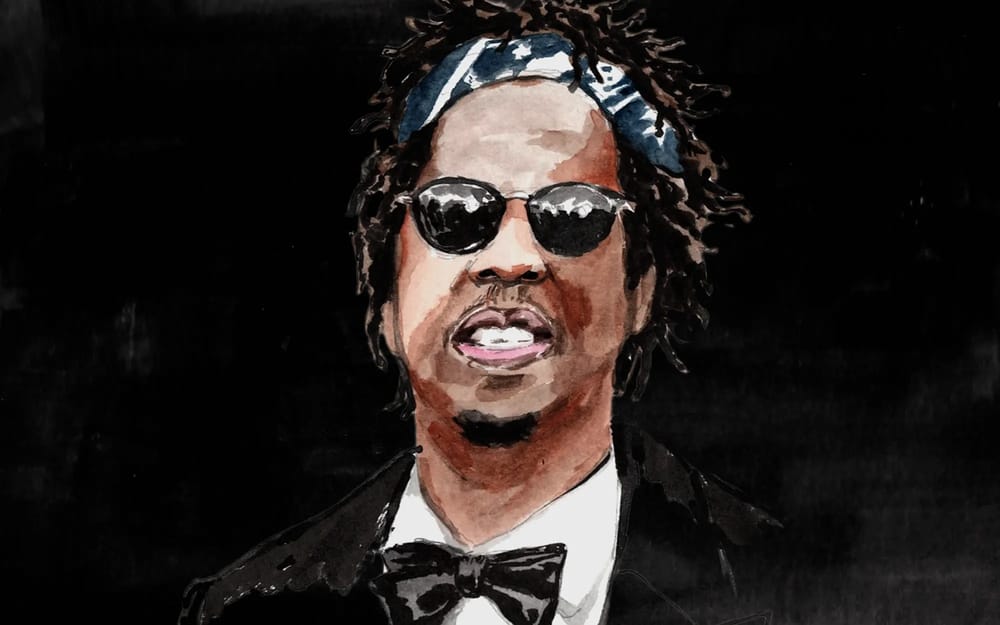
When the Remy’s in the system, ain’t no tellin’/
When I fuck em will I diss em? / That’s why they be yellin’/
I’m a pimp by blood, not relation / Y’all be chasin / I replace em’ ugh
That’s the kind of Jay-Z lie I loved when I was young.
I used to set my alarm to Hot 97 in the morning of junior year in high school. My mission was to memorize the radio edits of hit songs so I could sing along to the big choruses when they’d drop in our epic dances in the wrestling gym. “I Just Wanna Love You” was the one that year.
So at 6 a.m., there I was, mid-sleep, mumbling something about Remy Martin before I knew what Cognac was or what sex was or what VIP at the club looked like.
No matter. I couldn’t buy Jay-Z albums without a grilling from my mom because of the language. And I wasn’t gonna be a cornball who bought the censored version because that would make my recitations fall flat in the hype of the dance circle.
As much as I could, I made Jay-Z into a Brooklyn kid my mom could trust. It didn’t hurt that, at the time, my mom worked in the same city agency as his mother. “Yea, that’s Gloria’s son, and he’s famous.” He had the biggest song in the country, and every time I explained that, she was undeniably more familiar because he became synonymous with rap music.
Same time, I was learning how to diss and replace girls. How to demean the girls who had sex. They weren’t serious, just hoes meant for tossing and trading out like a roster spot. Same time, I was learning how money over everything wasn’t just philosophy, it was armor. I had learned that in my trips to the girls’ schools across town I needed to have the flyest North Face puffer, the latest Air Max 97s, the best Ralph Lauren rugby to even register with the girls I was looking to show me love.
I didn’t realize that no one loves anyone at that age, and that the ones who loved me were definitely not checking for my gear like that. But, that didn’t matter in the locker room when it was time to tell stories of what happened after the dance.
“So did you beat or not? Don’t lie, son.”
I hadn’t beat 99% of the time, and when I had, I didn’t want to tell anyone there because who wants to talk about kissing a lot or getting too excited to last more than 10 minutes? Who would talk about the taboo of dating my best friend who also had a boyfriend? Who would talk about screwing their best friend’s girl too? Who would talk about sexing the so-called hoes? I was making myself a list of the absolute unforgivables and checking it off as I discovered my real desires.
And there was Jay-Z, with his strict code of ethics: don’t feel, make money, betray friends, trust no one. There was hip-hop, in a hyper-masculine shell, one that looked like the Tony Stark Iron Man suit to me. I could be a super pimp, or a drug dealing entrepreneur. I could be fat and black and smooth with my tongue. I could be ugly. The only rule was: never be weak, never be feminine.
I bought that lie up until college. Ironically, Jay had put his best album out to date, The Blueprint, and I was rocking with it. The “Takeover” was my favorite song but I couldn’t concede that to my boys back in the Morehouse dorms. I was a Nas fanatic. I had learned, through those same girl we called hoes that my emotion was what they liked about me. My early freestyle writing attempts were like labyrinthine Nas verses, with internal rhymes. But secretly, in world history, I was writing and re-writing the Jay-Z verses from “Takeover.” They were snappy and succinct. Clear and concise. They were the lines that came from a hand that doesn’t write and I wanted to mimic that so bad because, even though it was practiced, it came off polished.
My little fake Queensbridge freestyles were only like Nas’s if you covered one ear and squinted your right eye. I had to rehearse them over and over for friends, and work up enough zeal at dawn to rush downstairs to the room where we made beats, to spit them off hot morning breath and freshman excitement.
They still didn’t land quite like the writing on the page.
I kept revisiting Jay-Z bars even though the substance felt nothing like what was happening to me. “I am a hustler baby. I sell water to a well.” This as I was running from store to store in the West Village looking for a job selling clothes so I could afford the cargo khakis from Triple 5 Soul and the Mecca hoodies. The paradox kept tripping me up because I was sweaty and tired with chapped lips. I wasn’t a finished hustler. I was just some broke kid.
With girls, I had continued a pattern of dating a few at the same time, writing 4-page emails, dropping every last dime from my magazine internship on dates to Upper West Side sushi bars and matinees of Cohen Brothers movies. My money was short and not soon replenished. Jay-Z was auditioning to be the next face on the 1,000-dollar bill. He was courting the R&B stars and actors from the same magazines I wanted to write for.
Then I started writing about hip-hop while living in Brooklyn. The Hov money evangelism made no sense, but it was still etched in my subconscious that it was okay to lie to women, treat them like second place objects, and then move on quickly when they tried to hold me accountable. That was pimp. That was a hustler ethos. That was Brooklyn style that couldn’t be explained except for living by a code of conduct that they’d never understand in their “emotional” make-up.
It’s funny because I was the emotional one in all my relationships as a young man. I was the one chasing recognition and validation in the DMs and on blog headlines. If I didn’t get it, I’d be sullen, or complain that others weren’t as pure in the art form as I was. That the cheap stuff sold. I was the one who got jealous of their accomplishments even though Jay-Z had taught me “Males shouldn’t be jealous / That’s a female trait / What you mad ‘cuz you push dimes and he sell weight?”
But something with him was awry too. I know Jay-Z was jealous of Nas because I had pledged my allegiance to and studied “Ether.” In that song Nas, very simply, called out Jay-Z for his obsessions, asserting the pillow talk theories I imagine he’d workshopped with lovers. As the Queens poet, the lifelong sex symbol, a hip-hop prodigy and Prince Charming in one, I know Nasir Jones had dealt with admirers materializing before him as bitter haters. Jay-Z didn’t love Nas’s precocious start, and you could tell because he kept trying to get Nas’s attention. (“So yeah, I sampled your voice. You was using it wrong. You made it a hot line; I made it a hot song” in hindsight, seems like an admission of jealousy, of weakness, of failure, and eventually, of mimicry.)
The Jay-Z story arc didn’t allow for his perverse admiration of a rival to lead him into that rival’s baby mama’s bed. That story, with its erotic undertones, ran counter to his fabricated kingly Jay-Z, a man to be respected and imitated. In the real interpretation of Hov bars, he’s just a scared kid with the green-eyed monster haunting him because he doesn’t look like the handsome rap star who’d taken his city by storm.
Those holes in his story didn’t square with the hero’s journey I’d followed from Reasonable Doubt all the way into the confused and convoluted Blueprint 2 and started to feel less reliable than some of the other voices I’d begun to seek from rap. Where others were growing up and confessing mistakes, Jay-Z was on a climb to become the next Rockefeller or Carnegie. He wasn’t a rapper; he was an institution.
“I’m not a businessman. I’m a business, man. Let me handle my business damn.”
I could no longer create those parallels when the distance between him and me was a universe of billions. Team ownerships and real estate deals, CEO seats and world tours. It didn’t make sense and I stopped trying to fit my story to his when his bars started sounding more like multi-level marketing hip-hop gurus than the Brooklyn memories that once bonded us.
Even as Shawn Carter’s fashioned enterprises wrapped with images of freedom fighters like Che Guevara and Marcus Garvey, I felt lucky enough to understand the dissonance. Garvey himself struggled at balancing the needs of the rich Black elite’s desires to cope and compensate for racial bigotry while his followers chased dreams of Black dignity that included a living wage.
That weight is too much for either fame or shareholders to bear.