
The art is what I find most intriguing about Japan, specifically the manga. From a distance, Japan can feel like the cold, corporate scene where everyone is driven by capitalism. Success is measured by financial gain and respectability.
However, the art says so much more. Manga tends to center the outcast, the unwanted, and the different. So often, it is about fighting back against oppressive systems. Manga is popular in Japan, but pursuing a career as a manga artist is usually not viewed with the respect one may imagine. It comes from a place of passion, not financial incentive or social acceptance.
It is a special mixture of pain, hope, and desire, and although it has a unique makeup, manga and anime are relatable to so much of the world.
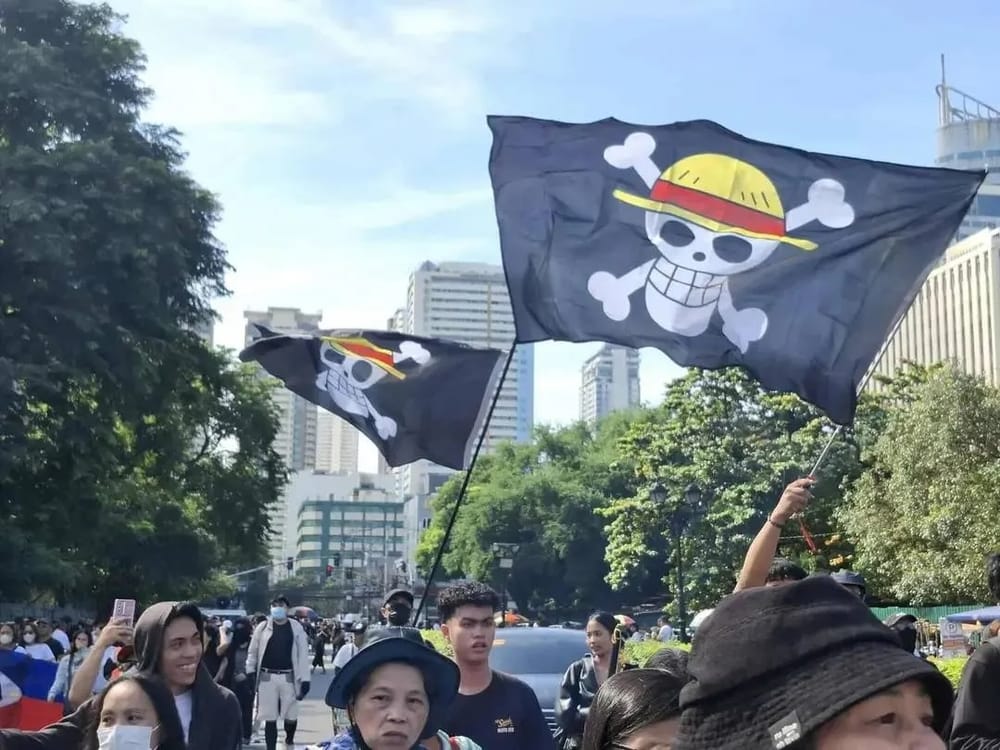
Having this knowledge, I wasn’t completely surprised to see a familiar manga flag flying as young people in the real world fought back against their oppressive governments.
‘One Piece’ resonates with oppressed people all over the world
One Piece is written and illustrated by Eiichiro Oda and has been running since 1997. The manga has over a thousand chapters. The anime has over a thousand episodes. It has cosplayers, video games, and even card games. The comic is on its way to being the best-selling comic of all time, beating out Superman, which has been running since the late 1930s. It is the most popular manga in the world.
At its heart, One Piece is about ostracized and oppressed people coming together and seeking the ultimate freedom. One Piece has a consistent message of challenging oppression, and presents this in multiple forms during its almost three-decade run.
It is no surprise then that people all over the world have found inspiration from this Japanese art.
The Jolly Roger flag, a grinning skull and crossbones in a straw hat, has been spotted during protests in Nepal, Indonesia, Madagascar, Morocco, and more.
Although the flag was already making its way into protests, it first gained widespread use in Indonesia with truck drivers. During the lead-up to their Independence Day, truck drivers would fly the Indonesian flag. This year, something was different.
The smiling skull was flying along, and sometimes completely in place of, the Indonesian flag. It was a way to peacefully protest. One truck driver said:
“The hope is that the government not only listens but also provides solutions," one truck driver said. "Don’t let the lower-income population continue to be oppressed.”
However, the power of the flag is uniting young people everywhere. Even though they all come from different cultures and have slightly different desires, the flag doesn’t need translating. They all share the desire to be free from oppressive governments.
“In addition to entertainment, the Straw Hat pirates symbolize freedom, liberty — the spirit that you have to oppose the unjust authority," said one protestor from Nepal. "That really inspired me.”
“It is so inspiring for young people," said a protestor in Madagascar. "In the story of One Piece there is injustice, there is corruption, the government is thinking themselves to be untouchable, but it can be touched by the power of the people.”
The political messages in One Piece are obvious to so many, but a loud minority believes otherwise.
The political messages in ‘One Piece’
I’m always a little sad to learn how many people lack media literacy. One Piece isn’t subtle in its messages, but Oda will sometimes even spell out the meanings of his stories for the fans not willing to do the legwork.
He will often tell allegories for historical and political events. For example, Great Terminal is a direct reference to the Smokey Mountain, which was a large dump site in the slums of the Philippines.
Drum Island is a direct shot at Big Pharma. The East Blue Saga deals with police corruption. Fishman Island deals with civil rights and racism. Wano Country touches on trans rights. Summit War explores the corruption of justice.
Oda even has a Che Guevara poster on his wall, which doesn’t say everything about someone’s politics, but it does say something about them.
Still, the “One Piece isn’t political” crowd has only grown louder since the protests. Somehow, people can consume One Piece and only see flashy colors and cool powers.
I would argue that fascism isn’t too hard to see either, and many of the antagonists in One Piece are fascists. Ironically, based on what I’ve seen, many of the people who are blind to One Piece’s politics are the same people who tend to be blind to real-world fascism. They are the ones who say, “But Hitler had a few good ideas, too.”
You would think people would look at over a thousand chapters of a work, an epic clearly concerned with the power of dreams and the desire for freedom, and at least find some level of appreciation outside of flashy fight scenes.
My most innocent interpretation is that ignorance is bliss. These people don’t fully consume the content, skipping through dialogue to get to the fights. This becomes frustrating when they argue with their whole chest that One Piece isn’t political.
The more pessimistic interpretation is that these people are purposefully attempting to gaslight people into believing One Piece is not political to quell the revolutionary spirit.
If I’m being honest, it is likely a bit of both.
It isn’t worth investing time in these individuals. It just distracts from the young people who are daring to dream and fight for their version of freedom.
Gen Z is Luffy, and Luffy is Gen Z.
Generation Z is unique because they are the first group to expect their lives to be worse than the previous generation. I’ve had brilliant students fall into a depression because of the state of the world. What is the point of working hard and going to college when they are stripping away rights?
These kids will inherit the world and all the problems. Despite being so distant, their fears cross cultural lines just like One Piece.
Protestors in France said:
“They liberate people wherever they go. That’s the story….This is a universal symbol. If Luffy were here, he’d go to Palestine and fight….One Piece is a symbol of resistance against government oppression, a symbol of freedom and peace.”
Luffy is one of them. Most of these kids grew up with One Piece. They’ve watched Luffy struggle, grow, and succeed.
The power of propaganda and symbols
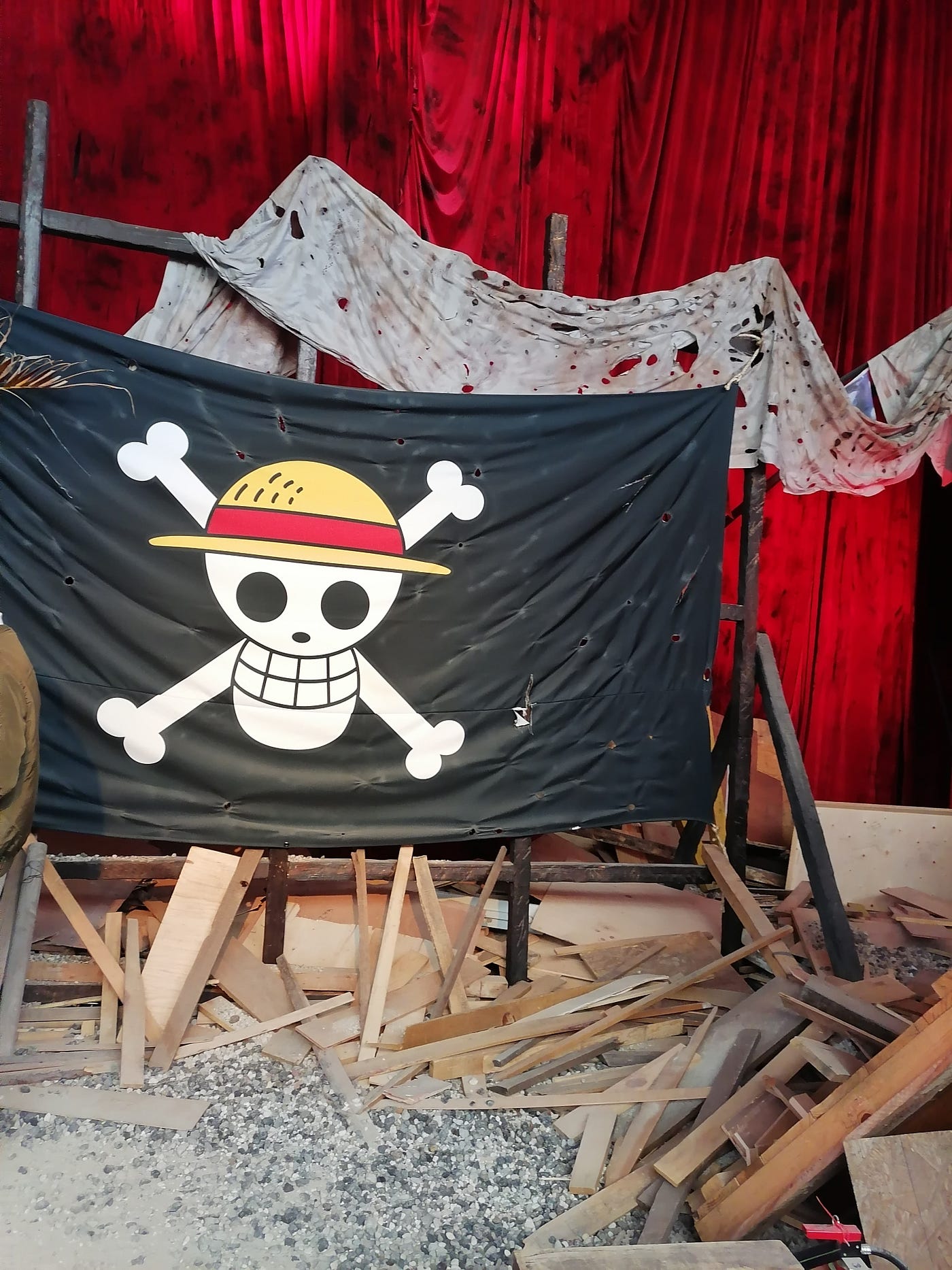
The One Piece flag is officially a symbol of resistance, whether people like it or not. Young people have toppled governments while waving the flag. Governments understand the power of symbols. Pro-government propaganda is built on symbols.
Cartoons and propaganda are almost synonymous. During World War 2, famous characters like Donald Duck were common tools. Superhero comics like Superman and Captain America are still used as American propaganda.
Anime is no different. In France, before the protests, Macron used anime as an attempt to subdue an increasingly frustrated populace. This included receiving a piece of original One Piece art from Oda and showing it off on social media.
In America, Peter Thiel, a billionaire techbro and integral part of the Trump regime, attempted to put his own spin on One Piece. This man is the World Government. The current vice president has his position because of Theil. He is one of Trump’s biggest backers, yet he views himself as Luffy and Luffy as Jesus.
Thiel wrote this piece in October, after the flag’s popularity began to spread. Despite Thiel clearly knowing One Piece, it is still an obvious attempt to defang a movement before it gains popularity in America.
“See, One Piece is actually conservative and supports technofascism.”
The One Piece flag being used in protests is a deliberate way to reclaim a culture oppressive governments do not represent (source). I would love to see more of this energy in America.
The power of the flag is viewed as a real threat in some countries. Indonesian officials have discussed banning the flag. It is the same type of fear the Strawhat Pirates from One Piece strike in oppressive regimes.
The power of the flag is not understated in One Piece. Each ship’s flag symbolically carries the hopes and dreams of the crew on the ship. This is no different for the Strawhat’s Jolly Roger and the dream of freedom. It is not uncommon for characters like Luffy, the protagonist, to illogically sacrifice themselves for the safety of the flag.
Anyone who is carrying the Jolly Roger into a protest is saying this cause goes down to the core of who they are. It is a dream for which they are willing to sacrifice.
Eiichiro Oda decided to follow his dream of being a manga artist at 4, and he created a piece of art to inspire others to pursue seemingly impossible dreams.
What dream is bigger than revolution? So many before have fallen, to push forward must be pure fantasy. And yet…
With the help of Oda’s pen, Luffy makes the impossible happen. With the help of Luffy’s flag, young people all over the world are accomplishing the impossible.
Anime is political
I grew up on anime, and the thought of fighting against oppressive governments is the norm. I’m surprised there is so much pushback when this topic arises.
Dragon Ball by Akira Toriyama isn’t discussed for its heavy metaphors, but even that series has a clear political message. At the start of Dragon Ball, something I watched when I was around 5 years old, the main antagonist was Emperor Pilaf. He was a small, angry little man who only cared about himself and planned to cheat his way into becoming the ruler of the universe using the Dragon Balls. Outside of his few fervent supporters, everyone views him as a joke. Does this sound familiar? It isn’t explicitly stated, but even my five-year-old brain understood this to be the bad guy.
Frieza, probably the most important antagonist of the series, is another example critiquing this type of leadership. Frieza is born into power, using his military police force to maintain and gain more power. Frieza is in charge of an oppressive government that revolves around him, the thing Pilaf wanted, and the thing Goku, Luffy, and so many real people are fighting against right now.
Hunter x Hunter, Demon Slayer, My Hero Academia all deal with similar themes, and yet, so many will claim they are just cartoons. We shouldn’t take them seriously. We shouldn’t think too hard.
That is a trap. The people in power need apathy and ignorance.
I’m proud of the young people fighting for their dreams. I wish my generation had found that fire, but we, at least in America, were still too blinded by potential. Despite the lessons I learned from anime at a young age, I didn’t find my flag to raise until I was older, and when I looked to my right and left, I had no crew to stand with me.
This young generation is Luffy and the Straw Hats. The crew is worldwide. Keep waving your flag and declaring war on the world government. Make your dreams a reality.
This post originally appeared on Medium and is edited and republished with author's permission. Read more of LG Ware's work on Medium.