
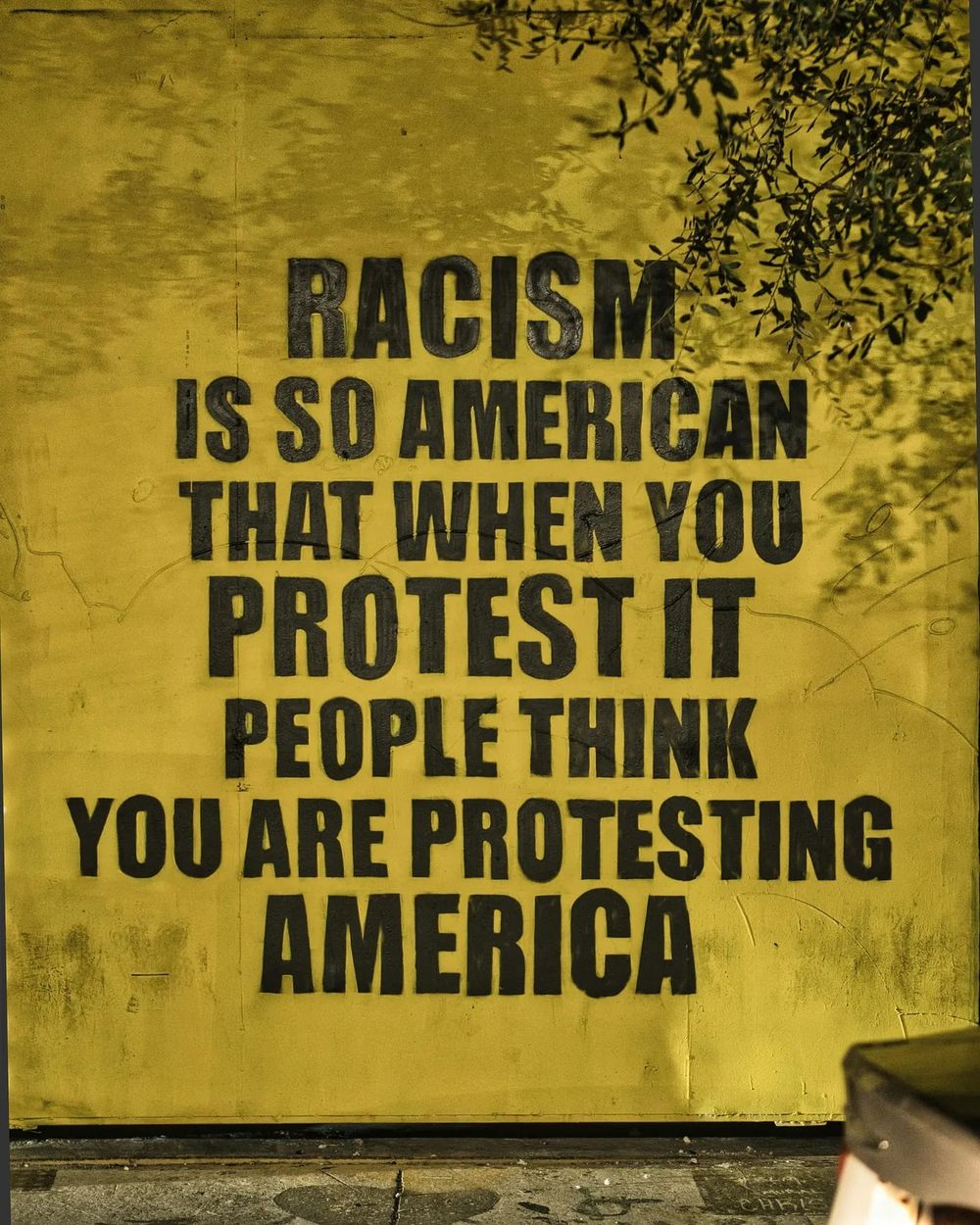
Alicia Garza, one of the women who co-founded Black Lives Matter, has been saying it out loud for months. What we are watching is not subtext. It is text. She calls it Jim Crow 2.0, and she is right.
The receipts are public now.
On April 29, 2026, the Supreme Court came out of the Louisiana redistricting case, Louisiana v. Callais, with a 6–3 ruling that put a knife to the heart of Section 2 of the Voting Rights Act. The Associated Press reported that the ruling “significantly weakened” the law that built most of the Black congressional representation we have. Legal analysts cited by the AP said the practical effect is brutal: intentional racial discrimination just got much harder to prove in court, and political camouflage became a near-perfect alibi.
Translation. A Southern legislature can crack a Black district apart, fold the pieces into surrounding white-majority districts, hand a half-million Black voters a representative they did not choose and have no realistic chance of unseating, and the federal courts will largely shrug.
This is happening in Louisiana. In Mississippi, lawmakers had been openly waiting on this case before redrawing their own map. Governor Tate Reeves announced a special legislative session for May 20, twenty-one days after the Court ruled, to reexamine Mississippi’s congressional district currently represented by Bennie Thompson. Alabama, South Carolina, Tennessee, Georgia, and Florida are scoping similar moves.
That is the legal frame. Now look at the people.
The Roster
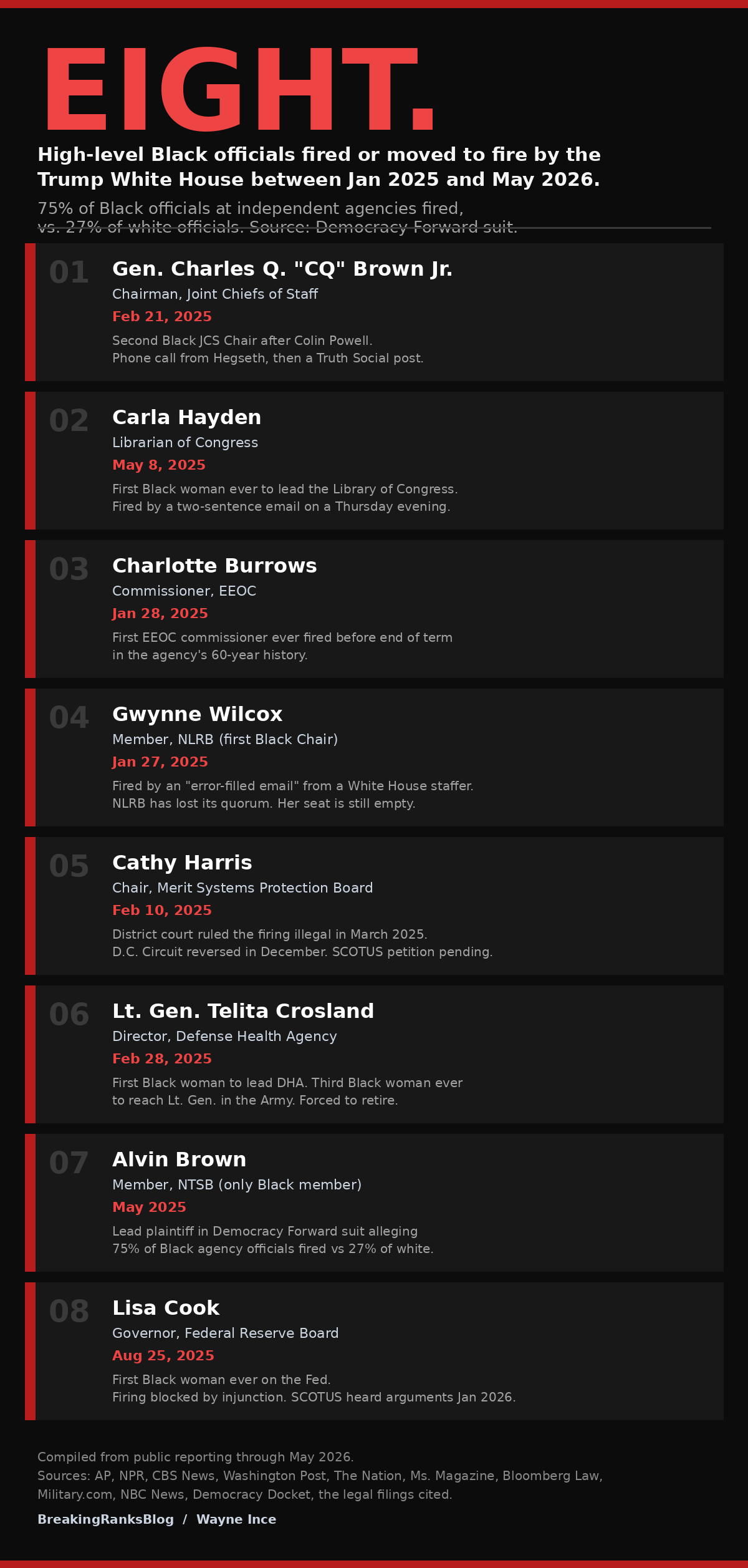
Since taking office in January 2025, Donald Trump’s White House has fired or moved to fire at least eight high-level Black officials. Their common feature, beyond competence, is the color of their skin and a refusal to perform loyalty.
This is not an opinion. In a federal lawsuit filed in April 2026, attorneys at Democracy Forward and Justice Legal Strategies presented the math on Trump’s second-term firings at independent federal agencies: roughly 75% of Black officials have been removed, compared to roughly 27% of white officials in the same positions. Almost three times the rate.
The graphic accompanying this essay names the eight. A few of the firings deserve to be told as scenes, because the cruelty is in the detail.
Carla Hayden, the first woman and the first African American ever to lead the Library of Congress, was fired on a Thursday evening, May 8, 2025. Her termination notice was a two-sentence email from a Deputy Director at the Presidential Personnel Office named Trent Morse: “On behalf of President Donald J. Trump, I am writing to inform you that your position as the Librarian of Congress is terminated effective immediately. Thank you for your service.” Hayden had been confirmed by the Senate in 2016 by a vote of 74–18, after running the Enoch Pratt Free Library system in Baltimore through the 2015 Freddie Gray uprising, when she kept her library branches open as places of refuge while the city burned. The White House Press Secretary, asked the next morning why a President had fired the head of the Library of Congress, said only this: “We felt she did not fit the needs of the American people.” A conservative outfit called the American Accountability Foundation had spent the previous month publishing dossiers accusing her of stocking the children’s section with what it called radical content.
General Charles Q. Brown Jr., Chairman of the Joint Chiefs of Staff. The second Black officer ever to hold the chair, after Colin Powell. A four-star Air Force pilot with more than 3,000 flight hours, 130 of them in combat, and four decades of service. Fired on February 21, 2025. He learned about it from a phone call from Defense Secretary Pete Hegseth, minutes before Trump posted the news on Truth Social. Three months earlier, on episode 143 of the Shawn Ryan Show, Hegseth had said on the public record, “First of all, you’ve got to fire the chairman of the Joint Chiefs,” and “any general that was involved in any of the DEI woke shit has got to go.” Brown had taped a five-minute video the summer of George Floyd’s death, in his uniform, talking about being asked, in his own flight suit, with his own pilot wings, “Are you a pilot?” Hegseth’s framing for the firing was that the Pentagon needed to restore the warrior ethos.
Charlotte Burrows, a Democratic Equal Employment Opportunity Commission commissioner, removed in late January 2025 in the middle of a five-year statutory term. In the EEOC’s 60-year history, no commissioner had ever been fired before the end of a term. Burrows is represented by Lisa Banks and Debra Katz of Katz Banks Kumin, the same attorneys who represented Christine Blasey Ford. Her case is now testing whether the President can override Senate-confirmed terms at independent agencies, and whether the 1935 Supreme Court ruling in Humphrey’s Executor still constrains the executive branch at all.
Gwynne Wilcox, the first Black woman ever to serve on the National Labor Relations Board, and its first Black Chair, fired late on January 27, 2025, by what The Nation later described as an “error-filled email” from a White House staffer. She sued nine days later. In May 2025, the Supreme Court refused to reinstate her while her case proceeded. In January 2026, the D.C. Circuit refused to rehear it. Her seat is still empty. The Board has lost its quorum, and federal labor law enforcement has effectively stopped, which appears to have been the point.
Cathy Harris, chair of the Merit Systems Protection Board, fired on February 10, 2025, by an email almost identical to Hayden’s. In March 2025, a federal district court ruled the firing illegal and ordered her reinstated, finding the Trump administration could not articulate a lawful cause. In December 2025, the D.C. Circuit reversed and upheld her removal. Her petition for Supreme Court review is pending. While her case has bounced between courts, the agency that protects two million federal workers from political reprisal has been left without working leadership.
Lieutenant General Telita Crosland, the first Black woman ever to lead the Defense Health Agency, the third Black woman ever to reach the rank of Lt. General in the U.S. Army, forced into abrupt retirement on February 28, 2025. Two officials told Reuters she was informed she had to retire and given no reason.
Alvin Brown, a member of the National Transportation Safety Board, the only Black member on the Board, fired in May 2025. He was the only NTSB member Trump fired. Brown is now the lead plaintiff in the Democracy Forward lawsuit cited above, the one that produced the 75-percent statistic. The administration’s defense in court has not been that Brown’s firing was justified by performance or politics. It has been that the statutory protection saying NTSB members can only be removed for cause is itself unconstitutional, and the President can fire whoever he wants.
Lisa Cook, Governor of the Federal Reserve, the first Black woman ever to serve on the Federal Reserve Board, was the eighth. On August 25, 2025, Trump announced he was removing her, citing a mortgage-fraud allegation generated by Federal Housing Finance Agency Director William Pulte. Cook has not been charged with any crime. A federal district court issued a preliminary injunction blocking the firing under the Federal Reserve Act’s “for cause” provision. The Supreme Court heard oral arguments in Trump v. Cook in January 2026. Whether or not the Court ultimately lets the President fire her, the message to every Black senior official in any independent agency was already sent in August.
Eight high-level Black firings, plus an attempted ninth, in a single year is not a personnel pattern. It is a purge with branding.
What this White House Finds Time for
All of this happened while the war in Iran kept burning.
American sailors are still in harm’s way in the Persian Gulf. Oil prices are still translating that conflict into the gas pump in Tampa and the grocery aisle in Birmingham. The administration has yet to put a coherent endgame in front of the American people, on television or in front of the Senate Armed Services Committee. There is no plan, no benchmark, no timetable. There is no week in which the President has stood at a podium and said, here is how this war ends.
But there has been time, week after week, to fire Black women who run small obscure boards. Time to draft executive orders attacking diversity hiring in the Coast Guard, federal grant programs, and law school admissions. Time to send Justice Department lawyers in to argue against majority-Black districts in three different states. Time for the Solicitor General to file an amicus brief in Louisiana v. Callais asking the Court to do exactly what the Court then did. Time, on a Thursday evening, for someone in the Presidential Personnel Office to draft two sentences and press send on Carla Hayden.
A presidency reveals its priorities by where it spends its calendar. This calendar is unambiguous.
Why this is the Midterm Play
Here is the part of the story the cable shows do not connect for you.
The President’s allies in the House sit on a single-digit majority. The 2026 midterm map, read honestly, was breaking against them. Suburban revolt over inflation. A war they cannot explain. A tariff regime that small business owners are openly cursing on local talk radio. A Medicaid fight that is going to land on every kitchen table in West Virginia and Mississippi by the fall. Polls in March and April had the GOP House majority in real danger.
So what do you do if you cannot win the argument?
You change the rules, and you change who is allowed to count.
Section 2 of the VRA, on its old reading, would have forced courts in Louisiana, Alabama, and Mississippi to hold the line on at least one majority-Black congressional seat in each state. Strip Section 2, and three to five additional Republican-leaning seats become available for the picking, by re-cracking Black communities into surrounding white-rural districts. Put that on top of the partisan-gerrymandering shield the Court already handed the same legislatures in Rucho v. Common Cause in 2019, and you have a House majority that gets manufactured at the cartographer’s table instead of earned at the ballot box.
The firings are the second front in the same war. A Defense Department, an EEOC, a Library of Congress, an NTSB, a Federal Reserve, and a federal judiciary scrubbed of senior Black leadership is a federal government that will not enforce voting rights, will not investigate civil rights complaints, will not preserve the historical record of Black political participation, and will not stand in the way of the next round of voter purges already being staged in Georgia and Texas.
That is not analysis. That is arithmetic.
While the country waits for the President to explain Iran, his lawyers are quietly building the maps that will hand him 2026 and 2028.
Jim Crow 2.0 is the Right Name
Alicia Garza did not pick that phrase out of a book. Garza co-founded Black Lives Matter, ran the Black Census Project, and has spent more than a decade interviewing Black voters across the South. When she says Jim Crow 2.0, she is naming a mechanism, not a feeling.
Original Jim Crow had three legs. Legal disenfranchisement: poll taxes, literacy tests, white primaries. Economic punishment: sharecropping, redlining, exclusion from federal benefits. Physical intimidation: nightriders, sheriffs, Klan with badges. Each leg is back, in updated dress.
The legal disenfranchisement leg in 2026 is the gutted VRA, the proof-of-citizenship laws, the polling-place closures across Black precincts in Georgia and North Carolina, and the felony disenfranchisement statutes that, the Sentencing Project estimates, lock Black Americans out of the vote at more than three times the rate of other Americans.
The economic punishment leg is the dismantling of federal contracting set-asides, the public attack on Black executives by name, the gutting of the Consumer Financial Protection Bureau enforcement teams that policed predatory lending in Black neighborhoods, and the refusal to extend SNAP increases that disproportionately fed Black children.
The physical intimidation leg, in 2026, runs through ICE and through the National Guard deployments. On September 15, 2025, Trump signed a presidential memorandum sending National Guard troops and federal agents into Memphis, a majority-Black city where police had reported the lowest violent crime totals in twenty-five years. The same federal posture has been extended to Washington, D.C., through the end of 2026. Federal agents in unmarked vehicles in majority-Black cities, sold to the country as crime suppression, are functionally the same instrument Bull Connor used in Birmingham, with better optics and worse oversight.
Trump did not invent these tools. He inherited them, sharpened them, and pointed them in one direction.
What We Owe Each Other Now
While he did, sailors stayed deployed against Iran with no clear mission beyond escalation. Veterans groups, including mine, have been asking the same questions every week. Where is the Authorization for Use of Military Force? Who voted for this war? When does it end? The White House has answered in silence.
Silence is itself an answer.
This White House has chosen, with its time and with its attention, to fight a war against Black political power inside the United States more vigorously than it is fighting the war it actually started in the Strait of Hormuz. That sentence is not rhetoric. Look at the calendar. Look at the firings. Compare the page count of every brief the Solicitor General has filed against Black voters in the last hundred days to the page count of any coherent Iran strategy document the administration has released to Congress. The numbers tell you everything.
So here is the bear-witness piece.
Think about Carla Hayden, two sentences and a Thursday evening, after a career building libraries that taught poor children how to read. Think about CQ Brown, four decades in the cockpit, told by a phone call. Think about Gwynne Wilcox, still locked out of the seat the Senate confirmed her to, while the agency that protects American workers sits without a quorum. Think about Lisa Cook, watching the highest court in the country debate whether the President can fire her over an unproven allegation. Then ask yourself what kind of country fires people like that, with election maps to keep them in office, from voting at all.
For Black Americans who have voted faithfully through worse, this is not a moment for despair. It is a moment for the same work it has always been a moment for. Organizing the precinct. Registering the cousin. Walking the elder to the polls. Suing the legislature in state court when the federal court is closed. Running for the school board when Congress is rigged. Remembering the names of the eight people in the accompanying graphic, because those names are the receipts.
Jim Crow 2.0 is not whispering. It is on the public record, signed by the President, blessed by a 6–3 court, and paid for with our taxes.
We do not get the option of looking away.