
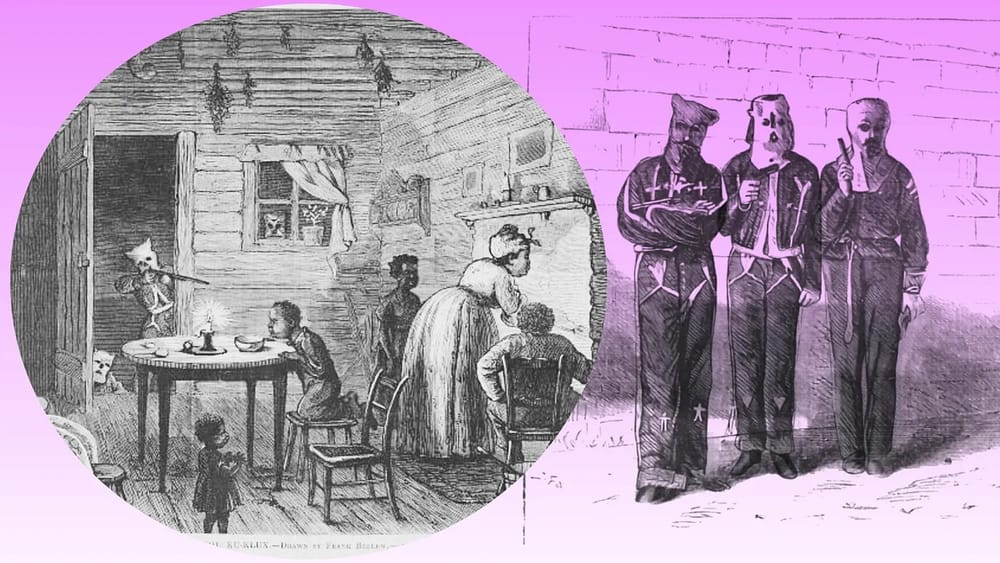
Whenever a Black person discusses the role of racism in modern-day policing, pointing to parallels with South Carolina slave patrols and extremist groups like the Ku Klux Klan, they’re accused of spinning a yarn, of lying about the severity of the problem. But every so often, evidence comes to light that makes these claims difficult to ignore. For example, this month, officials made such a discovery at the Jackson headquarters of the Mississippi Department of Safety while preparing to move their operations to another building. In a small blue briefcase, tucked away in a closet, they found 1960s-era Klan robes and hoods, along with “recruitment materials, propaganda, meeting notes, ledgers, and a list of members who paid or didn’t pay their dues.” While shocking to some, especially those who believe that law enforcement acts as neutral arbiters of justice, the news confirmed what Black Americans have been saying for generations, even as their concerns seemed to fall on deaf ears, that prejudice impacts policing.
The Mississippi Department of Archives and History plans to digitize the documents and photographs of items they found. Reports suggest that this includes a pamphlet titled “The Ugly Truth about Martin Luther King,” likely mischaracterizing the civil rights leader, known for organizing peaceful protests against racial segregation and discrimination, a notebook detailing meetings, and various other documents, such as the 1965 Imperial Executive Order. Once their work is complete, the public will have access to these artifacts. But the irony shouldn’t be lost on you that officials discovered Klan regalia in a public safety office. A vow to protect and serve a community means nothing when some officers have taken an oath to uphold white supremacy, and that’s what this organization required of its members. Many realize that Confederate veterans founded the Ku Klux Klan in 1865 after losing the Civil War, and that members carried out violent campaigns to intimidate and terrorize Black people. But few realize they sought positions of power, as prosecutors, judges, police officers, prison guards, and sheriffs’ deputies.
Ida B Wells, an anti-lynching journalist, once wrote, “those who commit the murders write the reports,” noting that following racial terror lynchings, very few white people ever faced criminal charges due to these crimes, because they held positions of power, and knew individuals within law enforcement agencies. Many overlook the relationship between white supremacist groups and law enforcement. Still, this latest discovery, of Klan regalia in a public safety office closet, exposes a direct link, even if some are unwilling to acknowledge the implications. In founding documents, Klan leaders referred to their organization as an “invisible army,” committed to the “maintenance of white supremacy.” So, Klansmen serving in law enforcement positions wasn’t a coincidence of geography, of them living in the South, where this organization spread its wings, but rather part of an intentional strategy to use the power afforded by these positions to terrorize the black community without fearing consequences, or damage one’s reputation. Their so-called invisible army carried out its objectives, protected by anonymity. Mike German, a former FBI agent, suggested in a Brennan Center report that by the 1920s, the Klan had at least one million members throughout the nation and had “fully infiltrated federal, state, and local governments to advance its exclusionist agenda.” And while some may assume explicit racism in policing is only a past problem, there is ample evidence that prejudice continues to impact policing today.
A 2017 FBI report noted that white supremacists pose a “persistent threat of lethal violence” and warned that they have established “active links” to law enforcement officials. While the Justice Department acknowledged the issue, “there is no national strategy designed to identify white supremacist police officers or to protect the safety and civil rights of the communities they patrol.” Although many officers may harbor implicit biases against Black people, only a small percentage of law enforcement personnel are likely serving as “active members of white supremacist groups.” Still, research shows this connection exists in many states and remains a nationwide concern. As it stands, Black people are more likely to be stopped and frisked, to face police brutality, including fatalities in custody. Yet, the FBI report indicated that disciplinary action for officers typically occurs only after a public scandal. Another problem German identified was that “few law enforcement agencies have policies that specifically prohibit affiliating with white supremacist groups.” Often, an unfair tradeoff is made, with officials choosing to protect the First Amendment rights of officers over and beyond the goal of providing “equal protection” to Black citizens, guaranteed by the Fourteenth Amendment.
Beyond white supremacists infiltrating police departments, a Critical Criminology study found “local and federal law enforcement consistently trivialized the presence of white power groups in the community, elevated the potential threat from protestors, concentrated intelligence efforts on activists, and provided differential protection to white supremacists.” Unlike the neutral public image these groups convey, typically, “police will not identify the far-right as a threat to the community because of a shared ideological commitment to maintaining a specific set of social arrangements — an authoritarian one that privileges security and order over the rights of certain individuals to dissent.” For instance, consider the events in Kenosha, Wisconsin, in the summer of 2020. Massive protests erupted after police officers shot Jacob Blake, a 29-year-old Black man, in the back seven times, leaving him paralyzed. On the evening of August 25th, officers gave water bottles to Kyle Rittenhouse, an armed 17-year-old, who would later shoot three White BLM protesters, killing two of them, drawing backlash for this preferential treatment. Officers didn’t see Rittenhouse as a threat because he supported the police, rather than those protesting police brutality. Former alderman Kevin Mathewson put out a “racially charged call to action” the day after the officers shot Blake, calling for help to guard against “evil thugs.” His statement was the catalyst for Rittenhouse and others arriving, with the understanding that they would help local police. Staff writer, Leah Watson, noted, “officers enabled and encouraged predominantly white, right-wing armed citizens and militia groups that night, creating a situation in which tensions escalated, and people were killed.”
“Efforts to address systemic racism and implicit biases in law enforcement are unlikely to be effective in reducing the racial disparities in the criminal justice system as long as explicit racism in law enforcement continues to endure,” German noted. More Americans need to acknowledge that racism persists in American policing. Only once people wake up to the severity of the problem will they support substantive changes. Someone who refuses to acknowledge the flames, in this case, ignited by prejudice, will never invest gallons of water to extinguish the fire. The lingering problem is that Black people can’t feel wholly secure in a society that stereotypes them as dangerous, while at the same time overlooking evidence of the clear and present danger posed by racist police. According to Spencer and Perlow (2018), the “police continue to murder African Americans in neo-lynching ways, spreading terror in and throughout minority communities.” While no one would consider it acceptable for Nazis to police Jewish communities, few seem to bat an eye at the fact that members of the Ku Klux Klan and other white supremacist groups were tasked with policing Black communities.
While this essay has focused on white supremacist groups having historical ties to police departments, here’s a modern-day example. The Department of Justice opened a pattern and practices investigation into the Rankin County Sheriff’s Department in September of 2024 due to a torture case involving six officers, part of the self-proclaimed “Goon Squad,” who were sentenced to serve decades in prison after pleading guilty to “assaulting two Black men and shooting one of them in the mouth during a raid on their home.” According to a New York Times investigation, this violence visited upon Black citizens, and others spanned nearly two decades,” describing a ‘loose band of Sheriff’s deputies,’ who ‘roamed impoverished communities across a central Mississippi county, meting out their own version of justice.” These officers routinely barged into homes, accused residents of selling drugs, handcuffed them, held individuals at gunpoint, and physically assaulted them to coerce confessions.
In one 2018 case, Robert Jones, a Black man, said deputies of the Rankin County Sheriff’s Department tased him “while he lay submerged in a flooded ditch, then rammed a stick down his throat until he vomited blood.” Carvis Johnson, another Black man, claimed officers “beat him like a slave.” While official reports did not mention any use of force during his arrest, a photo taken of him “shows his face bandaged and swollen.” Text messages revealed years of communication, as “deputies chatted routinely about ways to humiliate and brutalize criminal suspects.” They were given commemorative coins to signify their membership, and points were awarded for arrests made and acts of violence. Deputies even “joked about killing [a] man and burying him on Deputy Grogan’s property.” One of the officers, Hunter Elward, showed remorse and apologized for the role he played, saying, “I hate that I was involved in this,” and “I hate what’s happened to them.” While one of the victims, Eddie Parker, forgave them after hearing his plea, Michael Jenkins, the shooting victim, refused to, saying, “If he wouldn’t have gotten caught, he would still be doing the same thing.” Whatever opinion you personally hold of these former officers, one thing is clear — this case was reflective of routine violence.
Rankin County Sheriff Byran Bailey described these crimes as “horrendous” and noted he never imagined “it would happen in this department.” However, his optimistic assessment overlooks the longstanding pattern of racist policing in the state of Mississippi and the nation more broadly. Dismissing this case as the work of a few bad apples ignores the deep-rooted relationship between white supremacist groups and law enforcement in this country. Under the Trump administration’s leadership, the Department of Justice has indefinitely paused its investigation, freezing efforts to address the patterns and practices of the RCSD and the Lexington Police Department. Although federal agents found ongoing racial profiling and bias against Black people among officers — creating a culture that makes abuse more likely to occur, their failure to complete this investigation raises questions about America’s willingness to confront this issue. Discovering Klan regalia in Mississippi’s Public Safety Department should be a wake-up call, highlighting the harm caused when white supremacist groups gain influence. Yet, in today’s political climate, efforts to hold police accountable have come to a sudden halt.
History professor Khalil Gibran Muhammad suggested that the Ku Klux Klan “took about the business of terrorizing, policing, surveilling, and controlling Black people,” ultimately dominating “the machinery of justice in the South.” This is not a piece of history we should sweep under the rug, but rather, something we should reflect upon. Allowing members of the Klan to join police departments placed Black people in jeopardy. And while it may be reassuring for many to consider this as a historical problem, modern-day policing has ties to white supremacist groups. Unless we reckon with this problem, our country will never be able to successfully break this cycle, to create a system of public safety that’s meaningful for Black people, not just those who are White or wealthy. As Ward (2018) wrote in the Du Bois Review, “we must demand more of police and other state actors, and ultimately the body politic, in combating White supremacism in policing if we are to realize transformative change.” To confront this problem, Americans must see this discovery of Klan regalia in a Mississippi Public Safety Department office not as an anomaly to gawk at, but rather a symptom of a broader pattern of white supremacist groups infiltrating law enforcement agencies, a reminder of our collective responsibility to one another.