
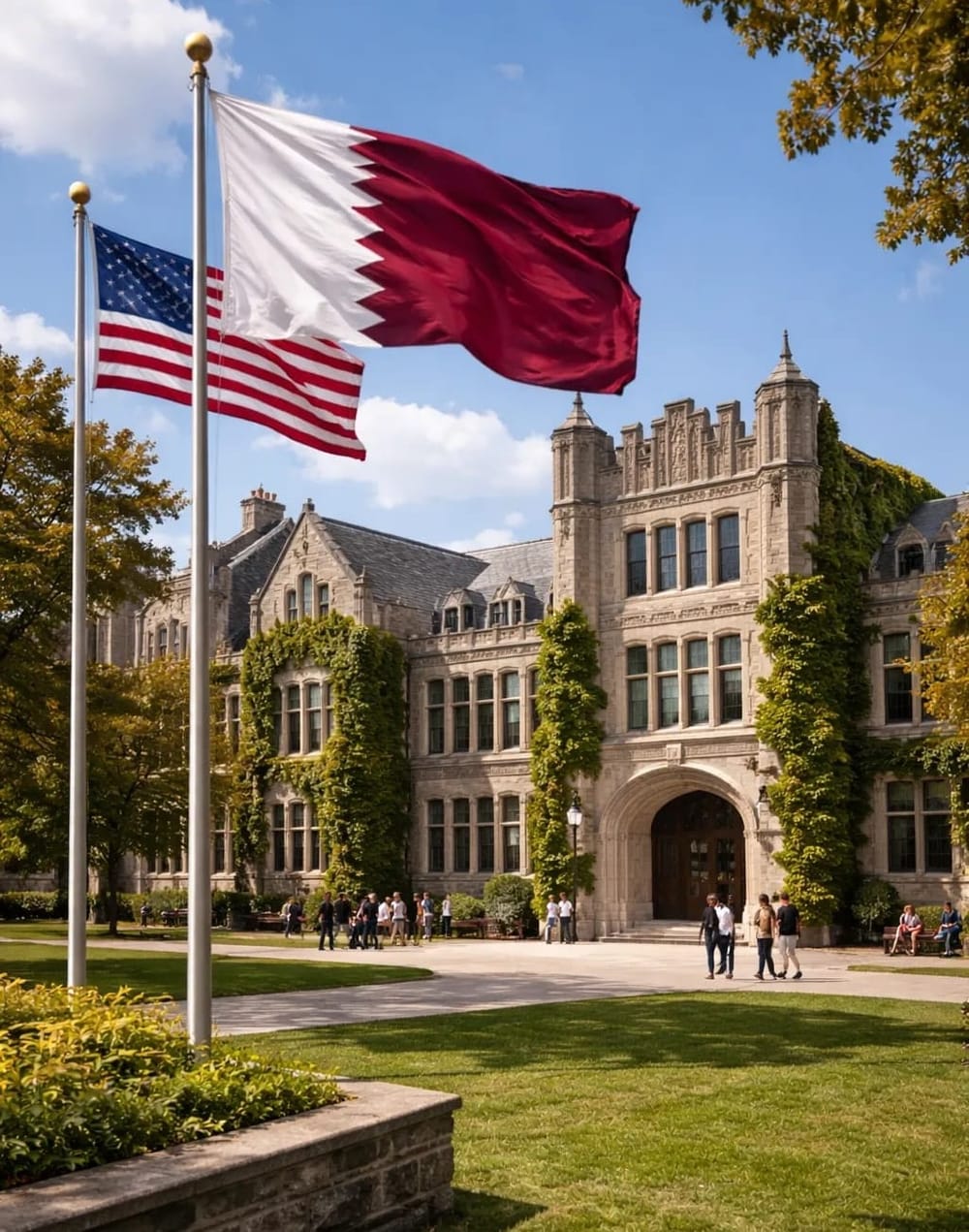
Most Americans hadn’t heard much about Qatar, let alone even pronounce it correctly, until recently. (Note it’s KAH-Tar — • Kah — a deep “k/qa” sound made in the back of the throat like a hard “k” and tar — similar to “tar” in English).
That was until the nation played a critical role in negotiations surrounding the horrific Israel–Hamas war and release of the living and murdered Israeli and American hostages.
Qatar has long positioned itself as a diplomatic intermediary in Middle Eastern conflicts.
Qatar is a tiny Arab Gulf nation situated between Saudi Arabia and the Persian Gulf, sharing its only land border with Saudi Arabia and just across the water from Iran. With a population the size of Denver, of roughly 2.7 million people, only 10 to 15 percent are even Qatari citizens. That’s right. About 300,000 Qataris in total.
Yet it’s one of the wealthiest countries in the world on a per-capita basis because of its enormous natural gas reserves.
Qatar sits atop the largest natural gas field on Earth, which it shares with Iran. This has made Qatar the world’s leading exporter of liquefied natural gas and given the country enormous economic and geopolitical influence despite its small size. Smaller than Connecticut in total square miles.
With that power, Qatar has played several constructive roles internationally.
It has frequently acted as a diplomatic mediator. Over the past decade it has helped broker negotiations between the United States and the Taliban, facilitated prisoner exchanges between Iran and the United States, and mediated ceasefire and hostage negotiations involving Israel and Hamas.
Many governments rely on Qatar precisely because it maintains channels to a broad array of actors that others won’t speak with.
Qatar also hosts the largest U.S. military installation in the Middle East, Al Udeid Air Base. Roughly 10,000 U.S. personnel there serving as the headquarters for U.S. Central Command operations across the region, including for missions in Iraq, Syria, and Afghanistan. That strategic partnership has made Qatar an important security partner for Washington.
Qatar also has used its immense wealth to fund large humanitarian and development projects around the world. Through the Qatar Fund for Development and other initiatives, it has provided billions in aid for disaster relief, education programs, refugee support, and infrastructure in places ranging from Gaza to Sudan to Afghanistan.
Sounds all nice and welcome. When Qatari officials appear on news shows, they seem so reasonable.
But the story is a lot more complicated.
For years Qatar hosted Hamas’s political leadership and allowed them to operate openly from Doha, where several of its senior figures, including terrorists Ismail Haniyeh and Khaled Mashal, lived and participated in society. When they were eliminated, Qatar eulogized the leaders of the Hamas death cult as if they were heroes.
That’s consistent with the fact that Qatar was, next to Iran, the number one funder of Hamas. Billions of dollars for over a decade. (To be fair, Netanyahu also helped facilitate that abusrd funding).
Qatar also funds and operates in highly controlled fashion Al Jazeera, the global media network it launched in 1996. The English-language service appears like respected journalism and investigative reporting sometimes.
However, the Arabic version that gets broadcast around the Middle East and impacts the opinion of everyday people is wildly lopsided in its reporting and has amplified highly partisan and divisive narratives, giving significant airtime to extremist and terrorist so-called Islamist movements. (I say “so-called” because over a billion muslims worldwide don’t subscribe to that twisted brand of Islam).
Al Jazeera broadcasts commentary that inflames regional political divisions and sets the stage for war and terror.
Beyond that, Qatar has faced other controversies.
In addition to Hamas, Qatar has funneled large sums of money to extremist terrorist so-called Islamist groups across the Middle East and North Africa, including the Muslim Brotherhood.
Qatar’s support of terror groups once led Saudi Arabia, the UAE, Bahrain, and Egypt to impose a diplomatic and economic blockade on Qatar from 2017 to 2021.
Qatar has also perpetrated horrific labor abuses tied to the massive construction boom leading up to the 2022 FIFA World Cup. Investigations by organizations such as Amnesty International and Human Rights Watch reported widespread and systemic exploitation of migrant workers under the “kafala” sponsorship system.
And now that same Qatar funds American colleges and universities more than anyone else.
According to U.S. Department of Education disclosures under Section 117 of the Higher Education Act, Qatar “donated” more than $5 billion in funding to American universities over the past two decades, making it the single largest donor to U.S. higher education.
Doha hosts branch campuses of institutions such as Georgetown University, Northwestern University, Carnegie Mellon University, Texas A&M University, and Virginia Commonwealth University. These campuses receive hundreds of millions of dollars to operate degree programs in Qatar.
Beyond Qatar-based campuses, financial disclosures show that American universities including Cornell, Harvard, Yale, and others have received substantial Qatari funding for research partnerships and academic programs.
The goal of these investments, according to Qatari officials, is to transform the country into a global education and research hub while building strong relationships with leading Western institutions.
We ought not be naïve. With that funding also comes wide influence over academic priorities, research agendas, and campus politics.
Unsuspecting young people can sometimes be drawn into ideological echo chambers, where complex geopolitical conflicts are reduced to simplistic narratives and activism becomes detached from deeper historical understanding. No nuance. All funded by Qatar.
We want our young people to be active, but also thoughtful and given a well-rounded robust education steeped in rigorous intellectual debate. Not brainwased.
Some of our politicians likewise now interact with a wide web of Qatari influence networks through layers of lobbying firms, think tanks, and diplomatic engagement.
While U.S. law prohibits Qatar from directly funding U.S. political campaigns, according to federal lobbying disclosures, Qatar has spent tens of millions of dollars in Washington over the past decade on lobbying, public relations, and strategic consulting to shape its image and influence U.S. policy debates.
In other words, the money eventually influences campaigns and voting decisions.
U.S. citizens of course have the right to lobby and petition our government under the First Amendment. Even for issues some people don’t like. But it’s time the United States rethink the extent to which we allow any foreign government (whether Russia, Qatar or China) to pour large sums of money into our universities and political ecosystem.
This doesn’t mean cutting off international partnerships entirely. Global academic exchange has enormous value. But transparency, safeguards, and public scrutiny matter when that kind of money is involved. The very nature of our independence is called into question when we allow others to buy us off.
The United States has plenty of challenges of its own making. The last thing it needs is additional external influence quietly shaping its institutions in ways the public barely understands.