
I’ve been hearing a lot about terrorism these days: state terrorism, state-sponsored terrorism, narco terrorists, domestic terrorists, individual actors, and more. Terrorism at the highest level typically involves a nation that either directly conducts terrorism or helps third parties conduct terrorism on its behalf.
State terrorism is defined as when a government terrorizes either its own people or those of another nation. For this story, I’m specifying it’s the government of a country, not that of a state, city, county, province, region, or district. For example, Canada could be guilty of state terrorism, but Quebec could not.
State-sponsored terrorism involves a third party supported by a government through financing, supply of weapons, endorsement, or turning a blind eye. Countries historically considered to have engaged in state-sponsored terrorism are Iran, through Hezbollah, Hamas, and the Houthis; Pakistan, via the Haqqani Network and others; the Soviet Union, through the Sandinistas, FARC, the African National Congress (ANC), and more; Israel through the South Lebanon Army (SLA), and various Kurdish and Palestinian factions, and the United States with it’s support of the Contras, Mujahadeen factions, UNITA, and various anti-communist militias and Cuban exiles.
There are examples of subnational units engaged in state-sponsored terrorism. The Punjab State of India used unofficial militias and encounter squads to intimidate, though the Indian central government was not involved. Bavaria supported the Freikorps and early Nazi groups without the involvement of the German government. After World War I, Germany was legally under the Weimar Republic, but Bavaria acted like a semi‑independent state.
One of the clearest examples of state-sponsored terrorism is in the United States. Jim Crow was state-sponsored terrorism. If I drew up a list, I would first include Georgia, Florida, North Carolina, Virginia, Arkansas, Tennessee, Texas, Kentucky, Maryland, Mississippi, Alabama, Louisiana, and South Carolina. However, I realized I had omitted Ohio, Minnesota, Oregon, Idaho, and others. Jim Crow was a national phenomenon, and it was state-sponsored terrorism.
States openly collaborated with or protected white supremacist terror groups, Citizens Councils, and night‑rider organizations. The federal government did not authorize this and, at times, opposed it, but the states themselves acted as sponsors of racial terror through local police, sheriffs, and political networks.
I most often hear about terrorism these days from various federal government sources. The White House press secretary typically points out others who are engaged in terrorism. State terrorism and state-sponsored terrorism are only conducted by other countries. The U.S. narco‑terrorism statute (18 U.S.C. § 960a) can apply to Americans, but in practice it has been used almost exclusively against foreign cartel leaders, foreign government officials, and foreign paramilitary groups (e.g., FARC).
A current example of America engaging in state terrorism is in Venezuela, where America is bombing small boats without offering any evidence that those boats were engaging in criminal activity. It doesn’t matter if the boats are headed to America, Europe, or other ports in South America. We blow them up, each time making the ridiculous claim that we saved 25,000 American lives. The threat was dangled for weeks that land operations would soon begin. Eventually, one did take place during which the President of Venezuela, Nicolás Maduro, and his wife were captured and brought to America for trial. We never hear from our government about the 40 foreigners killed during the operation. We’ve threatened a second strike and to seize Venezuelan oil in the ground, as we’ve already seized some tankers on the sea. The United States is terrorizing the average citizen in Venezuela, but we’d never call it that.
America is similarly terrorizing Greenland, Panama, Cuba, Colombia, Mexico, Iran, Nigeria, Syria, and Canada. U.S. law defines state sponsors of terrorism as governments that “repeatedly provide support for acts of international terrorism by non‑state actors. Our definition excludes cases in which we provide military support to states such as Israel. The U.S. is the largest supplier of aid and arms to other countries, providing to more than 150 countries annually. Many of those nations have not been accused of terrorism, while several of America’s friends, such as Saudi Arabia, Israel, Turkey, and Russia, are routinely terrorizing others.
I want to spend the rest of this article discussing America engaging in state terrorism against its own citizens and immigrants within its borders. There’s a definition of state terrorism that political scientists return to again and again: the use of fear, coercion, or violence by a government against civilian populations to control behavior, suppress dissent, or enforce political hierarchies. It’s a definition built not on rhetoric but on patterns—patterns of power, patterns of force, patterns of who is allowed to feel safe and who is required to live in fear.
When you apply that definition to American history, the examples are familiar: slavery, Jim Crow, COINTELPRO, the Red Summer, the MOVE bombing, and the killing of Fred Hampton. But the more challenging conversation — the one many communities are already having — is about the present. About what it means when the state deploys its coercive machinery inward, not as a neutral arbiter of public safety, but as an instrument of political messaging, demographic control, or ideological enforcement.
Scholars who study state violence argue that the United States is entering a period where specific federal actions resemble earlier forms of state terrorism, even if the language is different and the legal structures are more sophisticated. The tools have changed. The targets have shifted. However, the underlying logic—using state power to instill fear in specific populations—is recognizable.
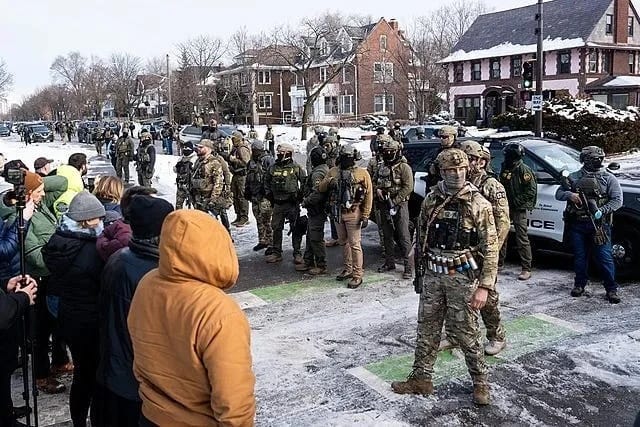
Historically, the National Guard has been deployed during natural disasters, riots, and emergencies. But in recent years, deployments have increasingly been used as political theater, a means of communicating who belongs and who does not. When Guard troops are sent into cities not because local officials requested them, but because Donald Trump wants to make a point about “law and order,” this crosses into the territory of state coercion aimed at civilian populations.
Communities of color feel this most acutely. The presence of armed soldiers on city streets is not neutral. It is a message. And for many residents — especially Black Americans whose grandparents lived through the era of state‑sanctioned racial terror — it is a message that echoes earlier forms of state intimidation. The uniforms are different. The legal justifications are different. But the emotional architecture—fear, uncertainty, the sense that the state is watching you rather than protecting you—is painfully familiar. When a government deploys military force domestically in ways that intimidate or suppress specific communities, this meets the criteria for state terrorism.
ICE and Border Patrol were originally designed as agencies focused on immigration enforcement at the border. But over the past two decades — and especially in recent years — their reach has expanded deep into the interior of the country. Raids at workplaces, apartment complexes, schools, and hospitals have created a climate of fear among immigrant communities, including U.S. citizens who “look foreign” or speak languages other than English. Brett Kavanaugh has opined that racial profiling is sufficient cause for stopping brown people, though he now realizes how bad that sounds and has tried to walk it back.
Somali communities have been particularly affected. In cities like Minneapolis, Somali Americans describe living under a form of perpetual surveillance, where federal agents appear at mosques, community centers, and apartment buildings. Scholars studying these patterns argue that when a state uses its security apparatus to create fear within a specific ethnic or religious group, the behavior aligns with the definitional criteria of state terrorism. The goal is not simply enforcement. It is deterrence through fear — a hallmark of terroristic governance.
One of the most powerful tools the federal government wields is money. When federal leadership threatens to withdraw funding from states, cities, or universities that refuse to adopt certain political positions, scholars describe this as a form of coercive governance. It is not violent in the traditional sense, but it employs the threat of harm—economic, institutional, and educational harm —to compel compliance.
When funding is withdrawn from universities that support diversity programs, or from states that refuse to enact specific immigration policies, the message is clear: align with federal ideology or face consequences. For transgender students, for Somali communities, for people of color, these funding battles are not abstract. They shape access to healthcare, education, housing, and safety.
When a state uses economic punishment to intimidate or marginalize specific populations, the behavior can fall under the broader umbrella of state terror, especially when the targeted groups are already vulnerable.
Transgender Americans are experiencing one of the most intense waves of state‑driven scrutiny in modern history. Laws restricting access to healthcare, bathroom access, sports participation, and public expression have proliferated. But beyond legislation, there is a deeper pattern: the use of state rhetoric to portray transgender people as threats, dangers, or corrupting influences.
When a government labels a minority population as inherently dangerous, it is a precursor to state terror. It creates a climate where violence — whether state‑driven or vigilante — becomes more likely. It also creates fear: fear of being stopped, questioned, denied care, or targeted by law enforcement.
For Black, Latino, Indigenous, and other communities of color, the relationship with state power has always been fraught. Police violence, discriminatory sentencing, surveillance, and economic disinvestment are not new. What is new is the federalization of these pressures — the use of national agencies, national rhetoric, and national policy to amplify local systems of control.
We are at a unique point in American history where, for all practical purposes, the president is the state. The thought of three equal branches of government is now a farce. Congress has abdicated its role, and the Supreme Court has embraced the unitary executive doctrine. The president, emboldened by the recently created absolute immunity for official acts, frequently ignores the Constitution and the law. One recent example is the failure to comply with the Jeffrey Epstein Transparency Act, which required the release of all documents by a date long since passed.
There are no checks and balances, and the president’s views determine federal government policy. If city or state officials disagree, he may withdraw federal funding or deploy the National Guard in their cities. Trump is ostensibly fighting crime, but he has yet to send troops to combat crime in Republican-led cities.
Those who historically experienced state terrorism knew it. The victims have always known it. Black Americans living under lynch law and Jim Crow knew it. Native nations forced into starvation knew it. Immigrant communities that are raided at dawn realize it.
And those facing state terrorism in the present know it. Protesters met with armored vehicles. The people who “don’t look like us,” who have been told for centuries that their safety is conditional and their citizenship negotiable, know it in their bones. When the Supreme Court allows voter suppression because only racist results were proven, and not racist intent.
A democracy that relies on terror — directly or through proxies — is not a democracy in crisis. It is a democracy in denial. And denial is how nations lose themselves. The question is no longer whether the United States has engaged in state and state‑sponsored terrorism. The record is clear. The question is whether we will continue to accept it as the cost of doing business, or whether we will finally confront the truth that a government cannot terrorize its own people and still claim to represent them. History will not judge us by what we say about freedom. It will judge us by whom we allow the state to fear, and whom we allow it to harm.