
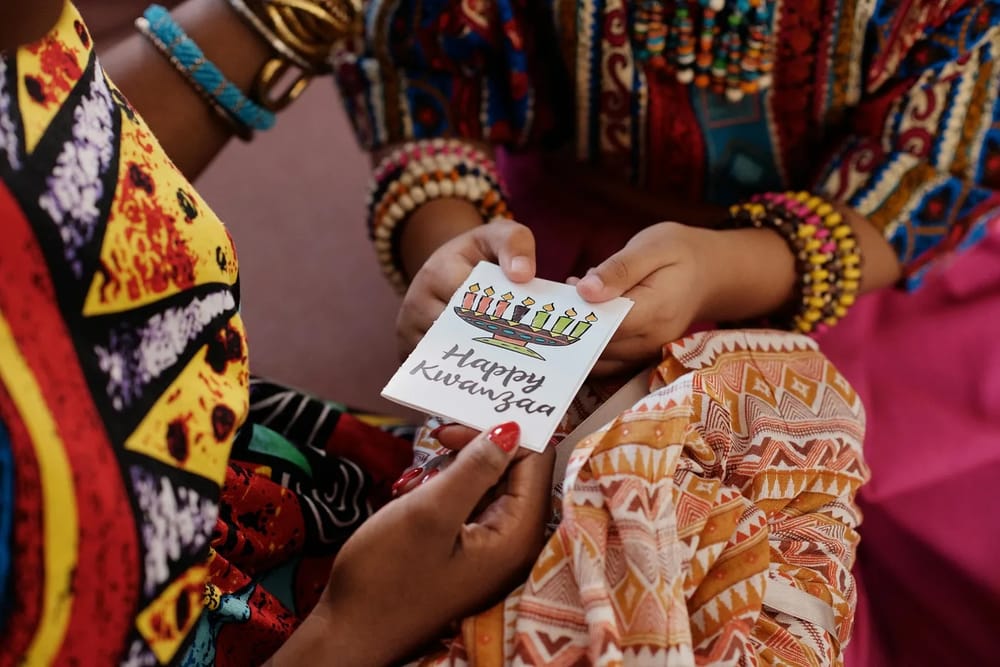
During the winter holiday season, people typically put work on the back burner, if they can, and spend time with their family and friends. People cook meals together, visit one another’s homes, listen to music, and exchange gifts. The mood is supposed to be festive and light-hearted. Yet, when it comes to racism, some people have no interest in taking any time off. At least that’s how it feels seeing them mock Kwanzaa, a holiday celebrating Black American culture. A post on the platform formally known as Twitter featuring Elmo, a Sesame Street character, the actor Michael B. Jordan, and others honoring the holiday last year, sparked backlash. In the video thumbnail, a wooden Kinara sits on a table, adorned with red, black, and green candles, and a gourd of vegetables representing a bountiful harvest. There’s also a Mkeka, a mat whose colors honor the heritage of Black people, their struggles and sacrifices, and their hope for the future. There was nothing provocative about the “H is for Holiday” special. Yet, some saw this moment as an opportunity to belittle Kwanzaa and those who celebrate it.
Consider, for instance, a statement made by Dale Partridge, an Arizona pastor. “They hate you and want your children to worship demons,” he said after seeing Jordan and muppets celebrating the holiday. Such a statement disparages Black people who celebrate Kwanzaa and portrays their cultural practices as not just different but threatening to children. Since it’s a cultural holiday, not a religious one, no deities were being worshipped here, for better or worse. Some laughed at the comment, finding it ridiculous that anyone would take issue with something so benign as a holiday celebration. It’s not like any of the characters wore horns, held a pitchfork, or asked viewers to bow their heads in prayer. But the racist accusation that Black people are worshipping demons is no laughing matter. In 1452, Pope Nicholas V granted the Portuguese permission to conquer and enslave non-Christian people in Africa, a decision that sparked a slave trade that spanned hundreds of years, subjugating millions of Black people. Celebrating Black culture isn’t hatred, and it’s unsettling that some think of it in this way, that they assume someone honoring their traditions is a slight against them.
Some of the resistance to Kwanzaa can be explained by the influence of white Christian Nationalism. If the post showed white children standing around a tree decorated with lights, opening presents instead of a Black person, and other characters celebrating Kwanzaa, it wouldn’t have provoked backlash. Christian nationalism is an extremist view, one that not all white Christians endorse. But it’s essential to understand the role this ideology plays in shaping public opinions about Black-centered holidays. A report by the Brookings Institution characterized Christian Nationalism as the belief that “the U.S. government should declare America a Christian nation,” that the nation’s laws should be “based on Christian values,” that “being a good Christian” is synonymous with being a good American, and that Christians should “exercise dominion over all areas of our society.” As relevant to this discussion, they believe that if we “move away from our Christian foundations, we will not have a country anymore.” This framework helps to explain why some people express frustration when they see Kwanzaa celebrated, why they feel so threatened by Black people having their own holidays.
At a Turning Point rally, Vice President J.D. Vance recently said, “By the grace of God, we always will be a Christian nation.” Of course, such a statement overlooks that America is actually a secular nation, but this rhetoric has become common among conservatives. However, this belief is inconsistent with federal law. The First Amendment to our Constitution guarantees citizens that “Congress shall make no law respecting an establishment of religion.” People should be free to choose which religious practices, if any, they engage in. However, white nationalists disagree that this country should be secular. And some are attempting to change that. For instance, the Oklahoma superintendent of public instruction issued a directive in 2024 stating that “schools are required to incorporate the Bible” in public schools for students in grades 5 through 12. Two weeks before this decision, Louisiana Gov. Jeff Landry signed a law requiring the Ten Commandments to be displayed in classrooms. There have also been efforts to introduce biblical references in Texas classrooms. These are just a few examples of efforts to prioritize Christian religious practices in publicly funded institutions.
Racism explains why some people see Kwanzaa as illegitimate. Celebrating this holiday is a reminder that Black Americans have unique experiences and traditions, and it’s bound to make some uncomfortable. While conservatives often refer to those whom they think are easily offended as “snowflakes,” some consider their use of the term ironic, given all the things that seem to get under their skin. Just a few years ago, a Black woman playing a mermaid sent some into a blind fit of rage. While their criticism didn’t stop the movie production or distribution, it subjected the actress and Black people across the board to racism from those who felt like Black people don’t belong, not even in fictional narratives.
In real life, Dr. Maulana Karena founded Kwanzaa in 1966 following the Watts Riots. It’s a week-long holiday lasting from the day after Christmas to the first day of the year. Each day presents an opportunity to reflect upon one of the seven principles, known as Nguzo Saba. The first day represents Umoja (unity), the second Kujichagulia (self-determination), the third Ujima (collective work and responsibility), the fourth Ujamaa (cooperative economics), the fifth Nia (purpose), the sixth Kuumba (creativity), and the seventh Imani (faith). During the holdiay, Black people are encouraged to spend time with one another in honor of their shared history and values. To celebrate, some host gatherings where people listen to music, dance, share meals, exchange gifts, and celebrate their shared history, values, and culture. Some assume that Kwanzaa is a replacement for Christmas. For some, it is. Author Michael Harriot has written on numerous occasions about his experience of growing up in a Black family that celebrated Kwanzaa but not Christmas. However, others celebrate the holiday alongside others.
Beyond the racist opposition to Kwanzaa, there is some controversy surrounding the holiday’s founder. While Dr. Karena denied the allegations, two women, members of a black nationalist group he founded, accused him of physically assaulting them. Testimony from the 1970 trial revealed they were “whipped with cords, beaten with batons, and seared with irons — while naked — in an effort to elicit confessions that they were conspiring against him.” This trial resulted in Karena’s conviction and prison sentence. Afterward, he earned his doctorate and taught. This case demonstrates how violence against Black women has, at times, undermined efforts to promote unity within the black community. Still, some feel his wrongdoing doesn’t entirely undo the positive impact of Kwanzaa. For instance, Chanté Griffin wrote in an LA Times op-ed, “Kwanzaa beckons us to the heights of our humanity, petitioning us to imagine ourselves and our communities in ways white American culture cannot and will not.” After taking a year off from the holiday, she began celebrating it again, saying, “My yearning for it is a sign that it fulfills its goals; it reminds African Americans of their crucial connections to each other.”
Rather than focusing on the real controversy surrounding the founder of the holiday and the problem posed by gendered violence in the modern era, some people express anger and frustration on a surface level. They’re upset that Kwanzaa exists, that it’s an unapologetically Black holiday, created by Black people for Black people. We see the same type of pushback against the federal holidays honoring Dr. Martin Luther King Jr., Juneteenth, and Black History Month. These days call upon us to reflect on the experiences of Black people. It stands to reason that those who harbor ill will toward Black people wouldn’t want these holidays recognized on a national scale. Those who feel uncomfortable talking about race are going to clutch their pearls every year that Kwanzaa exists. This may be triggered by seeing a happy Black family or group of friends in a poster, flier, or social media clip. By disregarding the significance of a holiday that celebrates Black people and those honoring other racial or ethnic minorities, some are asserting their social dominance.
While some may feel they have no personal connection to Kwanzaa, it’s privileged to suggest that any holiday you have no personal connection to isn’t worthy of celebrating. Just because something does not seem important to you doesn’t mean that it has no value to others. Calling holidays that center on Black culture “fake” and claiming they are illegitimate because some traditions are newer than others is a thin veil for racism. White Christian nationalism helps to shape public opinion in this country so much so that other traditions are often ridiculed and shunned. It’s a positive thing that some Black people enjoy celebrating Kwanzaa and passing that tradition on to younger generations. They’ve found a meaningful way to connect with those who share their identity, history, and culture. And this is a celebration that hurts no one. During a season when people should be spending time with family and friends, racists seem to have no interest in taking time off. It’s a reminder that racism is more than an expression of hatred toward another racial group; it’s an effort to maintain a racial hierarchy. Some are frustrated when they see Black people celebrating Kwanzaa because these traditions are a reminder of their fierce independence and perseverance.