
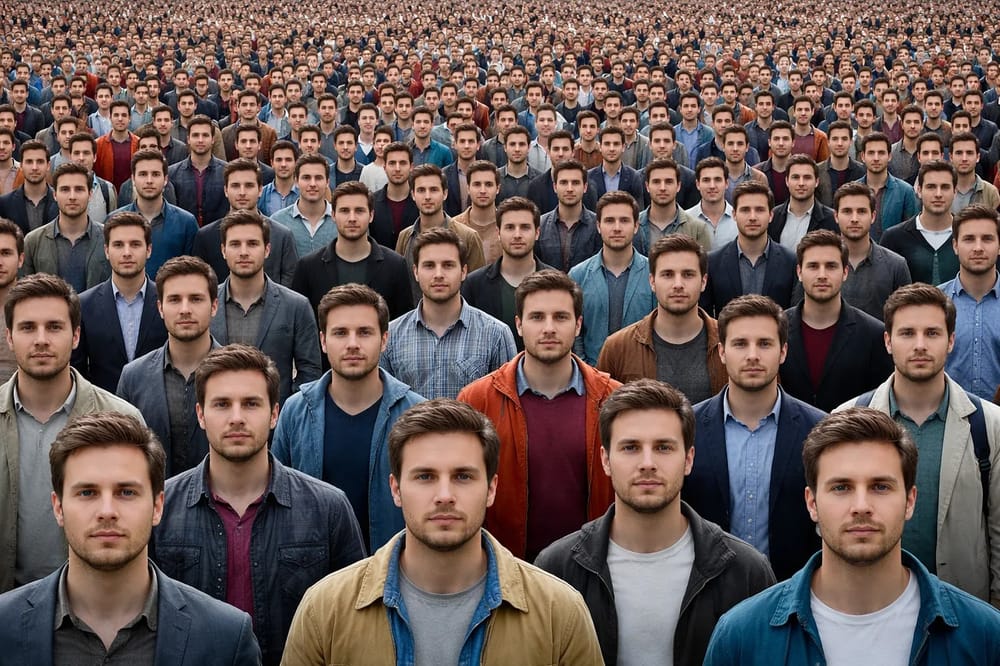
I’ve noticed a considerable uptick in the number of conversations where someone proclaims, “I don’t see race.”
The room relaxes and discussion stops.
The phrase sounds moral, generous, even enlightened. I just judge people by merit, the speaker assures everyone.
But this colorblind proclamation functions less as a solution and more as a conversation-ender. It essentially disqualifies discussions of race-related inequality by treating them as impolite, divisive, or already resolved.
The idea of colorblindness took root in post–Civil Rights America, when overt racism became socially unacceptable (sadly not so much anymore), but inequality stubbornly persisted.
Phrases like “We’re all human,” “I treat everyone the same,” and “Race doesn’t matter anymore” emerged as reactions against explicit bigotry.
Some even selectively quote Dr. Martin Luther King Jr. to support this notion, extracting his line about judging people by character while ignoring his far broader critique of economic and structural injustice.
Many people, good people I know and like, genuinely use these phrases to signal fairness rather than hostility. That sincerity matters. But good intentions still don’t guarantee good outcomes.
In fact, the opposite often occurs.
Colorblind language has the effect of erasing the lived very real experiences of Black Americans. While it purports to promote equality and a just society, it frequently invalidates experiences shaped by race and recasts racial awareness and identity itself as the problems, rather than the inequality being described.
We see this play out in real time.
When a Black employee raises concerns about being overlooked for a promotion despite qualifications, the response is often swift and well-meaning: “I don’t see race here.” The implication is clear. If race isn’t being “seen,” then it cannot be shaping outcomes, and therefore cannot be discussed.
What this response ignores, though, are racialized patterns.
Universal language appeals powerfully to our shared humanity. It sounds inclusive. Who could object to “we’re all human”? That’s why the right wing’s repeating this over and over again has strong appeal.
The problem isn’t the sentiment. The problem is the abstraction.
Equal moral worth doesn’t mean equal conditions. Even if we were treating everyone “the same,” in a society marked by unequal starting points, that often preserves inequality rather than correcting it.
Take healthcare as an example.
Discussions about wide racial disparities in maternal mortality or pain management are often met with assurances like, “Doctors treat everyone the same.” But data consistently shows otherwise. Black patients, and especially Black women, experience worse health outcomes even when controlling for income and education.
The CDC reports that Black women in the United States are nearly three times more likely to die than white women. Multiple peer-reviewed studies have found that Black patients are less likely to receive adequate pain treatment, a disparity not always just linked to a particular individual’s bad intent but to institutional norms and implicit assumptions.
Universal language allows the speaker to retreat into moral generalities while bypassing deeper structural critique. The insistence that “we’re all human” becomes a way to stop asking why outcomes are so uneven. The debate ends.
Colorblind language also merges seamlessly with meritocratic narratives. “Just work hard” sounds empowering, even inspiring. But it subtly re-defines inequality as individual failure. Essentially placing all the blame on the individual who wasn’t able to climb the ladder.
This ignores starting conditions, inherited advantage, and structural barriers that shape opportunity long before effort can matter. Of course effort matters.
Consider two students of equal ability.
One attends a well-funded school with advanced placement courses, counselors, and extracurriculars. The other attends an under-resourced school with overcrowded classrooms, a failing physical building and outdated materials. When their outcomes diverge, meritocratic language attributes the difference to effort rather than opportunity.
Research from the Department of Education, however, shows that schools serving predominantly Black and Latino students receive billions less in funding than those serving mostly white students, despite similar levels of need. Yet when achievement gaps persist, the explanation offered is rarely structural. It’s personal.
Meritocracy becomes moral cover. It converts systemic inequality into personal deficiency while preserving the appearance of fairness.
Colorblind phrases aren’t just nice ideas. They’re rhetorical tools.
They signal moral virtue (I’m not racist). They reposition the speaker as neutral (this isn’t about race). They shift the burden back onto the person raising inequality (why are you making this about race?).
The result? Silence replaces resolution.
It’s important to acknowledge why colorblind language is appealing. Conversations about race are usually very uncomfortable. People fear saying the wrong thing, being blamed, or being labeled unfairly. Harmonious language feels preferable to conflict.
Colorblindness offers emotional relief without requiring structural change. It allows people to feel morally upright while avoiding difficult conversations.
But silence only feels like peace to those not bearing the cost.
There’s a false choice in colorblind thinking. Either we see race and are causing division, or we don’t see race and are fair.
This is a mistake even good people make.
Seeing race doesn’t have to mean endorsing racism or hierarchy. It can mean acknowledging social reality. It can mean examining outcomes rather than intentions and replacing defensiveness with curiosity and a desire to correct.
Help me understand what you’re experiencing invites dialogue.
I don’t see race shuts it down.
Justice requires our thoughtfulness and attention. Not simply the nice idea of a colorblind world.