
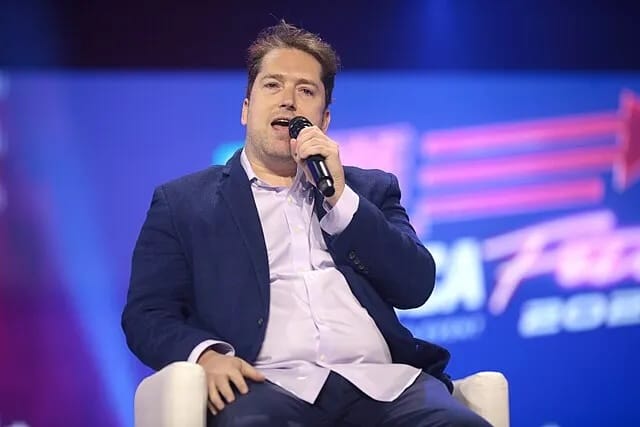
Imagine what it must have taken for a Trump official to be fired for making racist comments during the last Trump administration. Darren Beattie managed it. Beattie’s contract was terminated after he was found to have spoken at the 2016 H.L. Mencken Club conference alongside anti-immigration activist Peter Brimelow.
The H.L. Mencken Club calls itself an “organization for independent-minded intellectuals and academics of the Right.” It started in 2008 and was named after the American journalist who once described Jews as “plausibly…the most unpleasant race ever heard of” and an educated black person as being a “low-caste man” who will “remain inert and inefficient until fifty generations of him have lived in civilization. And even then, the superior white race will be fifty generations ahead of him.”
Previous speakers at the conference include alt-right figurehead Richard Spencer and writer John Derbyshire, who was fired from the National Review after he wrote an article for Taki’s Magazine in 2012 suggesting parents should warn their children about black people. The article included tips such as “If planning a trip to a beach or amusement park on some date, find out whether it is likely to be swamped with blacks” and “Avoid concentrations of blacks not all known to you personally.”
Lest you think that Beattie was simply one of the many Trump officials who claimed he didn’t know anything about the white supremacist groups they agreed to speak to. Beattie made his views clear a year ago, stating that white men should handle essential matters.
“Competent white men must be in charge if you want things to work. Unfortunately, our entire national ideology is predicated on coddling the feelings of women and minorities and demoralizing competent white men.”
You can’t keep a good racist down in an administration full of them. He wasn’t the least bit embarrassed after his firing.
“In 2016, I attended the Mencken conference in question and delivered a stand-alone, academic talk titled ‘The Intelligentsia and the Right.’ I said nothing objectionable and stand by my remarks completely. It was the honor of my life to serve in the Trump Administration. I love President Trump, who is a fearless American hero, and continue to support him one hundred percent. I have no further comment.”
Before joining the Trump administration, Beattie worked as a professor of political science at Duke University and openly supported Trump during his 2016 presidential campaign. Beattie said that Trump’s hard-line immigration policies were the main reason he backed him. His Ph.D. thesis was based on the teachings of Martin Heidegger, the German philosopher who was also a member of the Nazi Party. Trump appointed him to the Commission for the Preservation of American Heritage Abroad two years after his dismissal.
It was just announced that Beattie would be appointed to a top role at the State Department. White nationalist Steve Bannon was excited at the news.
“As important as his agency will be in the building at ‘Foggy Bottom,’ the symbolism of his hire by POTUS screams: ‘We Don’t Give 2 F****x’ for convention.’” — Steve Bannon
Beattie had led the right-wing news aggregator Revolver News for the last few years, often criticizing American foreign policy, including funding for Ukraine amid the Russian invasion.
Since October 2025, Beattie has been serving as the Senior Bureau Official at the Bureau of Educational and Cultural Affairs (ECA). This role places him in charge of major U.S. cultural diplomacy programs. Beattie was appointed by the Trump administration as the acting president of the U.S. Institute of Peace, while simultaneously continuing his State Department role.
This appointment is part of a broader restructuring effort in which the administration has sought to reshape or dismantle independent agencies. Beattie’s leadership at USIP has been described as controversial due to his history of inflammatory statements and his 2018 firing.
Recent 2026 reporting shows that Beattie is also involved in Brazil-related diplomacy. The Trump administration tapped him for a senior advisory role overseeing U.S. policy toward Brazil. Brazil’s former president Jair Bolsonaro — currently imprisoned — requested court approval for Beattie to visit him in March 2026.
Beattie’s return to power isn’t an anomaly — it’s a pattern. The Trump administration has never treated racist rhetoric as a disqualifier. If anything, it has often been treated as a credential. Stephen Miller is the clearest example: despite years of public criticism over leaked emails promoting white‑nationalist literature and nativist conspiracy theories, he wasn’t sidelined. He was elevated to become one of the most influential policy architects in the White House. The same dynamic played out with other figures whose comments drew widespread condemnation, yet whose careers advanced rather than stalled. Steve Bannon once commented that being called a racist was a badge of honor.
Beattie’s trajectory reinforces what the last decade has already shown. This administration doesn’t remove people after racist statements come to light — it promotes them. It rewards the very behavior that would end careers anywhere else. And in doing so, it makes clear that these aren’t isolated lapses or misunderstandings. They’re part of the governing culture, a feature rather than a flaw, and a warning about what kind of country this leadership is trying to build.