

The Supreme Court is entering into oral arguments about whether to get rid of birthright citizenship, the Fourteenth Amendment provision stating that people in almost every instance born in the United States are American citizens. Pundits, outside of Fox News and far-right-wing media, are generally skeptical that the Supreme Court would do away with the provision, long considered a bedrock principle. Some are betting that SCOTUS’s ultimate ruling, expected by late June or early July 2026, will be unanimous, because the Supreme Court would never reinterpret the Fourteenth Amendment.
History is full of examples of things people thought the Supreme Court would never do. These are a combination of decisions considered historically bad and others generally hailed that still produced results other than expected. Here are ten times the Supreme Court defied expectations and changed the American way of life.
- Dred Scott v. Sandford (1857): This is the case that the Fourteenth Amendment was supposed to cure. In his majority opinion, Chief Justice Roger B. Taney argued that Black people of African descent were not and could not be citizens of the United States under the Constitution. He claimed that at the time of the founding, they were regarded as an “inferior class” with “no rights which the white man was bound to respect.” Taney concluded that Dred Scott lacked standing even to bring a case in federal Court. Even advocates of enslavement didn’t expect SCOTUS to go as far as they did, legalizing a racial hierarchy. If SCOTUS in 2026 undoes the Fourteenth Amendment, are they suggesting a return to Dred Scott?
- Brown v. Board of Education (1954): That segregation would ultimately be declared unconstitutional was probably inevitable, but it wasn’t expected to happen in Brown v. Board of Education. Fred Vinson, a Truman appointee and former Treasury Secretary, was Chief Justice when the school‑segregation cases first reached the Court. Vinson died suddenly in September 1953, before the Court issued a ruling. At the time of his death, the Court was deeply divided, and Vinson was widely believed to be unable or unwilling to secure a majority to overturn segregation. President Harry Truman appointed Earl Warren as Chief Justice shortly after Vinson’s death. Warren immediately reframed the case, insisting that the Court speak with one voice. Under Warren’s leadership, the Court delayed decision, re‑argued the case, and ultimately issued a unanimous ruling in Brown v. Board of Education (1954). The decision wasn’t nearly as wide-ranging as history suggests, but it was definitely unexpected.
 William Spivey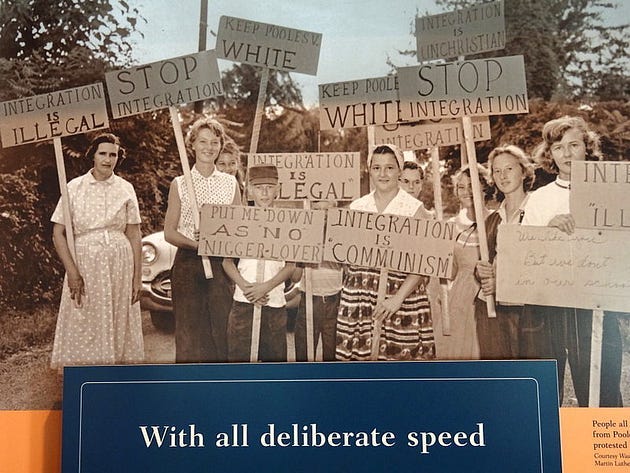
3. Roe v. Wade (1973): The Court was expected to rule narrowly on Texas law. Instead, it announced a nationwide constitutional right to abortion, surprising even many supporters. Roe established that the Constitution protects a right to privacy broad enough to include a woman’s decision to terminate a pregnancy, grounding that right in the Due Process Clause of the Fourteenth Amendment. In doing so, the Court:
- Invalidated abortion bans in most states overnight
- Created a national constitutional standard, replacing state‑by‑state regulation
- Introduced the trimester framework, limiting how and when states could regulate abortion
This was one of the most sweeping exercises of judicial power in Supreme Court history.
4. Bush v. Gore (2000): The Court’s direct intervention to halt a recount and effectively decide a presidential election was unprecedented and unexpected, especially given the Court’s traditional reluctance to enter electoral disputes. Given the Court’s direct intervention, which determined the result of a Presidential Election, are we certain this Court wouldn’t intervene in the 2028 election, or the 2026 midterms?
5. Citizens United v. FEC (2010): Observers anticipated a limited ruling. Instead, the Court overturned decades of campaign‑finance precedent, equating corporate political spending with protected speech, a shock to regulators and foreign observers. The majority held that the First Amendment prohibits the government from restricting independent political expenditures by corporations, just as it prohibits restrictions on individuals. SCOTUS equated corporations to people; nobody expected that.
6. NFIB v. Sebelius (2015): Nearly all predictions assumed the Affordable Care Act would be struck down—Chief Justice Roberts’ decision to uphold it under Congress’s taxing power stunned both sides. Many conservative lawyers, commentators, and activists were stunned. Court watchers had widely assumed that Chief Justice John Roberts would join the conservative bloc to invalidate the individual mandate. When he instead upheld it under Congress’s taxing power, some accused Roberts of betrayal, others claimed he had bowed to political pressure. A few openly questioned his legitimacy as a conservative jurist. Prominent conservative outlets initially misreported the decision as a loss for the ACA — a reflection of how unexpected the outcome was.
7. Obergefell v. Hodges (2015): The momentum favored marriage equality, but many expected a state‑by‑state outcome. The Court instead recognized same‑sex marriage as a constitutional right nationwide. Supporters of marriage equality reacted with jubilation. Crowds gathered outside the Supreme Court, waving rainbow flags. LGBTQ+ advocates described the ruling as a moment of long‑delayed recognition and dignity. For many couples, the decision meant instant legal security — marriages recognized nationwide, parental rights clarified, and benefits unlocked overnight. Those opposed to same‑sex marriage reacted with disbelief and outrage. Conservative leaders accused the Court of “judicial overreach.” Some governors and clerks initially resisted compliance. Religious liberty groups warned the decision would marginalize people of faith. Several dissenting justices echoed this reaction, with Justice Scalia calling the ruling a threat to democratic self‑government. Legal scholars suggest there is no realistic path to reversal, which gave the ruling a sense of permanence even amid backlash. Clarence Thomas, however, has often suggested revisiting Obergefell; it may not be over.
8. Trump v. Hawaii (2018): Given campaign statements and lower‑court rulings, many expected the travel ban to be invalidated. The Court’s decision to uphold it surprised civil‑liberties advocates and foreign governments. The case challenged Presidential Proclamation 9645, issued in September 2017, which restricted entry into the United States for nationals of several countries. The plaintiffs argued that the policy violated the Establishment Clause of the First Amendment, federal immigration law, and equal protection principles
They pointed to Trump’s campaign statements calling for a “total and complete shutdown of Muslims entering the United States” as evidence of discriminatory intent.
The Supreme Court upheld the third iteration of the travel ban, which applied restrictions to nationals from Iran, Libya, Somalia, Syria, Yemen, North Korea and Venezuela (limited to certain officials).
The inclusion of non‑Muslim‑majority countries was central to the administration’s argument that the policy was based on national security, not religion.
9. Dobbs v. Jackson Women’s Health Organization (2022): While restrictions were anticipated, the Court’s complete reversal of Roe v. Wade, eliminating a half‑century‑old precedent, shocked much of the world. Court watchers widely predicted the Court would uphold Mississippi’s 15‑week ban. Many expected the Court to weaken Roe without killing it. A narrow ruling modifying the “viability” standard was considered the most likely outcome. Even conservative legal scholars assumed the Court would avoid outright reversal to preserve institutional legitimacy. Instead, the Court explicitly overturned Roe v. Wade and Planned Parenthood v. Casey. It declared that the Constitution confers no right to abortion. The Court returned full regulatory authority to the states. No one expected total repudiation of Roe v. Wade, but it happened.
10. Trump v. United States (2024): In this case, the Supreme Court held that presidents are immune from criminal prosecution for official acts, marking the first time the Court recognized criminal immunity for presidential conduct. It may take decades to unravel the crimes committed by the current president, along with impunity, given that he knows he is immune to prosecution. We can only hope this decision is overturned.
These ten cases remind us that the Supreme Court is far less predictable than the commentary surrounding it. We are asked to believe that Justices simply follow the law, setting aside ideology, even as voting blocs harden and outcomes align with political power. Surprise, in this system, is not a malfunction — it is how authority is exercised without admitting it.
As I write this, I am listening to oral arguments in the birthright citizenship case. For the first time in American history, Donald Trump has appeared at the Supreme Court not as a petitioner seeking relief, but as a political figure hoping to influence the Court itself. Courts are not meant to be stages, and Justices are not meant to be audiences.
History shows that the Court’s most shocking decisions arrive when confidence is highest — when precedent feels settled and we are told there is nothing to fear. Many of those decisions did not occur in some distant past. They happened recently, under the same assurances of neutrality and restraint we hear today. The lesson is not that the Court is unpredictable. It is that power, once insulated, becomes bold. And when the Supreme Court surprises us, it is rarely because it has lost its way; it is because it has chosen one.
Food for Thought
These ten cases remind us that the Supreme Court is far less predictable than the commentary surrounding it. We are asked to believe that Justices simply follow the law, setting aside ideology, even as voting blocs harden and outcomes align with political power. Surprise, in this system, is not a malfunction — it is how authority is exercised without admitting it.
As I write this, I am listening to oral arguments in the birthright citizenship case. For the first time in American history, Donald Trump has appeared at the Supreme Court not as a petitioner seeking relief, but as a political figure hoping to influence the Court itself. Courts are not meant to be stages, and Justices are not meant to be audiences.
History shows that the Court’s most shocking decisions arrive when confidence is highest — when precedent feels settled and we are told there is nothing to fear. Many of those decisions did not occur in some distant past. They happened recently, under the same assurances of neutrality and restraint we hear today. The lesson is not that the Court is unpredictable. It is that power, once insulated, becomes bold. And when the Supreme Court surprises us, it is rarely because it has lost its way; it is because it has chosen one.