
Thomasville, North Carolina, is a small city in central North Carolina, in Davidson County, in the Piedmont region. It sits between Charlotte and the Greensboro–Winston-Salem metropolitan area along the Interstate 85 corridor. Since I’ve driven that stretch, I’ve passed by Thomasville, but I don’t remember doing so. Thomasville has approximately 27,000 residents. Its racial and ethnic composition is about 59% white, 20% Black, and 17% Latino, with most of the rest sharing two or more backgrounds. Compared to America as a whole, Thomasville is slightly more Black and slightly less Hispanic, with its white population mirroring the nation.
East Davidson High School and Thomasville High School are both in the same city and county (Davidson County) but are in different school districts. Davidson County has three school districts; if you’re wondering why, part of the answer is segregation. North Carolina has always allowed incorporated cities to have their own school districts.
The three systems are:
- Davidson County Schools
- Thomasville City Schools
- Lexington City Schools
Davidson County Schools serve a mostly white population with a growing number of Hispanics, while the other two districts have a combined majority of Black and Hispanic students.
North Carolina historically allowed incorporated cities to maintain their own independent school systems rather than automatically placing every public school under countywide control.
Thomasville and Lexington developed separate city school systems. Those systems continued to exist alongside Davidson County’s school system as the county grew. State law recognizes both county and city administrative school units, each with its own school board and superintendent.
The racial segregation issue
The history becomes more consequential when you examine what happened during the civil-rights era. A 2015 investigation by EducationNC, drawing on research from the UNC Center for Civil Rights and Duke University, documented that the three districts had very different racial compositions.
The Thomasville and Lexington systems serve a disproportionately large share of the county’s Black and Hispanic students, while the county system was overwhelmingly White.
Another important historical detail: In 1955, the North Carolina General Assembly authorized the transfer of two predominantly Black schools from the county system to the Thomasville city system. EducationNC’s investigation identifies that action as contributing to the racial separation that persisted in the county’s school systems.
The boundaries themselves became part of the problem
The 2015 EducationNC investigation found that the school district boundaries did not simply follow the municipal boundaries. For example, Thomasville City Schools served the city’s more densely populated central areas, which had larger Black and Hispanic populations, while some predominantly White neighborhoods in the northern and southern portions of Thomasville were assigned to Davidson County Schools.
The investigation also cited a 2013 Duke University study that found Davidson County had the second-most segregated schools in North Carolina at that time.
More recently, a North Carolina Justice Center report, Still Stymied, again identified Davidson County as an example where multiple district boundaries exacerbate racial segregation. It described the two city districts as primarily serving students of color while the county system remains overwhelmingly White.
Why this matters to the East Davidson–Thomasville soccer story
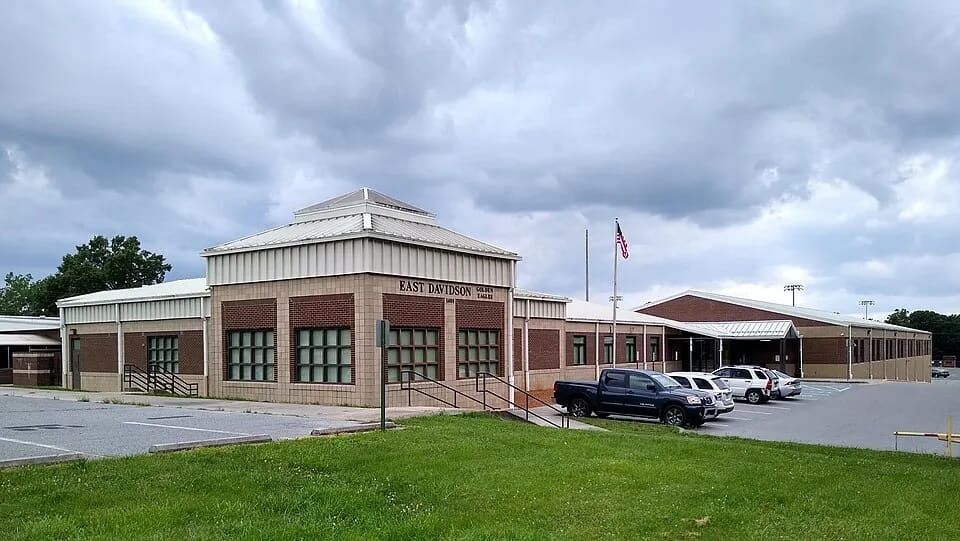
This history provides a much broader context for the incident involving the East Davidson soccer team. East Davidson belongs to Davidson County Schools, the historically predominantly White system. Thomasville High belongs to Thomasville City Schools, which has a substantially larger Black and Hispanic enrollment. The two schools compete against each other, but they are part of separate educational systems shaped by a history of racial separation.
Segregation played a significant role in shaping Davidson County’s three-school-district arrangement, particularly after the Supreme Court’s 1954 Brown v. Board of Education decision. The important historical distinction is that the three systems did not all originate as a single plan to segregate students. However, decisions made during the struggle over desegregation helped preserve and deepen racial separation among them.
In fact, Davidson County provides a particularly revealing example of how school-district boundaries could be used to maintain segregation even after legally mandated racial separation in public schools had been declared unconstitutional.
Separate city school systems existed before desegregation
Thomasville and Lexington had their own city school systems, separate from Davidson County’s countywide system. These arrangements reflected North Carolina’s longstanding practice of allowing incorporated cities to operate independent school districts.
Consequently, separate systems were not proof that they had originally been created for racial reasons. But once the Supreme Court ordered public schools to desegregate, having multiple independently governed systems created opportunities to maintain racial separation through district boundaries, school assignments, and administrative decisions.
The 1954 Brown decision created a new challenge for segregationists
In May 1954, the Supreme Court ruled unanimously in Brown v. Board of Education that racial segregation in public schools was unconstitutional.
Rather than integrating schools immediately, many North Carolina political leaders sought ways to delay or avoid compliance.
Governor Luther Hodges supported what became known as the Pearsall Plan. Adopted in 1956, it gave local authorities considerable power over student assignments and allowed public schools to close rather than integrate under certain circumstances. It also provided financial assistance for white students who left public schools facing integration. The Supreme Court eventually declared the plan unconstitutional in 1969. The broader strategy was to retain local control over school assignments rather than allow integration to proceed through a statewide system.
The 1955 Thomasville school-property transfer
One of the most important developments in Davidson County occurred in 1955. The North Carolina General Assembly passed legislation authorizing the Davidson County Board of Education to transfer ownership of two school properties in Thomasville — Kern Street School and Church Street School — to the Thomasville City Board of Education.
The legislation itself identifies the properties and authorizes the conveyance. It does not explicitly mention race. However, an investigation published by EducationNC in 2015, drawing on research by the UNC Center for Civil Rights, identifies these as two predominantly African American schools and describes the transfer as a decision that further entrenched racial segregation in the county’s school systems.
District boundaries helped preserve racial separation
Another important part of the story involved the geographic boundaries separating the three systems. In 1959, the General Assembly passed legislation establishing that the boundaries of the Thomasville City administrative school unit would correspond to the boundaries of the city itself.
Over time, the relationship between municipal growth, school-district boundaries, and residential demographics contributed to very different student populations in the three systems.
EducationNC’s 2015 investigation found that Thomasville City Schools served the more racially diverse central portion of Thomasville, while predominantly White areas in the northern and southern portions of the city were outside its school district. The investigation concluded that district boundaries had also been altered in ways that increased racial segregation.
Athletic Teams Cross Racial Boundaries
The East Davidson High School soccer team, which I will refer to later as the white school (with a growing Hispanic population), was scheduled to play 22 regular-season games. The Davidson County School Board, the white school board, has eight high schools, meaning they must schedule teams outside the district to complete their schedule. Nearby Thomasville High School, the Black and Hispanic school, was scheduled twice. The first time, the white team won at home, 3–1, on October 5, 2026, and the game concluded without incident. The rematch was held at the Black/Hispanic school, with the white team taking a school bus to the match.
This time, the home team won 4–3, and on the ride home, players on the bus broke into a chant, which was repeated multiple times:
“Attention, Everybody! Make Noise if You Hate Niggers!”
https://x.com/SeeRacists/status/2115608408024043764/video/1?t=8
Many, if not all, of the players made noise. The white school’s soccer team has listed eight players with what appear to be Hispanic surnames. The video did not show any Black soccer players on the squad from a school with a 3% Black population. The racist chant might have gone unnoticed, just another thing that happens when a white school loses to a diverse school in an era when segregation has been lessened but still exists. The problem was that someone captured the racism on video, and it got out beyond the intended audience.
To their credit, the white school board acted quickly. The white team was 17–4 at the time, with one regular-season game remaining. The final game was forfeited, and the team lost its spot in the state playoffs they’d already qualified for.
Davidson County Schools Superintendent Dr. Gregg Slate condemned the behavior, saying it “was inconsistent” with the district’s expectations of respect, inclusion, and responsibility. He emphasized that students are expected to demonstrate appropriate conduct not only in classrooms but also in athletics and other school-sponsored activities. East Davidson principal Jennifer Woodrum also condemned the behavior.
On October 28, the school announced that it was ending the varsity soccer season immediately. Its statement said:
“The behavior depicted in the social media post is unacceptable and does not reflect the standards we uphold at East Davidson High School.”
I’m thinking that if you operate what is basically a segregated school, isn’t it an exact reflection of your values?
My years of playing high school sports suggest that when a team travels by bus, the coaches are on the bus as well. What kind of environment exists where kids feel comfortable acting that way in front of their coaches with no fear of retribution?I wonder if the Hispanic members of the team considered what the white kids must say about them behind their backs?
The NAACP thanked the administration for its response and encouraged residents to consult Davidson County Schools’ Policy 4310, which addresses the district’s expectations concerning student conduct.
The organization’s response emphasized that the incident affected more than the individuals shown in the video. It affected the broader school community, including Black students and families who had to confront the implications of seeing classmates participating in a racist chant.
Threats and additional controversy
The incident raised another concern when threatening social media posts directed at East Davidson High School reportedly appeared after the video circulated. The Davidson County Sheriff’s Office confirmed that it was investigating those threats.
It is tempting to dismiss what happened on the East Davidson soccer team’s bus as the thoughtless behavior of a few teenagers who should have known better. Teenagers make mistakes, sometimes serious ones, and those responsible should be held accountable. But stopping there would ignore the larger question raised by this incident: Where do young people learn to regard racial hostility as acceptable, or even something worth celebrating?
East Davidson and Thomasville High School are separated by little more than a few miles, yet their student populations reflect two very different educational environments. They belong to separate school systems in the same county, systems whose histories include decisions that helped preserve racial segregation long after the Supreme Court declared segregated public education unconstitutional. Those divisions are not merely historical footnotes. They remain visible in today's school demographics.
And this is happening at a time when efforts to teach the history of racism, acknowledge racial inequality, and promote diversity and inclusion in public education have increasingly become political targets. The national campaign against DEI initiatives sends its own message about whether racial differences should be acknowledged, whether historical discrimination deserves attention, and whether schools have a responsibility to prepare students to live in a diverse society.
It would be unfair to claim that the East Davidson students were repeating a particular political message or that separate school districts caused their behavior. No evidence establishes that connection. But it is equally simplistic to treat the incident as though young people develop their attitudes in isolation from the communities, institutions, and political climate surrounding them.
So perhaps the question is not simply whether a few East Davidson students behaved disgracefully. It is whether their behavior reflects a larger failure to confront the racial divisions that continue to shape their schools and communities. When students attend separate schools with dramatically different racial compositions, when the history behind those divisions receives insufficient attention, and when teaching about diversity and racial discrimination becomes a political controversy, what lessons are young people taking away?
Canceling a soccer season may punish a team, but it cannot answer those questions. Nor will it change the attitudes that produced the incident. That requires something more difficult: confronting the history of segregation, acknowledging the divisions that remain, and teaching young people that racial equality is not a political slogan or an optional educational priority. It is a fundamental responsibility of a public school system.