
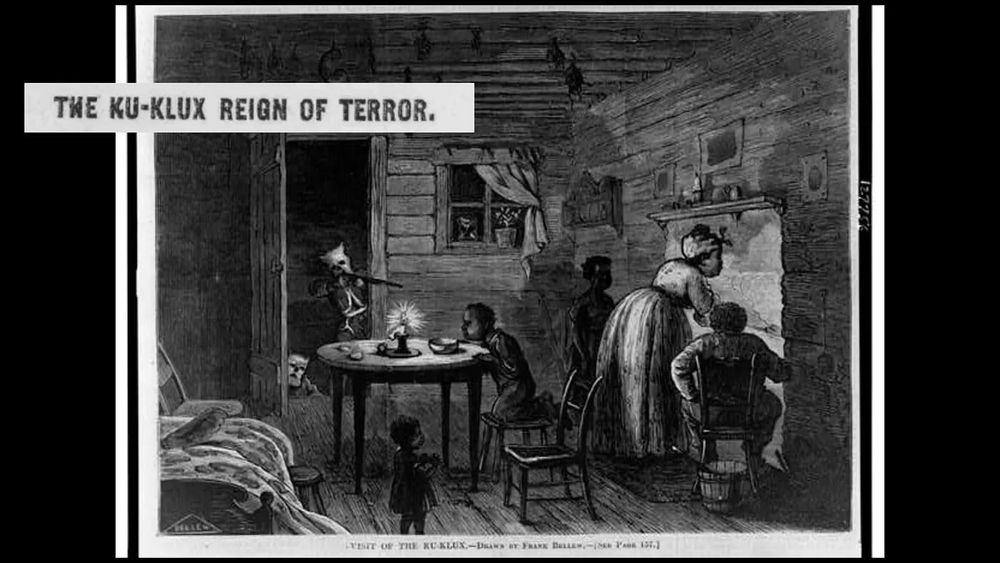
InAmerica, even a simple piece of attire — white sheets fitted into a robe and a masked hood with eye holes cut to see but not be seen — is enough to provoke a deep sense of dread among Black Americans. Former Confederates founded the Ku Klux Klan in 1866, and in the decades that followed created a legacy of violence. Klan members “committed uncounted murders, bombings, kidnappings, and assaults, as well as innumerable acts of intimidation and threats, including night riding and cross burning, all in the name of white supremacy and preserving white rule.”
The image of the Klan robe is just as jarring to a Black American as the Nazi symbol is to the European Jew or the Israeli flag is to a Palestinian, for that matter. Because whenever a group of people is systematically targeted by another group, the cultural tapestry surrounding that oppression is seared into their collective consciousness. Still, while many are familiar with the Klan, few have given much thought to the clothing members wore. Anonymity was of the utmost importance to Klansmen, especially the prominent ones. Over time, their ghastly disguises became associated with racial violence. But why white sheets?
Early Klansmen portrayed themselves as the wandering spirits of Confederate soldiers, often referencing their deaths at the Battle of Shiloh in April 1862 in Tennessee and other high-casualty battles, and claimed they were thirsty while pretending to drink a large bucketful of water. Initially, not all of them wore white hooded robes. Throughout the 1860s, Klansmen wore gowns dyed white, black, blue, or red. Some even wore animal horns, fake beards, and other disguises, such as pillowcases, flour sacks, burlap sacks, and even dresses turned inside out.
The Birth of a Nation, a film that premiered at the White House, popularized the image of Klansmen wearing white sheets and portrayed members as honorable, while Black people, in contrast, were depicted as simple-minded and superstitious, making them easy to fool. Of course, the irony is that most Black Americans didn’t fall for this trick and knew they were dealing with flesh-and-blood ghouls. For decades, the Klan used violence to subjugate Black people throughout the South, blocking their access to the ballot box, limiting economic opportunities, and depriving their children of equal access to an education. The consequences were undeniably real.
Abram Colby, the son of an enslaved woman and a white landowner, who served as a Georgia legislator, gave testimony in 1872 about the Klan violence he endured. He said some of the men who attacked him were “first-class men in our town. One is a lawyer, one a doctor, and some are farmers.” While those who participated in the attack varied in socioeconomic status, they shared a belief in white supremacy. “These Klansmen whipped him with sticks and straps with buckles on the ends, which caused him great pain.” Initially determined to claim his slice of the American pie, he saw the dream of being treated equally die when the Klan “peppered the house with shot and bullets,” causing him to leave town quickly before the election and abandon future efforts. Sadly, this experience became commonplace.
In another example, Rev. Elias Hill, a Baptist minister in York County, South Carolina, who served as president of the local Union League, stated that whippings by Klansmen made colored people in the area “so alarmed that they did not sleep in the houses at night.” As a result of this domestic terrorism, Black people were too fearful to hold a meeting, as they “fear being killed, because some have been shot.” The violence became so routine that many felt they had no refuge. Members of the Klan also brutally beat Harriet Hernandez and her husband after they rented land in South Carolina, and she “withdrew from domestic labor.” When asked what they feared, she said, “being killed or whipped to death.”
The violence of the Ku Klux Klan brought an unceremonious end to the Reconstruction Era, sunsetting the nation’s commitment to addressing racial inequalities produced by slavery. In 1871, hundreds of White men gathered near a South Carolina county jail and kidnapped and lynched ten Black militia members. This wave of violence was so unruly that President Ulysses S. Grant suspended habeas corpus and launched an investigation. Federal officers discovered that every single White man in York County, South Carolina, was a member of the Klan. They sought to oust every duly elected Black man from office and to restore an all-white government.
The 1873 Colfax Massacre in Louisiana was the bloodiest event during the Reconstruction Era. It’s estimated that Klan members and other non-affiliated Confederate veterans killed between 50 and 150 Black men who were defending local officials under threat. In the following year, members of the White League, another white nationalist group engaged in political violence, killed 6 White elected officials and 20 Black freedmen in the Coushatta Massacre. According to the Equal Justice Initiative, 6,500 racial terror lynchings were documented between 1865 and 1950.
Given the Ku Klux Klan’s history in America, it’s concerning that some trivialize the harm caused. Some wear a Klan robe to provoke shock and awe, while others seem to openly promote racism against Black people. Consider, for instance, that in El Paso, Texas, a group of white boys was recently seen marching in an Eastside neighborhood, dressed in full Ku Klux Klan regalia. What started as a Halloween party at a private residence turned into a public spectacle when they made their way down the street, and neighbors witnessed them chanting “We hate n*ggers” and other hateful rhetoric. Whoever said time heals all wounds never knew what it was like to be Black in America.
White supremacists wear hooded white sheets for two reasons. For one, most White people do not want to be associated with the group’s blatant racism and instead prefer to maintain plausible deniability. Wearing a mask helps them to achieve that goal. Secondly, white hooded sheets with crudely cut eye holes became a symbol of systemic violence against Black Americans. The atrocities committed by Klansmen since 1866 left a lasting impact on the nation, transforming an otherwise benign piece of white cloth into a symbol of terror for Black Americans.