
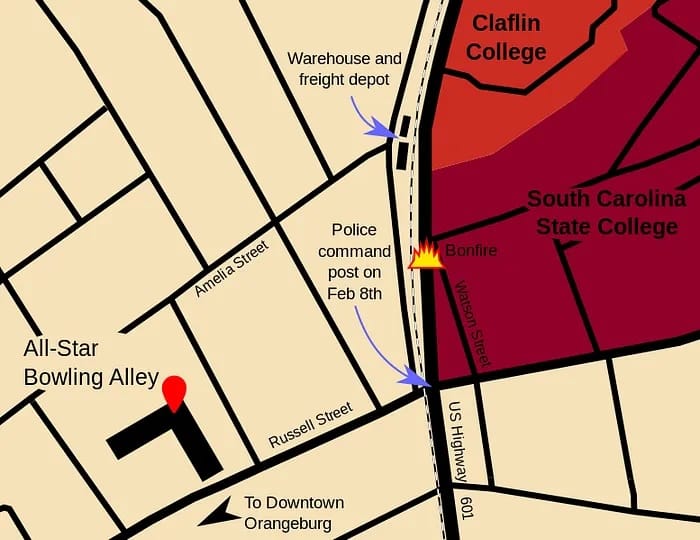
The 58th anniversary of the Orangeburg Massacre just passed (February 8, 1968), and most Americans aren’t aware it ever happened. Most adults know of the Kent State shootings in 1970, during which the National Guard killed four students on the campus. A much smaller percentage know of the killing of two Jackson State students by local police and state troopers in Mississippi. Few know of the Orangeburg Massacre; Three students were killed, and another 28 were wounded when police opened fire on students who were gathered around a bonfire on a college campus.
To fully appreciate what happened, you have to understand Orangeburg, South Carolina itself. Europeans settled in the area in 1704 to establish a fur trading post with Native Americans. In 1735, 200 Swiss, German, and Dutch immigrants formed a community near the banks of the North Edisto River. The river provided a link to the port of Charleston, allowing for the export of timber and agricultural products.
The invention of the cotton gin in 1793 changed the way of life in and around Orangeburg. Large cotton plantations took over the area with the labor provided by enslaved Black people. Charleston was still the largest port in the country receiving Africans during the Trans-Atlantic Slave Trade; when that ended in 1808, domestic-bred enslaved people were forcibly migrated to Orangeburg. The Black population far exceeded that of white people. Whites maintained control through the use of slave patrols, which were invented in the Carolinas. When Denmark Vesey’s plot in 1822 to overthrow Charleston became known, it added to the pressure to control the Black population in Orangeburg, just 75 miles away.
The Civil War changed Orangeburg in several ways. A private college, Claflin College (now Claflin University), was established in 1869 to educate freedmen and their children. A separate school within Claflin College was established in 1872 in compliance with the 1862 Land-Grant Act. That was the South Carolina Agricultural and Mechanical Institute, which later became South Carolina State University (SCSU). SCSU was the sole state institution of public higher education for Black people in South Carolina.
Claflin was next door to SCSU, and students often mingled at social events and combined efforts on political issues. Slave patrols evolved into police departments, and enslavement became Jim Crow, but in many ways, Orangeburg hadn’t changed until the Civil Rights Movement, beginning in the mid-1950s.
The population of Orangeburg is currently just over 13,000. The combined student population of Claflin and SCSU exceeds 4,500, and the town is more than 75% Black. Orangeburg became the center of South Carolina’s efforts to desegregate. In 1960, students led a sit-in at the S.H. Kress & Co. department store lunch counter that refused to serve Black people. Over 1,000 students marched in a boycott of segregated stores, sometimes leading to police violence when students refused to disband. In February 1968, students focused on the All-Star Bowling Lane, just a few blocks from the campuses whose owners refused to desegregate.
In 1968, all political and economic power outside of the colleges in Orangeburg was in the hands of white people. SCSU was a state institution overseen by white politicians and mostly white trustees. White Methodists founded Claflin, and it was still dependent on their financial support, so they both had to be considerate of white feelings. In February 1968, a Black student who was a Vietnam War veteran was denied access to the bowling alley, setting off a new round of protests. Students leaned on the 1964 Civil Rights Act and the fact that the bowling alley operated a public restaurant to make their case for access. The owners didn’t care.
The daily protests grew to 300 students until police broke them up, severely beating two Black women involved in the demonstrations. Students smashed the windows of some white-owned businesses as they were forced back to campus. By late evening, eight tanks and over 100 lawmen surrounded the campus, and another 450 National Guard officers were stationed in nearby downtown.
About 200 students were gathered around a bonfire on the South Carolina State campus. A fire truck with an armed escort was sent in, and without warning, shots were fired by police, resulting in the deaths of three students and wounding 28 more. Most of the students were shot in the back as they attempted to run away.
The governor said shots came from the campus, but an AP photographer on the scene denied the claim. Only nine officers were charged, and all were exonerated in a 1970 trial. One Black man was convicted on charges related to the protests at the bowling alley after they found no evidence of a crime in the shootings. Cleveland Sellers, a native South Carolinian and civil rights activist, was accused of inciting the riot. “Black Power” was labeled as the ultimate reason for the murders, with an “outside agitator” causing all the disruption.
The 58th anniversary of the Orangeburg Massacre was marked with a formal remembrance program, social justice awards, a torch‑lighting ceremony with the victims’ families, and the reopening of Bulldog Lanes — the bowling alley whose segregation sparked the original protest. Only one state in America mentions the Orangeburg Massacre in its official K-12 social studies curriculum, and that’s South Carolina, where it occurred.
The Orangeburg Massacre is one of the most overlooked civil rights tragedies in American education, which is just how the Trump administration, with its aversion to Black history, likes it.