
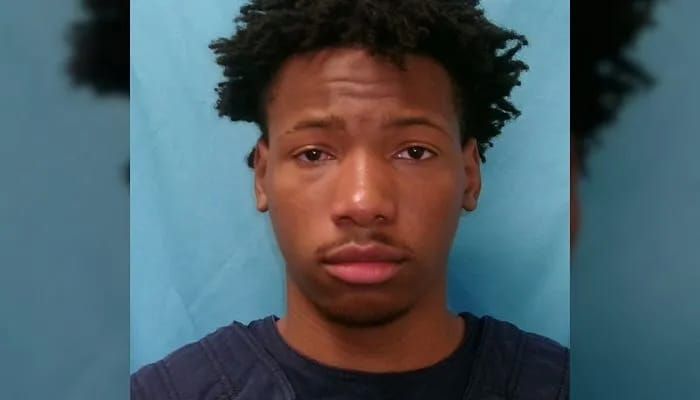
New information is coming out that we never saw during the Karmelo Anthony trial. It wasn’t as if it wasn’t known. The prosecution team and the defense attorneys, all white, decided to exclude the material because it might prove inflammatory in what was already going to be a heated trial. Some of the material made Karmelo Anthony look worse. He was allegedly stalking his ex-girlfriend, and he’d texted a photo of the knife, legal to carry in Texas, eventually used to kill Austin Metcalf. Right-wing media is running with the new information about Anthony, portraying him as a violent thug who deserved the guilty verdict in his murder trial.
What is barely covered is the material about the victim, showing he’d been “accused of spray-painting racist messages and engaging in threatening conduct.” Metcalf had been accused of more than that, but that's for later.
Anthony, now 19, was convicted of murder on June 9, 2026, and sentenced to 35 years in prison for the fatal stabbing of 17-year-old Metcalf at a Frisco high school track meet on April 2, 2025. The verdict arrived in under three hours. The jury was not all-white, but all potential Black jurors had been excluded before trial. At the trial, the jury pool had been whittled to 18 jurors, of which 12 would be jurors and 2 alternates. The prosecution used its final three challenges to eliminate the three remaining Black jurors. The defense challenged their removal. The prosecutor gave the excuse that the three Black people were educators and, therefore, had interaction with children. They argued that people who work with youth might be more lenient toward a teenage defendant.
The defense immediately challenged this explanation because a white educator was allowed to remain on the jury. If “educators are too sympathetic” was truly the reason, then all educators should have been struck. But prosecutors struck only the Black educators, not the white one. The defense argued that the “educator” rationale was a pretext for racial exclusion. The jury was told, by attorneys on both sides, that race had nothing to do with what happened beneath the Memorial High School tent on that rainy spring afternoon. Race, it turns out, may have had quite a bit to do with it. It just never made it into the courtroom.
The narrative the jury received was clean and prosecutable. Two teenagers, strangers to each other, ended up beneath the same tent. One belonged there. The other was from a rival school. Words were exchanged. A shove occurred. A knife appeared. The confrontation lasted under thirty seconds. The white teenager died.
Prosecutor Bill Wirskye distilled his theory to a single declarative sentence: “You don’t get to meet a shove with a stab, especially if you provoke the shove.” The defense, led by Mike Howard, countered that Metcalf had no legal right to put his hands on Anthony, and that Anthony’s belief that he needed to defend himself was sincere. Anthony had told the arresting officers: “He put his hands on me. I told him not to.”
That self-defense framing of a Black teenager claiming the right to respond to a white teenager’s physical aggression — sits at one of the most statistically treacherous intersections in American criminal law. A 2021 Everytown for Gun Safety study found that homicides are ruled justified more often, in nearly every state, when the killer is white, and the victim is Black. Research from the Urban Institute put precise numbers to that disparity: when the killer is Black and the victim is white, the killing is ruled justified in just over one percent of cases. When the racial dynamics are reversed, that figure rises to 11.4 percent. Karmelo Anthony was, before a single piece of evidence was introduced, swimming against a current that powerful. But he was also swimming without a life jacket that his own attorney had agreed to set aside.
During a new-trial hearing in August 2026, before visiting Judge Michael B. Chitty — who had replaced trial Judge John Roach Jr. after Roach gave post-verdict media interviews that raised questions about his impartiality — Anthony’s appellate attorney Russell Wilson described something he said he had rarely encountered in a murder case.
“I don’t know that I’ve seen a murder case with this much off the record stuff,” Wilson told the court. What had been off the record, it emerged, was substantial. Prosecutors and Howard had reached an unwritten agreement — never formally placed before the court, never approved by the defendant in any documented on-the-record colloquy — to exclude character evidence about both teenagers. The stated rationale was sensible enough on its face: the case had already exploded across social media in racial terms, and both sides believed that introducing the backgrounds of the two teens would turn the courtroom into a referendum on race in America rather than a focused examination of what happened on April 2.
The agreement worked as designed. Race, as a formal evidentiary matter, stayed out of the courtroom. Both sides honored the deal. The jury was shielded from inflammatory material. And Karmelo Anthony was convicted of murder.
What Wilson now argues — and what the new-trial hearing has forced into open court — is that the deal protected both sides’ strategic interests while gutting Anthony’s only viable defense. Because the agreement, by excluding character evidence symmetrically, was not actually symmetrical. The excluded evidence about Metcalf was directly relevant to whether Anthony’s fear of him was reasonable. The excluded evidence about Anthony was only relevant to undermining him on cross-examination. The agreement traded Anthony’s most powerful defense card for a shield he never asked for.
What the Files Contained
The files that never reached the jury told a different story about Austin Metcalf than the one presented to the public in the year between his death and the trial.
The most significant item was a juvenile court record from Denton County. Austin Metcalf and his twin brother, Hunter, had been adjudicated for spray-painting racist and antisemitic graffiti. The phrases they painted included “KKK kill all blacks,” “Heil Hitler,” and the N-word. Both boys received twelve months of juvenile probation. When asked about it, Hunter and Austin reportedly told authorities: “We did some dumb stuff.” “We did some vandalism.”
The graffiti alone reframes the tent confrontation in ways worth exploring. A Black teenager was ordered to leave a space by a white teenager who had previously, with his own hand, written “kill all Blacks” on a surface intended for public view. Whatever one concludes about what happened next — whatever weight one assigns to Anthony’s split-second decision — the question of whether Anthony’s fear had a reasonable basis looks different when that context is available. Jurors never had the chance to weigh it.
The graffiti was not an isolated artifact of a bad moment. School records introduced at the hearing documented a pattern. In 2023, Metcalf was accused of bullying a Black student in class and using racial slurs — conduct that, combined with the adjudicated graffiti, traces something more durable than adolescent impulsiveness.
There was also a documented history of violence. In 2018, while still in elementary school, Metcalf and his brother were accused of bullying and assaulting a female student; Austin was arrested in connection with that incident. In 2024, he allegedly knocked another female student to the ground and punched her in the stomach. That same year, he was removed from a football game and sent a text message in which he said he had been about to “beat the shit out of those kids.” He met with a school counselor at least five times in 2024 to address anger and rage problems that had surfaced during athletic events. He was banned from basketball games for an entire season in 2021 for yelling profanity at a player. Court documents describe a separate track meet incident in which, after being told that someone on the other side of the bench was “talking wild,” Metcalf allegedly replied: “Kill that mf.”
In a particularly striking detail, school records indicate Metcalf was suspended after he and another student discussed bringing a gun to school the following day.
The picture that emerges from those records is of a young man with a documented capacity for explosive anger, a documented history of anti-Black racism — not as rumor, but as adjudicated fact — and a documented pattern of physical aggression. None of that picture was available to the twelve people asked to decide whether Karmelo Anthony’s fear, in the moment he reached into his bag, was reasonable.
Howard testified at the new-trial hearing that he knew about Metcalf’s background report and agreed not to use it anyway. He explained that introducing it would have opened the door to Anthony’s own prior conduct, which prosecutors had documented in a 75-page file that included, among other things, a text message Anthony allegedly sent to his former girlfriend hours before the stabbing: “I’m low key on the verge.” It also included a message, sent on a prior occasion, that read: “When I stab somebody I’m gonna lick their blood off the blade.”
That material, in a conventional trial, would have been devastating on cross-examination. Howard’s calculus was understandable in isolation: don’t open a door that lets in something worse.
But Wilson’s argument is not that Howard made a strategically incomprehensible decision in a vacuum. It is that the decision was made without Anthony — then a 17-year-old facing a murder charge — having a full, on-the-record understanding of what he was giving up. Wilson argues that the agreement, which was never formally placed before the court, coerced Anthony into not testifying in his own defense. Anthony chose not to take the stand; the defense argues that testifying would have exposed the agreement and brought to light 75 pages of prior conduct material. The defendant’s constitutional right to testify, Wilson contends, was made effectively illusory by a deal he had not meaningfully approved.
“He was denied a complete defense,” Wilson argued. What he meant, stripped to its core, is that Anthony was handed a strategy—race stays out; we fight on the facts of the tent—and then denied the context that would have made those facts cohere.
There is a final element of the trial that cannot be disentangled from everything else. The jury that deliberated for less than three hours and chose murder over manslaughter contained no Black members. The Black potential jurors had been struck during jury selection.
This is not, by itself, proof of anything. Prosecutors strike jurors for reasons that survive Batson v. Kentucky every day in courtrooms across the country. But it is context. It is the context within which twelve people were asked to evaluate the claim of a Black teenager that he was afraid of a white teenager who was physically larger and had put his hands on him first. And it is the context within which those twelve people were never told that the white teenager had, years earlier, written “kill all Blacks” on a wall in Denton County and received twelve months of probation for it.
The jury reached a verdict on a story edited by lawyers who were not the defendant. The question before Judge Chitty is whether that edited story constituted a fair trial. The question for the rest of us is broader.
American jurisprudence has long grappled with the tension between keeping trials focused and keeping them fair. Evidence rules exist for legitimate reasons — relevance, prejudice, confusion of issues. The agreement in the Anthony trial was not illegal. It was a choice, made by two attorneys, two white attorneys, to define the boundaries of what a jury would know, keeping race out of a discussion it belonged in.
But a self-defense claim is, by its nature, a claim about context. It asks a jury to inhabit the defendant’s perception at the moment of the act — to ask whether a reasonable person in that position, with that history, facing that threat, would have done the same thing. Strip away the context, and you strip away the claim. You are left with a body on the ground and a teenager with a knife, and the verdict writes itself.
Karmelo Anthony’s jury was given exactly that. A body on the ground. A teenager with a knife. Less than three hours to decide.
What they were not given was the knowledge that the person who approached that teenager, who told him to move, who escalated until physical contact occurred, had already told Denton County, in paint, what he thought about Black lives. That information did not appear in the jury’s instructions. It did not come in through testimony. It was in a file that both sides had agreed, off the record, to leave closed.
Judge Chitty now has to decide whether a new trial is warranted. He will weigh procedural standards, constitutional arguments, and the record of what was and was not disclosed. He will likely not be asked to rule on whether justice, in the broader sense, was done.
That question remains open. It was decided by an agreement nobody voted on, in a case where a jury was told it had nothing to do with race, while the evidence that it did sat in a manila folder, unread.
Karmelo Anthony is currently serving a 35-year sentence at a Texas correctional facility. A hearing on his motion for a new trial before Judge Michael B. Chitty is ongoing. His conviction has not been overturned.