
Beyond a shadow of a doubt, researchers have determined that Thomas Jefferson fathered the two sons of Sally Hemings, whose DNA was tested. A new wave of DNA research, published September 22, 2026, has delivered the most conclusive scientific evidence yet that Thomas Jefferson likely fathered six children with Sally Hemings, the enslaved woman he owned. Using cutting‑edge genomic techniques, Smithsonian researchers extracted Jefferson’s DNA from multiple rootless hair samples preserved since he died in 1826. They compared it with genetic material from living descendants of Hemings’s sons Madison and Eston. The results were striking: scientists found a less than 0.001% chance Jefferson was not the father of both sons, and companion analyses reported a 99.9% probability of paternity.
These findings go far beyond the landmark 1998 Y‑chromosome study, which could only confirm a Jefferson male; by sequencing Jefferson’s own genome, researchers eliminated the possibility that a brother, nephew, or cousin was responsible. The new evidence reinforces generations of Hemings family testimony and aligns with historical records placing Jefferson and Hemings together during conception windows. After more than two centuries of denial, speculation, and political distortion, the scientific record now overwhelmingly supports what Hemings’s descendants have long asserted: Jefferson fathered her children.
The Jefferson family and many disbelievers refused to accept that Jefferson slept with Hemings for over a century. Almost everyone has grudgingly accepted the relationship as a fact. The argument has changed from whether it happened to how to frame it. Was it a consensual relationship in which the pair fell in love, or was the power and age differential so great, along with the fact that Jefferson owned Hemings and her entire extended family, to the point where she could not say no, and it was rape?
When Sally Hemings accompanied Jefferson’s daughter, Polly, to Paris in 1787, she was 14. Thomas Jefferson was 44. When Jefferson’s 9‑year‑old daughter Polly and 14‑year‑old Sally Hemings arrived in London on June 26, 1787, they stayed at the Adams residence in Grosvenor Square — but Abigail Adams was the only one home. John Adams had already been appointed U.S. minister to the Netherlands (a post he’d held since 1782), and in late June 1787 he was in The Hague, not London. Abigail Adams wrote to Jefferson about Sally’s immaturity.
“The girl who is with her is quite a child, and Captain Ramsey is of opinion will be of so little Service that he had better carry her back with him. But of this, you will be a judge. She seems fond of the child and appears good naturd.” — Abigail Adams
Sally was not originally supposed to accompany Polly to Paris after her older sister Lucy died (her mother died two years earlier). Polly’s nurse, who would have accompanied Polly, was pregnant and unable to make the trip. Sally was selected instead, as the children got along well as playmates, and Polly pushed for her selection.
Once the combination of oral histories and DNA evidence led to the conclusion that Jefferson had indeed been sleeping with Hemings. America seemingly conspired to make the best of things and absolve one of its beloved presidents of rape, claiming either Sally was a seductress or the couple was in love. Several books made their cases, most presenting Jefferson as innocent and helpless. Jefferson’s home at Monticello acknowledges a relationship and calls it “complicated.” Rape is never suggested as a possibility. American filmmakers have done the most to legitimize the relationship as justifiable, everyonewith casting much older Black actresses as Sally Hemings than the 14-year-old whowho went to Paris,, where the relationship began.

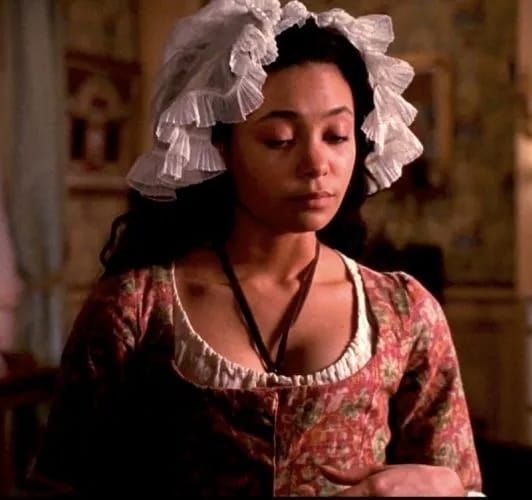
In 1995, we see Jefferson in Paris,, where 21-year-old Thandiwe Newton pretends to be the 14-year-old Hemings. The movie showed Jefferson pursuing a married Italian aristocrat, Maria Cosway, living in Paris at the time. Cosway left to return to London with her husband, leaving Jefferson sad and lonely. Jefferson was never much of a player, possibly due to his stutter. His attention soon turned to the teenage Hemings.

Newton’s casting has been criticized because she was required to lighten her skin to get the part. Hemings has been described as “very light-skinned,” no doubt because Jefferson’s first wife’s father raped her mother, and her grandmother was raped by a white sailor before that. She was also panned in the Black community for portraying a much younger Hemings.
“Any number of African-Americans take a shot at me for that one.” — Thandiwe Newton.
Jefferson in Paris wasn’t the first time we saw an older actress play Sally. The 1985 stage production, The Mistress of Monticello, featured Tina Andrews as Sally. Andrews was 35 at the time. She later wrote the screenplay for Sally Hemings: An American Scandal, in which the 26-year-old Carmen Ejogo played Sally Hemings. In a 2013 episode of Saturday Night Live, the 41-year-old Maya Rudolph played Hemings in a comedy skit, “Thomas Jefferson Meets Sally Hemings,” which has no basis in history or truth. The point is that what you have never seen is an actress other than a grown woman playing the child Jefferson slept with as a teenager.
America is incapable of acknowledging its 3rd President raped a teenager.The same is true of the 47th President, which is why we may never see the complete Epstein Files where such a case is described. But that’s a story for another day.
Casting much older actresses as Sally is but one way of changing the narrative about the Jefferson/Hemings relationship to avoid the word rape. My wife was watching Sally Hemings: An American Scandal on television, and I walked in on a scene where Sally's mother, Betty (Diahann Carol), told her she’d be accompanying Polly to Paris.

My first thought was that Sally was fourteen when she undertook the journey, and no way did Carmen Ejogo look as young as the real Sally. As I watched, the story suggested Sally was upset about leaving because she was preparing to “jump the broom” with an enslaved boy named Henry. They turned the immature child (according to Abigail Adams) into someone already considering the equivalent of marriage and presumably thinking of, if not already doing, marriage-like things. It wouldn’t be so bad if Jefferson slept with her; if it wasn’t him, it would have been someone else. Because Jefferson kept such meticulous records, we know there was a Henry at Monticello, but nowhere near Sally’s age. The character in the film was wholly imagined to give us an inkling that Sally was a sexual being before Jefferson literally got his hands on her. The movie, Sally Hemings: An American Scandal, was also marketed on DVD as Sally Hemings: An American Love Story. The subtitle was "Bound by Slavery, Freed by Love." Jefferson never freed Sally, not even in his will. After she walked away and went to Charlottesville to live with her sons, Martha Jefferson Randolph allegedly “given her time” to her.
Watching Sally Hemings: An American Scandal, you’d never know Sally Hemings was his first wife’s half-sister. You’d believe Jefferson’s feelings were pure and romantic and that he would free any of their children when they came of age (it happened only in one case because Jefferson died first). You wouldn’t know that in eight years, Sally never went to the President’s House (White House), though several of Monticello’s slaves worked there. And you wouldn’t even consider the possibility that Thomas Jefferson raped Sally Hemings.
Other films avoided the issue in different ways.The musical, 1776, doesn’t show Sally or any enslaved people at all. The most influential Jefferson documentary of the 1990s, Thomas Jefferson (1997), mentions Hemings without showing her. The Emmy-winning HBO series John Adams gives us plenty of Jefferson and Monticello, but no Hemings. The Real Thomas Jefferson (2008) leaves out the very real Sally Hemings.
My last hope was for The History Channel. surely they would get it right? They did acknowledge the sexual relationship. Suggest her age wasn’t as much an issue then as it would be now but offered no excuse for the age and power differential. They described how Jefferson attempted to hide the legal status of Sally and her brother in France where slavery wasn’t allowed and they could have petitioned for their freedom. What you never saw was Sally and Thomas in a romantic scene, The History Channel wouldn’t go that far. Jefferson in Paris showed an embrace and implied a consensual relationship. Sally Hemings: An American Scandal, showed a gentle kiss that presumably led to sex. There was no nudity. America wasn’t ready to confont the nature of their sexual relationship, especially when the facts say it could only be rape.
The question of whether a powerful man in his forties had sex with a teenager he legally owned is not an open historical mystery. It has been answered. Jefferson fathered Sally Hemings’s children; Hemings was enslaved, a minor, and unable to refuse him under any legal or human framework that recognizes coercion.
And yet, for more than two centuries, American culture has produced a steady stream of reinterpretations — romances, euphemisms, “special relationships,” and scholarly contortions designed to make the dynamic seem mutual. These efforts all collapse under one simple test: if the man were anyone other than Thomas Jefferson, and the girl anyone other than Sally Hemings, we would know exactly what to call it.
The only time this country reliably abandons that clarity is when the man in question is a Founding Father. Or, more recently, when he appears in the Epstein files — where accountability has been so selective that only one woman is in jail.