
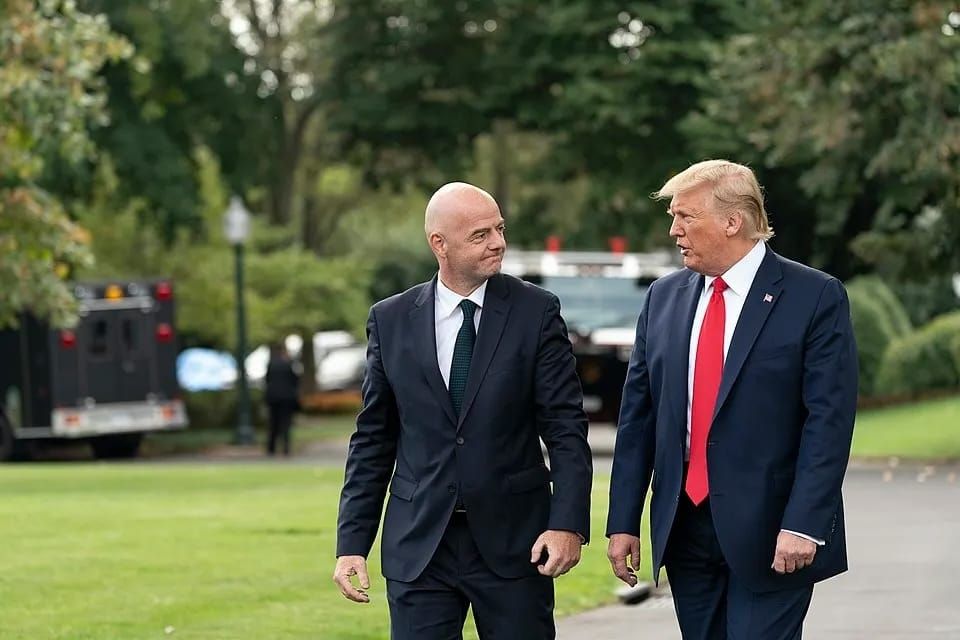
When Gianni Infantino won the FIFA presidency in 2016, he inherited an organization still staggering from the corruption scandals that toppled Sepp Blatter and sent shockwaves through global sport. Many hoped Infantino would be a reformer — someone who could stabilize FIFA, restore trust, and steer the world’s most influential sports body toward transparency.
Instead, according to reporting from multiple international outlets, Infantino has spent the last several years eroding FIFA’s credibility, alienating member associations, and entangling the organization in political relationships that have raised alarms across the football world. The most recent uproar centers on Infantino’s alleged outreach to the Trump administration for political help, a move that stunned many FIFA members who expect the organization’s president to remain neutral in global politics.
But this controversy is only one chapter in a broader story: Infantino’s willingness to court powerful political figures — including Donald Trump and Josh Kushner, not Jared — while advancing proposals that would fundamentally reshape the World Cup for private investors. And then there was the moment Infantino presented Trump with a made‑up FIFA “Peace Prize” — an award that did not exist, had never been approved by FIFA’s membership, and was created solely to placate Trump.
Infantino allowed Trump to put his imprint on the games themselves, lifting the red-card suspension of Folarin Balogun, the U.S. men’s national team striker, so he could continue playing in the 2026 World Cup. FIFA lifted the suspension after Donald Trump requested it of Infantino. FIFA turned down similar requests from other nations, including Bosnia and Herzegovina and African federations. Belgium’s coach Rudi Garcia said it was “the first time in the history of the World Cup that there is this kind of decision.”
Together, these actions have fueled a perception that Infantino is not safeguarding football’s global interests but instead leveraging the sport’s most sacred institutions for political and financial gain.
Infantino’s political maneuvering, his relationship with Trump, and his push to partially privatize the World Cup have damaged FIFA’s credibility and fractured support among member nations.
I. A President Seeking Political Lifelines
When multiple federations, including those representing Europe and Africa, started coming for Infantino’s job. Infantino allegedly sought help from the Trump administration to secure his position as FIFA president. Infantino placed a call to Trump, who didn’t respond. He’s now expected to talk to Secretary of State Marco Rubio.
For many FIFA members, this crossed a line. FIFA presidents have always interacted with heads of state — football is global, and diplomacy is part of the job — but actively seeking political intervention to influence internal FIFA politics is something different. It suggests desperation, insecurity, and a willingness to blur the boundaries between sport governance and geopolitical power.
According to the reporting, Infantino’s outreach was not subtle. He allegedly asked Trump’s team to help him maintain support among certain federations, particularly in regions where U.S. influence is strong. Even if no formal action was taken, the mere fact that Infantino pursued this avenue unsettled FIFA members who expect the president to remain above political entanglements.
The optics are damaging: a FIFA president, facing declining support, turning to a polarizing political figure for help. For many federations — especially those wary of U.S. political influence — this reinforced the belief that Infantino is willing to compromise FIFA’s independence to secure his own power.
II. The Trump Relationship: From Public Praise to a Fabricated “Peace Prize”
Infantino’s relationship with Donald Trump has long been controversial. He appeared alongside Trump at public events, praised him during joint appearances, and cultivated a rapport that many observers found politically risky.
But the most striking moment came when Infantino presented Trump with a “FIFA Order of Peace” — a prize that did not exist, had never been approved by FIFA’s membership, and was created solely for the occasion. According to multiple reports, Infantino did not consult FIFA’s governing bodies before awarding Trump this invented honor.
For many federations, this was a breach of protocol and a symbolic misuse of FIFA’s global stature. The award was widely interpreted as political flattery rather than diplomacy. It also raised questions about whether Infantino was using FIFA’s brand to curry favor with a polarizing political figure.
The incident damaged Infantino’s credibility because it suggested he was willing to fabricate honors and bypass FIFA’s governance structures to strengthen his personal alliances.
III. The Kushner Correction and the World Cup Sell‑Off
Infantino’s political entanglements are only part of the story. His willingness to entertain private investment in the World Cup — reportedly involving Josh Kushner, founder of Thrive Capital — has alarmed FIFA members worldwide.
1. The Proposal
Infantino explored a plan to sell a portion of the World Cup’s commercial rights to a private investment consortium. The proposal would have created a new entity with billions in capital to manage expanded tournaments and related competitions.
2. The Backlash
Member associations reacted with immediate concern:
- Privatizing part of the World Cup would fundamentally alter FIFA’s governance structure.
- Private investors could gain disproportionate influence over scheduling, format, and revenue distribution.
- Many federations already feel sidelined by Infantino’s centralization of power; privatization would deepen that imbalance.
3. The Kushner Factor
Early reporting incorrectly suggested Jared Kushner’s involvement. Later clarification showed that Josh Kushner, not Jared, was connected to the investment discussions.
Even with the correction, the controversy remained. Kushner is a politically adjacent figure whose involvement raised concerns about the blending of private capital, political networks, and FIFA governance.
For many federations, the idea that the World Cup — arguably the most important sporting event on the planet — could be partially sold off to private investors was unacceptable. The uproar was swift, and the plan stalled. But the damage to Infantino’s credibility was lasting.
A Presidency Defined by Missteps
Gianni Infantino entered office promising reform. Instead, he has presided over a period marked by political entanglements, controversial alliances, and proposals that threaten the integrity of the World Cup itself.
His alleged outreach to the Trump administration for help preserving his job symbolizes the broader problem: Infantino has repeatedly blurred the line between global sport governance and political opportunism. His decision to present Trump with a fabricated “Peace Prize” without consulting FIFA members further damaged his credibility. And his willingness to entertain a World Cup sell‑off involving Josh Kushner revealed a troubling openness to privatizing football’s most sacred institution.
The result is a credibility crisis. Infantino has not only lost support among many FIFA members; he has damaged the organization’s reputation at a moment when global football needs stability, transparency, and trust.
Infantino’s biggest mistake was aligning himself with one of the most hated individuals in the world. Trump imposed tariffs on every single member nation of FIFA. Are they supposed to forget that? He has labeled all the African and some Central American nations “shithole countries.” He has threatened to blow up NATO, which contributes to world peace. He ended USAID programs that historically saved millions of lives and it’s absence is projected to lead to 700,000 deaths. He’s threatened to take over Greenland, while regretting not keeping Panama. He’s taken Venezuelan oil and threatened the same in Iran. He’s suggested making Canada the 51st state. He’s criticized America’s longest-standing partners in Europe. The world sees him hounding and sometimes killing brown people without apology. Being close to a U.S. President isn’t what it used to be. In Infantino’s case, it may bring him down.
Whether FIFA can recover depends on whether its member nations are willing to confront the structural issues that allowed these controversies to unfold — and whether they are prepared to demand leadership that serves the world’s game rather than political interests. Infantino’s chances of recovery are lessening by the day, and Donald Trump isn’t taking his calls.