
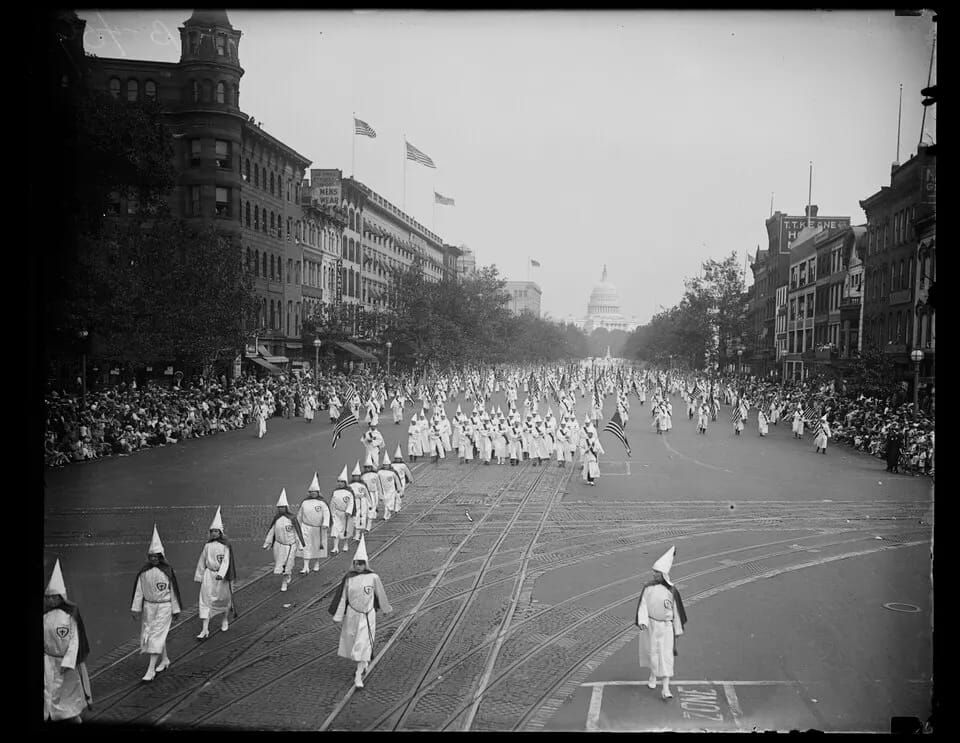
In 1925 and 1926, the Ku Klux Klan brought tens of thousands of white-robed marchers down Pennsylvania Avenue, proclaiming their defense of Christianity and American identity. On January 3, 2027, a pardoned January 6 participant named Jake Lang plans to bring his own Christian-themed demonstration to Washington. The costumes, slogans, and political circumstances may differ, but the historical parallels deserve examination.
There was a time when Americans could look down Pennsylvania Avenue and see tens of thousands of men dressed in white robes and pointed hoods marching toward the nation’s Capitol. They carried American flags; some carried crosses; they displayed their organization's symbols. They presented themselves as defenders of Christianity, traditional values, and what they considered the proper American way of life. They were members of the Ku Klux Klan.
In 1925, the Klan was at the height of its political and organizational power. Its members were not hiding in the woods or operating exclusively in the dark. They were marching openly in the nation’s capital, confident enough in their political influence to demonstrate their numbers before the federal government and the American public. A year later, the Klan returned to Washington for another demonstration of strength. To be clear, this included tens of thousands of Klan marchers, including the Women of the Ku Klux Klan. The streets were lined with supporters who cheered them on.

Now, a century later, another controversial figure is planning a Christian-themed march in Washington. His name is Jake Lang, a participant in the January 6, 2021, attack on the Capitol who received a presidential pardon from Donald Trump. His proposed Million Crusader Cross March is scheduled for January 3, 2027, the day the 120th Congress is scheduled to convene.
Lang describes his movement in the language of Christianity and national renewal. His activities during 2026, however, have included a Nazi salute, antisemitic rhetoric, and demonstrations directed against Muslims and their religious institutions.
The comparison with the Ku Klux Klan is not that Lang’s proposed gathering will necessarily reproduce the violence or organizational structure of the Klan. No evidence shows it will. Rather, the comparison concerns something more fundamental:the historical use of Christianity as a political identity by movements that promote racial, religious, or ethnic exclusion.The Klan claimed Christianity, too.
The Klan’s march on Pennsylvania Avenue
The Klan’s best-known Washington demonstration took place on August 8, 1925. At the time, the organization was experiencing extraordinary growth. The second Ku Klux Klan, founded in 1915, had expanded far beyond the South. It had established a national presence and attracted members in states throughout the country.
Its appeal was built around white Protestant nationalism, racial segregation, hostility toward immigration, and opposition to Catholics and Jews. Black Americans remained its principal historical target, but the organization also portrayed other religious and ethnic groups as threats to American society.
The Klan claimed millions of members during its 1920s expansion, although its actual membership figures were difficult to verify.
On August 8, thousands of its members descended on Washington. Contemporary accounts and historical estimates place the number of marchers at approximately 25,000 to 30,000.
They assembled near the Capitol and proceeded along Pennsylvania Avenue in carefully organized formations. Their white robes and pointed hoods made the demonstration unmistakable.
The marchers carried American flags and banners identifying their state delegations. Spectators lined the avenue, watching an organization that had once operated largely through secrecy demonstrate its political strength in the open.
The Washington Post reported the following day on the enormous procession. The National Mall’s historical archive identifies the event as a demonstration by an organization founded on white supremacy and committed to attacking the social and political rights of African Americans, immigrants, Catholics and Jews.
It is worth distinguishing the 1925 and 1926 demonstrations because they are sometimes confused in historical references. The Klan returned to Washington in September 1926. According to Time magazine’s September 20 account, approximately 30,000 members arrived, considerably fewer than the 200,000 organizers had reportedly anticipated.
The police mobilized the entire force, and Marines guarded the Treasury Building. The marchers proceeded peacefully and without their masks, according to the magazine’s contemporary report.
These were not insignificant gatherings. They demonstrated that an organization built around racial and religious exclusion could assemble tens of thousands of supporters in the nation’s capital and present itself as a legitimate political movement.
The Klan wanted Americans to understand that it was powerful, organized, and unafraid of public scrutiny. It also wanted Americans to believe that its political objectives were compatible with Christianity.
The Klan’s claim to Christianity
One of the most important aspects of the Klan’s history was its appropriation of Christian identity. The organization did not present itself simply as a white supremacist movement. It described itself as a defender of Protestant Christianity and American civilization. Its members used religious language, invoked biblical imagery, and portrayed their political objectives as a struggle to preserve a Christian nation.
The second Klan’s membership was overwhelmingly Protestant. Its hostility toward Catholics was especially important to its political identity. It portrayed Catholicism as an allegiance to a foreign religious authority that supposedly threatened American democracy.
The Klan also opposed Jewish Americans, immigrants, and Black Americans, presenting their presence and political advancement as threats to the society it wanted to preserve.
Its religious symbolism was particularly visible in its use of the burning cross. The practice was intended to evoke Christian imagery while serving as an instrument of intimidation.
But the Klan’s claim to Christianity did not make its racial ideology consistent with the teachings of Christian equality.
Its central political proposition was that white Protestant Americans deserved a privileged position in the country and that other groups should be restricted, excluded, or subordinated.
That contradiction is important when examining Jake Lang.
The issue is not whether Lang or his supporters have the right to identify themselves as Christians. They do. The issue is whether invoking Christianity can be used to legitimize hostility toward entire religious and ethnic populations. A century ago, the Klan believed it could.
And the historical record demonstrates the consequences of allowing religious identity to become a justification for racial and religious persecution.
Jake Lang: From January 6 to the Million Crusader Cross March

Lang became nationally known for his participation in the January 6, 2021, Capitol attack. He faced federal charges that included assaulting police officers and spent approximately four years in federal custody before receiving a pardon from President Trump on January 20, 2025.
Lang was among approximately 1,500 people who received clemency through Trump’s January 2025 action, which included pardons for most January 6 defendants and commutations for certain others. The pardon removed the federal criminal consequences of the covered offenses. It did not establish that Lang had been innocent of the conduct charged against him.
Instead of disappearing from public life, Lang became an increasingly visible political activist. During 2026, his demonstrations attracted attention for their antisemitic and anti-Muslim rhetoric, as well as his use of imagery associated with extremist movements. One of the most disturbing incidents occurred in Washington in January.
The Nazi salute and antisemitic demonstration
On January 4, 2026, Lang organized a demonstration outside the headquarters of the American Israel Public Affairs Committee (AIPAC), a pro-Israel lobbying organization. The demonstration was not simply criticism of Israeli government policy or opposition to AIPAC’s political influence.
According to reporting by the Jewish Telegraphic Agency, Lang threw chocolate coins, made antisemitic statements, and performed a Nazi salute. He invoked the Great Replacement Theory, an antisemitic conspiracy narrative claiming that Jews are orchestrating immigration to replace white populations.
At one point, Lang declared:
“White people in America, you will be replaced, and your children will be Black Muslims if you don’t stand up now.”
He also described immigrant children as weapons supposedly sent by Jewish people and threatened lawmakers who received AIPAC contributions with execution for treason.
When questioned about the Holocaust, he responded that he did not believe it happened at the scale generally documented by historians. Before departing, Lang performed another Nazi salute.
These incidents are important because they demonstrate that the Nazi salute was not merely an incidental gesture photographed out of context. It occurred during a demonstration featuring repeated antisemitic statements and threats. The symbolism was unmistakable.
Minneapolis: Anti-Muslim and anti-immigrant rhetoric
On January 17, Lang traveled to Minneapolis and organized an anti-immigration demonstration. He and a small group of supporters gathered near the federal courthouse and City Hall. Several hundred counterprotesters confronted them.
According to The Washington Post, Lang shouted racist and anti-Muslim slogans and promoted claims that immigrants were replacing white Americans. The much larger counterprotest overwhelmed the demonstration.
Lang was chased away from the gathering and was later seen bleeding from the head after confrontations with counterprotesters. The incident illustrated how Lang’s demonstrations were increasingly organized around provoking confrontations over immigration, race, and religion.
The attacks on Muslim communities
Lang’s activities extended beyond political speeches. In late 2025, he had already staged demonstrations involving Quran burning and protests outside Muslim institutions. Those activities continued to inform his public campaign during 2026. The Global Project Against Hate and Extremism documented several of his statements and activities.
At a May 19, 2026, city council meeting in Frisco, Texas, Lang made inflammatory remarks about Muslims and Hindus. He claimed that these religious communities were conspiring to displace Christians and threatened that, if he lived in Texas, he would burn down one of the mosques.
He also promoted the claim that Muslims and other immigrants were attempting to take over the country. In March 2026, he posted a demand to ban Islam from America.
These statements are particularly relevant to the proposed January 2027 march because they demonstrate the religious character of the political message Lang has been promoting.
His rhetoric is not limited to immigration policy or foreign-affairs disagreements. It repeatedly identifies religious communities as enemies of the country and threats to Christians.
The Million Crusader Cross March
Lang’s proposed Washington demonstration is being advertised as the Million Crusader Cross March. The event poster describes it as a:
“Peaceful protest & Christian unity against the rigged midterms.”
Participants are encouraged to bring crosses. The stated objective is to protest the results of the 2026 midterm elections, which the organizers characterize as rigged.
That date is significant for two reasons.
First, it is three days before the sixth anniversary of the January 6 Capitol attack.
Second, it is the constitutionally established date for the convening of the 120th Congress, unless Congress has enacted a different date.
The Twentieth Amendment provides that a new Congress begins at noon on January 3 in odd-numbered years. The House must organize itself, elect a Speaker and administer the oath to its new members.
Thus, Lang is proposing to stage a major political demonstration at the Capitol on the very day the newly elected Congress begins its work. That timing deserves attention. The combination of the date, the organizer’s history, and the election-fraud message makes this an event worth watching.
The parallels between the Klan and Lang’s movement
The Klan was a massive national organization with chapters, financial resources, political connections,s and millions of claimed members. Lang’s demonstrations have generally attracted much smaller groups.
Both movements present themselves as defenders of Christianity.
The Klan portrayed itself as the guardian of Protestant America. Lang uses crosses, Crusader imagery, and Christian unity as central elements of his political messaging.
Both appeal to the idea that Christianity is under attack and that their political movements are necessary to defend it.
Second, both identify religious and ethnic groups as threats.
The Klan targeted Black Americans, Catholics, Jews, and immigrants.
Lang has directed his rhetoric against Jews, Muslims, immigrants, and other religious communities. His statements about Muslims replacing white Americans are particularly reminiscent of the conspiratorial thinking that has historically accompanied white supremacist movements.
Third, both use American nationalism to justify their political objectives.
The Klan marched with American flags and presented its objectives as an effort to preserve the country.
Lang’s demonstrations similarly invoke American identity, national renewal, and the defense of Christianity.
The implication is that America belongs to a particular religious and cultural constituency and that other groups threaten its survival.
Fourth, both use public demonstrations to project political power.
The Klan’s 1925 and 1926 marches were designed to demonstrate that it was not a marginal organization hiding from public view. Lang’s proposed march also seeks a visible presence at the center of American political life. The difference in scale is substantial, but the political purpose of public spectacle deserves attention.
The importance of January 3, 2027
The timing of Lang’s proposed march is perhaps its most consequential feature. January 3 is not an ordinary day on the congressional calendar.
It is the day the newly elected representatives and senators begin the next Congress. The House must elect its Speaker, organize its leadership, and prepare to conduct the people’s legislative business.
In other words, the march is scheduled to coincide with the beginning of a new congressional term. That creates an uncomfortable historical connection to January 6, 2021.
On that day, a crowd attacked the Capitol while Congress was meeting to certify the presidential election results. The attack interrupted the constitutional process of transferring presidential power. Lang was among those charged in connection with the violence that day. He subsequently received a presidential pardon.
Now, the same individual is advertising another demonstration at the Capitol, this time using the language of Christian unity and alleging that the midterm elections were rigged. The circumstances warrant serious attention from congressional leaders and Capitol security officials.
The right to assemble and protest is fundamental to American democracy. It does not, however, include the right to intimidate public officials, obstruct Congress or use violence against political opponents.
A pardon and the question of political accountability
There is another dimension to this story that deserves consideration. To understand Lang’s ability to organize these demonstrations, we must consider Trump’s January 2025 pardon.
Presidential pardons are an established constitutional power. Presidents of both parties have used them, sometimes for compelling reasons and sometimes controversially. But a pardon does more than eliminate criminal punishment. It can also change the political circumstances of the recipient.
Lang spent years in federal custody awaiting the resolution of charges arising from January 6. After his pardon, he returned to public life and became an organizer of demonstrations that have included Nazi symbolism, antisemitic rhetoric, and attacks on Muslim communities.
That does not mean the pardon legally authorized or endorsed his subsequent activities. But it raises a legitimate question about the political consequences of using presidential clemency on such a broad scale.
What message does it send when people convicted or charged in connection with an attack on the nation’s Capitol are granted clemency, and some subsequently use their newfound freedom to organize confrontational political demonstrations?
That question extends beyond Lang. It concerns the relationship between presidential power, political violence, and accountability.
Christianity does not belong to the Klan or the Crusaders
Perhaps the most important issue in this comparison is how Christianity was used. The Klan claimed to represent Christianity. Its members believed they were defending their religious traditions and preserving what they considered a Christian nation.
But Black Americans were among the people most violently persecuted by the organization. Catholics and Jews were also targeted because their religious identities did not conform to the Klan’s preferred vision of America.
A movement that claimed to defend Christian civilization was simultaneously committed to denying millions of Americans the freedom, dignity, and equality that Christianity supposedly taught its members to respect.
A century later, the question remains.
In 1925, the Klan marched down Pennsylvania Avenue because it wanted the country to see its strength. In 1926, it returned, again demonstrating that its members were willing to assemble publicly in the nation’s capital.
The organization believed it was defending Christianity and preserving America. Its history, however, is inseparable from racial terrorism, religious intolerance, and the systematic denial of civil rights.
A century later, Jake Lang is attempting to organize another Christian-themed demonstration in Washington.
The proposed Million Crusader Cross March is considerably smaller in its presently documented organization than the Klan’s historic demonstrations. Its eventual size and character remain unknown. But its organizer’s public record cannot be ignored.
He has performed a Nazi salute, promoted antisemitic conspiracy theories, questioned the historical reality of the Holocaust, attacked Muslim,s and made inflammatory statements about religious institutions. He has also proudly defended his participation in January 6. Now he wants to bring a Christian-branded political demonstration to the Capitol on the day a new Congress convenes.
There is an important lesson in the history of the Klan. Religious language does not automatically make a political movement religiously principled. Carrying a cross does not establish that a movement represents the teachings of Christ. And declaring that one is defending America does not establish that the movement’s objectives are consistent with American constitutional principles.
The Klan understood the political value of presenting intolerance as patriotism and religious exclusion as Christian duty. So does MAGA.
Whether Lang’s proposed march attracts a handful of supporters or a substantially larger crowd, Americans should recognize the historical questions it raises.
The Constitution protects Lang’s right to demonstrate. It protects the rights of Muslims, Jews, Christians, and people of every other faith to live without intimidation. It also protects Americans' right to disagree with one another without resorting to political violence.
The question is not whether Lang has the right to invoke Christianity. He does. The question is whether Americans will recognize the difference between a movement defending religious freedom and one using religion to justify hostility toward people who believe differently.
A hundred years ago, the Ku Klux Klan marched down Pennsylvania Avenue claiming to defend Christianity and America. We should remember what that claim ultimately represented before another group attempts to march under a similar banner.