
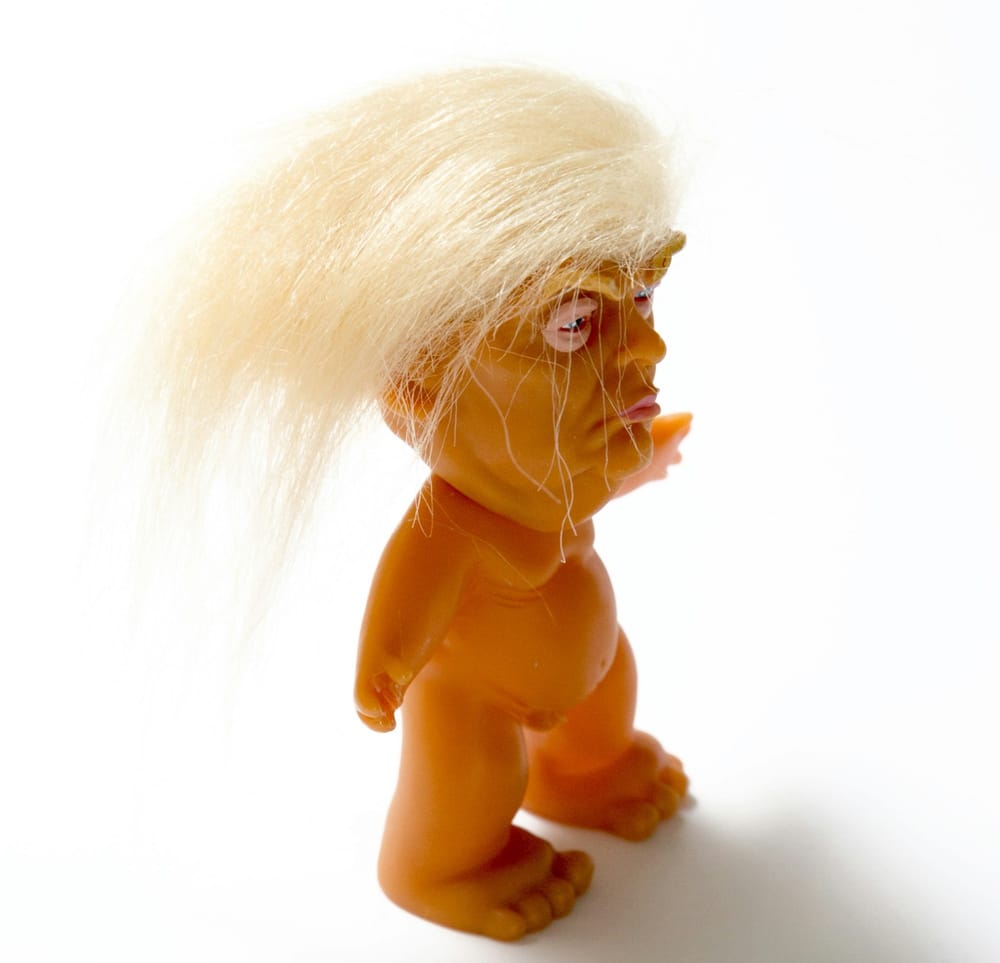
William March was an author whose best-known work was, inarguably, The Bad Seed. It’s unlikely March ever met Donald Trump, though March visited New York often during the years he was writing the novel about a horrific child, during a time Trump was the same age as the main character.
In the original 1956 film, the bad seed was an eight-year-old blonde pigtailed girl named Rhoda. The actress, Patty McCormack, worked for years to avoid being typecast and wouldn’t discuss the role for decades afterward. Rhoda’s mother discovers the child she adopted was the daughter of an Australian serial killer and wonders if her daughter may have inherited similar traits. In the movie, Rhoda kills three people, one of whom she decides she has to kill so she can get a medal she wants. In the novel, Rhoda killed four people and a dog.

Donald Trump wasn’t adopted, though his father constantly instilled in him to “Compete, win, be a killer.” His mother, Mary Anne MacLeod Trump, a Scottish immigrant who adored glamour and wealth, became gravely ill when Donald was just two‑and‑a‑half years old. She was hospitalized and largely absent during a critical period of his development. According to Mary Trump, the family’s psychologist‑trained niece, Donald experienced this as a kind of abandonment, a rupture that shaped his emotional life.
Fred Trump, meanwhile, was not the kind of father who made up for it with tenderness. He was stern, demanding, and emotionally distant — a man who believed softness was weakness and compassion was a liability.
As you might imagine, young Donald Trump was a pretty little liar. As a child, he developed a reputation for braggadocio and exaggeration. Teachers and classmates described him as a boy who needed to be the center of attention, who inflated his accomplishments, and who bent the truth whenever it suited him. If the truth didn’t make him look like a winner, he created a better version.
When Donald Trump attended Kew-Forest School in the 1950s, it had a reputation as a small, elite, expensive private school serving upper‑middle‑class families. Donald was there from kindergarten through 7th grade. In his later years there, he began sneaking into Manhattan, later regaling his friends with made-up stories about his adventures there. Donald’s behavior by 7th grade had become characterized by fighting, bullying, arguing with teachers, and acquiring knives on his Manhattan excursions. The school was ready to expel him. A trustee at Kew‑Forest recommended that Fred Trump send him to the New York Military Academy. Fred agreed.
Donald's father believed the academy would instill discipline. Instead, it sharpened Donald’s instinct for domination. Classmates described him as a bully, someone who yelled at peers, pushed them around, and ruled dormitory life “with an iron fist.”
This was where he learned that force — physical, emotional, or social could get him what he wanted. It was also where he learned to perform authority, to project strength even when he didn’t feel it. Donald was a decent athlete and a member of the baseball team.
Trump has repeatedly claimed he was one of the best baseball players in the state, even saying major league teams scouted him. No evidence supports this. Former teammates and biographers say he was solid, not exceptional.
Trump says he was a top leader at the academy. In reality, he was demoted from his position as a supply sergeant after failing to supervise a subordinate.
After graduating from NYMA in 1964, Trump enrolled at Fordham University. He stayed two years before transferring to the Wharton School at the University of Pennsylvania, a move he later framed as evidence of elite academic achievement.
He transferred early in his sophomore year because Wharton had a stronger business network — something his father valued. Trump did not participate in extracurricular activities after freshman year. It is alleged by his niece, Mary Trump, that he paid a “smart kid” named Joe Shapiro to take the SAT for him. The high score helped Trump transfer to the University of Pennsylvania’s Wharton School. Trump has repeatedly implied he graduated at the top of his class, a claim contradicted by school records and classmates. Wharton does not list him among honors graduates, and his classmates describe him as academically disengaged.
Trump has repeatedly described his Vietnam‑era draft deferments as routine or medically necessary. In reality, he received multiple deferments, including one for bone spurs diagnosed by a doctor who later said he provided the exemption as a favor to Fred Trump.
William March built Rhoda as a study in performance, a child who learned early that charm could be weaponized, that rules were for other people, and that consequences were things to be outrun, not absorbed. She smiles, she flatters, she denies, and she destroys, all while insisting she’s the real victim.
Trump’s public life has followed a similar emotional blueprint. The boy who learned to bend the truth at Kew‑Forest became the man who insisted he was the best baseball player in New York, the top student at Wharton, the self‑made billionaire who “started with a small loan,” the dealmaker who always won even when the paperwork said otherwise. When confronted with failures — bankrupt casinos, fraudulent charities, a university shut down for deception — he responded with the same reflexive denial that Rhoda used when confronted with Claude Daigle’s medal. Someone else was to blame. Someone else was lying. Someone else had wronged him.
Rhoda never admits fault; she creates a new story. Trump’s adult behavior often follows that same pattern. When the Access Hollywood tape emerged, he said it was “locker room talk.” When confronted with the crowd size at his inauguration, he insisted the photographs were fake. When asked about the people who took exams, wrote letters, or inflated valuations on his behalf, he said he knew nothing about it. When it was proven that American missiles struck an Iranian girl’s school, he was unaware. The details change, but the structure remains the same: deny, deflect, dominate.
March understood that the most dangerous characters are not those who rage openly, but those who smile as they rearrange reality around themselves. Rhoda’s power comes from her ability to make adults doubt their own eyes. Trump’s power has often come from the same place — the audacity to insist that truth is whatever he needs it to be in that moment, and the confidence that enough people will accept the performance. Trump does rage openly, having reached a place where no one dares defy him.
Rhoda Penmark is a fictional character, but the psychology behind her is not. March wrote her as a warning about what happens when a child grows up rewarded for ruthlessness and shielded from consequences. Trump’s life, from the boarding school corridors of Queens to the boardrooms of Manhattan and the global stage, shows what that warning looks like when it grows up, learns to talk to cameras, and discovers that an entire political movement can be built on the same principles that once got him sent to military school.
Rhoda’s mother spends the entire novel trying to understand how her daughter became what she is. The country has spent years asking a similar question about Trump. March’s answer, written seventy years ago, still resonates: some people learn early that the world will let them get away with anything, as long as they smile while they’re doing it.