
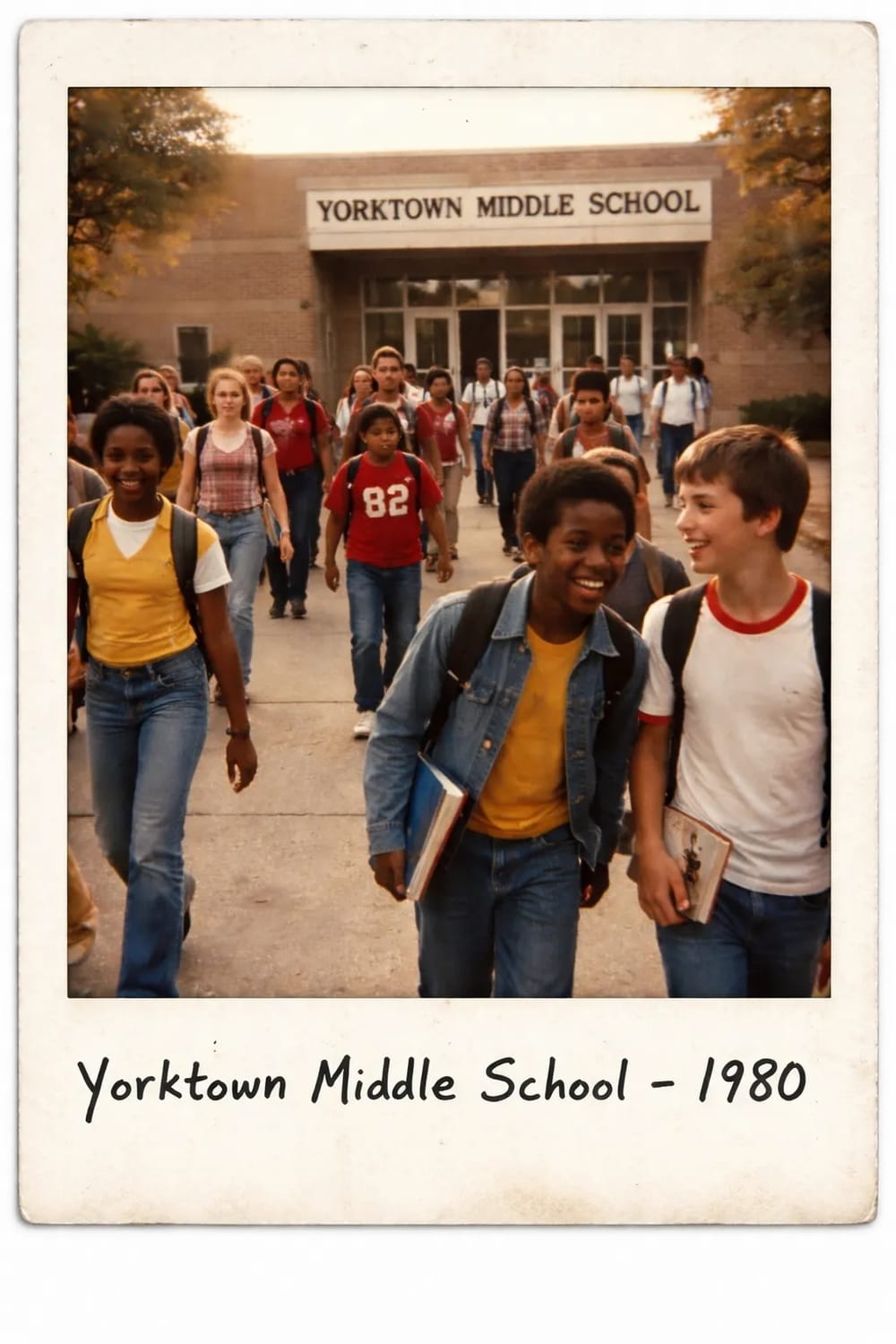
I remember the day clearly. My first day at Yorktown Middle School in Columbus, Ohio. September 8, 1980. Sixth grade. Nappy, curly hair and all.
I walked into my new school ready for the next phase of life. Still the smallest kid among the masses, but carrying an attitude much taller than my four foot, four inch body.
But something was immediately different about the place. Half the student body was Black.
I was 11 years old and had barely been around Black people before. There was one Black kid in my otherwise all-white elementary school. I met a few when my mom took me to the school where she taught. But actually playing with Black kids? That was new. Our blue-collar, lower-middle-class neighborhood was solidly, predictably all white. Peterbilt trucks and Chevys on blocks and all.
In 1980, though, a judge ordered the notoriousy inequitable Columbus Public School system to integrate.
As a result, kids got bussed in to different schools to produce integration.
And yet, somehow, the new difference felt…well… ordinary.
Kids were laughing in the hallways. Conversations buzzed in the morning. When the bell rang for homeroom, everyone stampeded into classrooms like a fire alarm had gone off. No one paused to announce, “Welcome to integration.” Life just happened.
Sure, there were some cultural differences. I quickly learned the healing power of jokes. I learned how humor worked as social currency and emotional lubricant. Black humor. Jewish humor. Self-deprecation. Roasting. Timing mattered. Trust mattered. Humor wasn’t just funny, it was intelligence.
I learned that some families struggled just like ours. Sometimes worse. Others less so. But they were still all kids navigating life, pre-algebra, and bad haircuts like everyone else. White and Black.
I also got a front-row seat to misunderstanding and discomfort. Arguments. Someone saying the wrong thing. Someone else having to call it out. And then, the important part, repair. Integrated schools don’t eliminate tension. They teach you how to survive it without fleeing the room.
We didn’t learn to avoid difference. We learned how to stay when things got uncomfortable.
Integrated schools made inequality visible in ways homogenous schools never can. You notice disparities in discipline, tracking, expectations, and attention when you’re sharing the same hallways. Fairness stops being theoretical when it’s happening to the kid sitting next to you.
That’s where my sense of justice came from. Not from slogans or lectures, but from observation. Social justice wasn’t some ideology back then. It was response to reality.
Being raised among difference also gave us a stable sense of self that didn’t require superiority. You didn’t need to defend whiteness or masculinity like fragile heirlooms because identity wasn’t zero-sum. Someone else existing fully didn’t threaten you. Dignity wasn’t diluted by proximity.
I spent all three years of middle school and then high school in that same integrated Black-white environment. What it produced wasn’t just tolerance. It produced citizens. People who could listen, disagree without dehumanizing, partner across difference, and still care. In other words, people capable of democracy.
And it didn’t just produce white kids with more empathy.
It produced Black kids who understood they were just as capable and deserving as everyone else. It’s why my high school’s top five performing students included two Black students, two Jews and one white girl. Now scientists, doctors and lawyers.
We’ve sadly retreated from those days.
When schools re-segregated by race, class, ethnicity, or culture, they became breeding grounds for caricature, fear, projection, and myth. And even for low self-esteem. By adulthood, it’s much harder to unlearn ideas that calcified in childhood.
That’s why we need to return to the integration that shaped so many of us. Not as nostalgia. As necessity.
Stop and ask: Who am I because of the schools I attended? Where did my sense of humor come from? My empathy? My instinct for fairness? Or my lack of it? Was it shaped by shared lunches, shared jokes, shared grief, and shared joy? Or by a narrow window into society that never got called to stretch?
This isn’t social engineering. It’s education.
And more evolved people make a more evolved, loving society.