
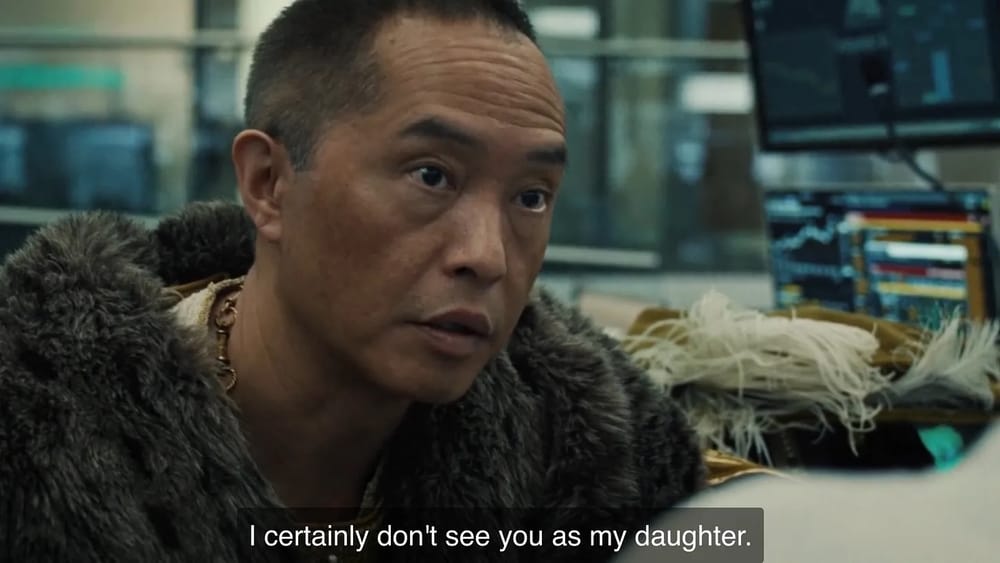
As Ken Leung explodes with emotion in the scene of his career, the viewer can’t wait to see what’s on his phone screen. His incredible restraint, stoic default settings, and smug quips melt down into one horrified lip quiver. His eyes bulge and the blood drains from his crown to his neck. The shot actually seems like Eric goes blue, struggling for oxygen to keep him alert the same way he goes black in the previous episode to detach.
Give that man the Emmy.
The world is crumbling around us and Industry goes out of its way not to blame the finance types or the AI or any overt boogeyman. This is the evolutionary avalanche of individual greed.
The same trait that’s helped us survive is the precursor to hubris.
When I’m in the group chat, ducking conspiracy theories left, right, and center, the main thing I tell my family is that it ain’t a conspiracy if it’s out in the open. Kompromat, the hinge of Episode 6, is also at the nexus of our real, current Biggest Scandal Ever.
In the information era, one disgusting man, Jeffrey Epstein, held world leaders’ secrets in his creepy memory and logged countless hours and email luring people into their worst desires. He was obtaining all levels of kompromat, blackmail-ready videos, photos, messages, and memories to hold power to heel and always know a fact we didn’t know solidly and could only theorize: no power is earned that isn’t bought. The currency of the rich and depraved isn’t the money they already have, it’s the secrets that could put them away. Capsize their reputation and their freedom in one blow and you could tell the elite class to do anything you wished, including endorsing and funding a global child abuse operation. This is how it works, sadly. Our delicate house of cards propped up by the violent loss of innocence so many children face daily.

I am so unmoved by the depths of evil the world promotes that even fictional takes like Industry’s only serve to reinforce how cynical we need to be to suspend disbelief. What is there to suspend, I wonder. Characters like Whitney, the snake from Tender, could be any CEO of a financial company or a social platform or a toothbrush startup. They all want to scale at any cost, see their consumers and their workers as human capital, and ignore the reality of limits no matter the product. There is some wiz kid convincing a fund manager that AI eldercare will replace nursing homes and the best part is neither party believes it. The infinite shell game, where we drain our accounts with subscription fees to phantom services soon to vanish, like farm fresh, pre-packaged dog food, has hit its expiration date. Since no one told us, we’re grasping for any Whitney we meet to be the one who sells us on the idea of finally surviving. Who sells us on the dream of living within our means.
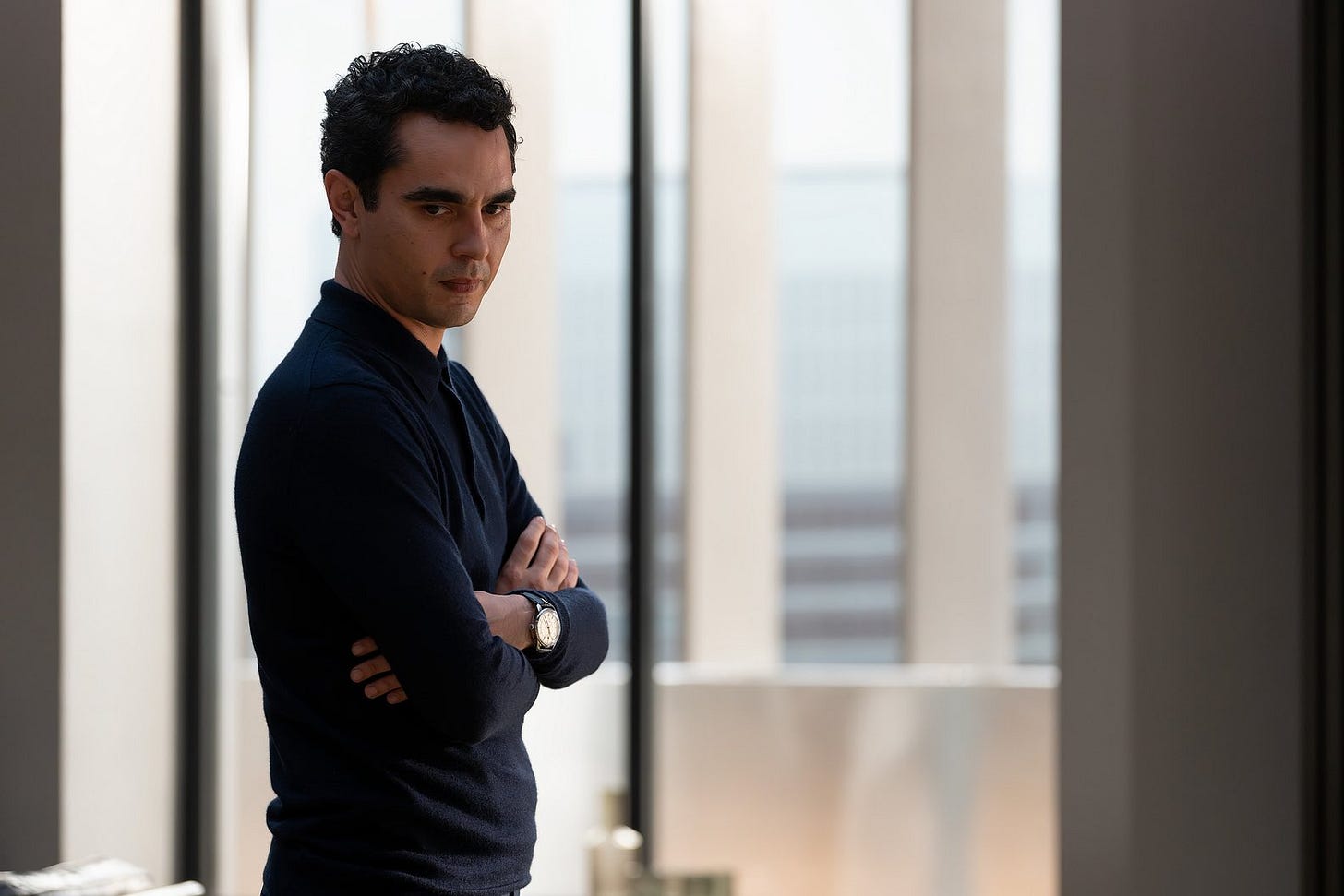
While viewers are stuck on the palpable erotics of Industry, I’d argue there’s nothing less sexy than the transactional coitus of power. Someone’s always getting fucked. Again, that’s no conspiracy. The food chain model of our economy hasn’t yet market-corrected the dystopian edge of loneliness on which we teeter. If Eric is lonely, for example, he can buy company, and he does. At the other end of his loneliness, however, sits a trafficked girl and a rival CEO, iPhone recording in 4k to prey on him in the scavenger’s festival they’ve invented to justify being piss-poor humans. If Harper is lonely, she can destroy Whitney, an erstwhile lover to exact revenge on her mother for not offering unconditional love. She can expose him once on the ground of his kinks, and again on the grounds of his fraud fetish. Either way, a loser’s extracted.
The breakup of Eric and Harper, or SternTao as the writers cleverly called them, a euphemism for “The Hard Way” perhaps, is the dissolution of virtue. Or, the idea of virtue. The two never stood for anything, to be clear, but we wanted them to consider standing for each other. In Eric’s final monologue, with Harper as his main onlooker and cheerleader, he expresses his one true value: I’m evil too. As if to crush any naive dream the viewer might still cling to of the firm taking out the bad actors in the financial sector, he stamps his foot saying, “No! I’m not your savior! I’m here for myself! (And that’s the best thing anyone like me could tell you.)”
He’s right too. The problem with conspiracies is they pre-suppose anyone gives a fuck about you enough to lie, to keep their dirty laundry in a locked closet. Elon Musk, Donald Trump, Larry Summers, Chris Tucker, Bill Clinton, Jamie Dimon and their type are long past reproach. Their money too, too long and the mass of people could stand on each other’s shoulders and never hop the gates of their fortress or cave in their bunker. We’re already what they’re preparing for, but we’re suckling at the mammy’s milk of GLP-1s and timeline refreshes.
Henry has the most devastating line in this episode because it’s delivered like a dig to his troublesome spouse, Yasmin. But Henry’s blue blood side delivers it with so much extra sauce you can tell it’s more like the moral of the story itself: You only want me to be out of control because that’s what makes you useful.
We, the masses, want a semblance of order. But this is the order we have: a cabal of corrupt leaders who swear to us up and down they’ll fix the crime, they’ll lock the borders, and they’ll lower the prices. The world they built on our backs is outta control, and only they can fix it. We are useful when we rebel against the status quo in the form of temporary protest, so the powerful don’t say a peep about the actual turns the world is taking toward chaos.
I’m just praying I’ll hear a voice whisper ‘Everyone wants you’ as my life force empties.