
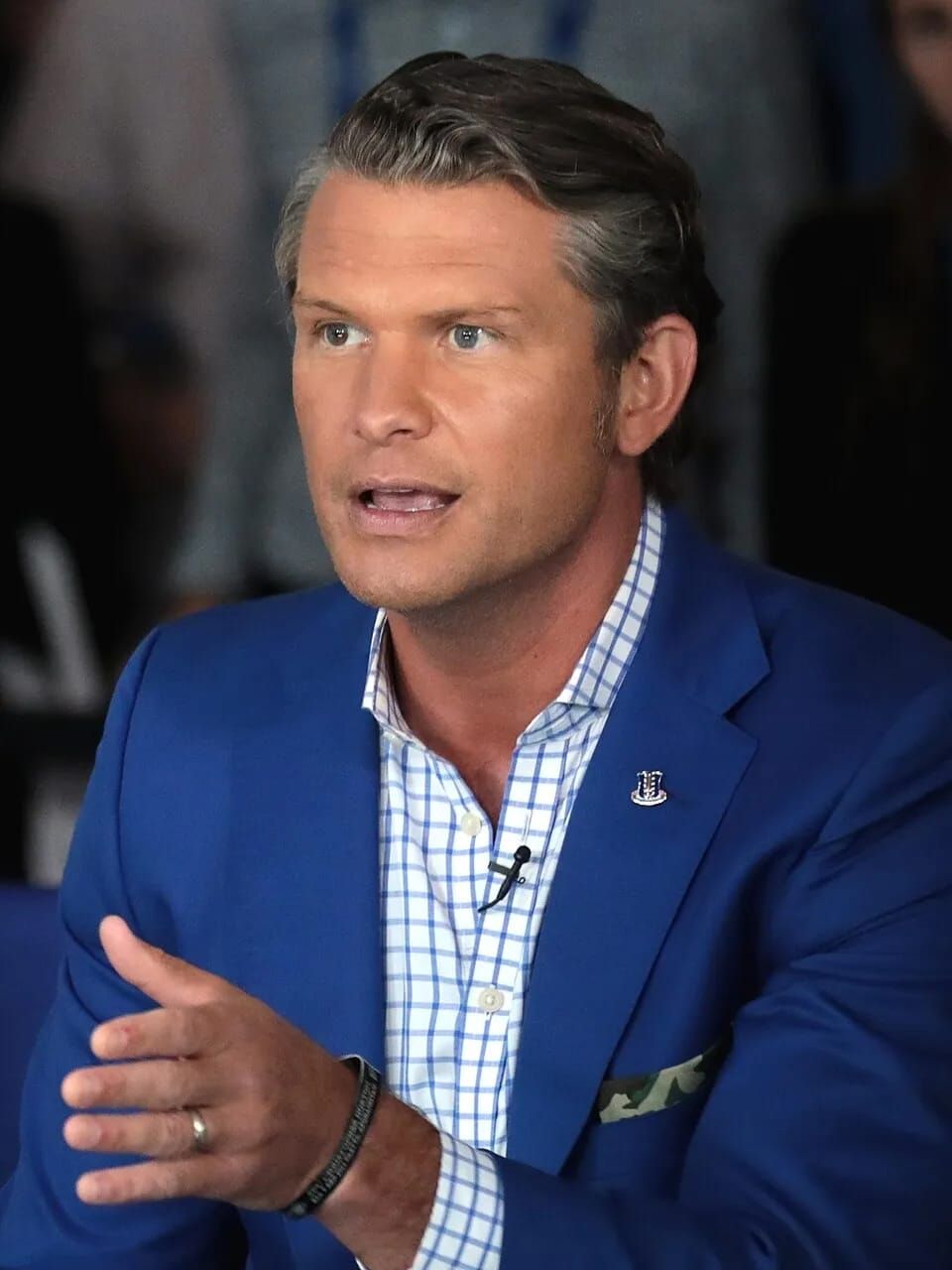
Donald Trump openly brags about the people he’s hired that look like they came from “central casting.” Central casting originally referred to Hollywood’s real casting office (Central Casting Corporation, founded 1926), which supplied extras and bit‑players. Over time, the term became shorthand for a person who looks or behaves exactly like the cliché of a particular type. Looking like you came from central casting doesn’t speak to qualifications or skills, only appearance.
In the Trump administration, central casting includes a preference for white people and, in certain roles, men. Pete Hegseth was handed a list of candidates for military promotions. He personally blocked all the Black and female officers.
Military Times reports that Hegseth blocked the promotions of four Army officers — two Black men and two women. He personally removed their names from the list. NPR confirms that Hegseth crossed out four Army colonels (two Black, two women) and two more colonels from another service (one Black, one woman). This was described as “highly unusual and possibly even illegal.” AP News reports that Hegseth cut nine Navy officers from a promotion list — including all the women and two Black men. This resulted in zero women being promoted to one‑star admiral that year.
Hegseth implemented and defended a grooming policy that would result in Black service members with medical shaving conditions being separated from the military after 12 months. He framed non‑shaving as grounds for needing a “new position or a new profession.” Black men with beards apparently aren’t central casting.
Trump isn’t limited to reserving roles in his administration to white men (in certain roles). He told the Israel Defense Forces Chief of Staff, Eyal Zamil, he looked like what an Israeli should look like. He told Chinese President Xi Jinping he’s who Hollywood would choose as a leader of China. Among the white men who look like white men in their roles should, Trump at various times has declared General James Mattis, Vice President Mike Pence, Ronny Jackson, Kevin Warsh, General Dan Caine, and Pete Hegseth, all looked like they came from central casting.
Central casting is a place where the only requirement is to look the part. This must be how those opposed to DEI must think Black men and women got their jobs. Look the part, get the job, qualifications be damned.
I mentioned there are roles reserved for women. Usually blonde, but not always. The Stepford Wives would be proud of how they manage to look the same, talk similarly, wear make-up in the same way. Over his first and second terms, Trump has surrounded himself with interchangeable women. Most had degrees from one religious school or another. I’m not implying a sexual relationship with any or all; maybe their company is enough? Some have already left the circle; few are better off than before.
Caroline Sunshine

Madeline Westerhout

Kayleigh McEnany

Cassidy Hutchinson

Alyssa Farah Griffin

Sarah Matthews

Hope Hicks

Caroline Leavett

Natalie Harp

If DEI is the contemporary right‑wing shorthand for “identity preferences,” then central casting is the older, more cinematic version — the one Donald Trump has used for years to describe the ideal look, posture, and vibe of the people he wants around him. DEI is about metrics; central casting is about aesthetic destiny.
Central casting is Trump’s preferred talent‑acquisition framework: a visual litmus test for whether someone fits the archetype Hollywood has spent a century burnishing. A general should look like a general. A vice president should look like a vice president. A foreign leader should look like the man who would play a foreign leader in a movie about America winning something. It’s not a résumé; it’s a silhouette.
DEI, in conservative discourse, is framed as the opposite: a system that elevates people because of identity rather than competence. But Trump’s version of central casting is simply DEI with the polarity reversed — a preference for white, male, square‑jawed, camera‑ready authority figures who match the cultural template of power. It’s not anti‑DEI; it’s DEI for the historically dominant group, dressed up as instinct rather than ideology.
The irony is that central casting is every bit as identity‑driven as the DEI programs Trump rails against. It just selects for the identities Hollywood taught America to trust: whiteness, maleness, height, military bearing, the kind of face that looks good framed by a flag. DEI asks institutions to diversify the archetype. Central casting insists the archetype is the qualification.
In practice, central casting is a visual quota system — not written down, not formalized, but enforced through Trump’s own language. DEI is bureaucratic. Central casting is vibes. But both are systems for deciding who gets to stand closest to power. One expands the frame; the other freezes it.
Conclusion
In the end, “central casting” and DEI aren’t opposites so much as mirrors — each revealing who an institution believes should stand closest to power. DEI tries to widen the frame; central casting freezes it in place. One asks what leadership could look like; the other insists leadership must look exactly as Hollywood taught America to imagine it.
Trump didn’t invent central casting, but he weaponized it — turning a century of cinematic shorthand into an informal hiring doctrine. It’s a worldview where competence is measured by silhouette, where authority is a jawline, and where the country’s most powerful roles are filled by people who resemble the last people who held them.
If DEI is accused of elevating identity, central casting is guilty of the same charge — just for a different identity group, one that never needed a program to be chosen. It’s DEI for the already‑chosen, a preference masquerading as instinct, a pipeline disguised as nostalgia. And once you see it, you can’t unsee it: the administration built like a movie set, the generals who look like generals, the advisors who look like advisors, the America imagined as a casting call rather than a democracy.
Central casting isn’t just a phrase. It’s a worldview — and a reminder that the fight over who gets to lead is never just about policy. It’s about who gets to be seen as believable in the role. In Trump’s case, it’s also about surrounding himself with women in hopes it makes him appear masculine. Instead, it provokes laughter.
In the end, central casting isn’t a compliment — it’s a confession. Power keeps choosing the same faces because it can’t imagine any others. And the war against DEI is about holding onto power and preventing others from obtaining it