
In a moment that reshaped his legacy, John McCain was unexpectedly confronted with an act of racism, and his response became the textbook response as to how one should act in such a circumstance.
At a 2008 Minnesota town hall, an elderly woman stepped to the microphone, visibly nervous, and said something that instantly froze the room: “I can’t trust Obama. I have read about him… he’s an Arab.” The crowd murmured, some cheering, others stunned. McCain immediately shook his head, reached for the microphone, and cut her off mid‑sentence. “No, ma’am,” he said firmly, his voice rising over the crowd. “He’s a decent family man, a citizen that I just happen to have disagreements with on fundamental issues.” He handed the microphone back, refusing to let the remark stand. The moment became one of the most replayed exchanges of the campaign — a rare instance of a candidate publicly correcting a supporter’s racist misinformation in real time, even at political cost. McCain’s intervention didn’t quiet the room, but it drew a clear line: he would not win by indulging racism, even when it came from his own voters.
In the early 1980s, as a freshman congressman from Arizona, John McCain voted against establishing the federal Martin Luther King Jr. holiday. At the time, he aligned himself with conservatives who claimed the holiday would be “too costly” and that King’s legacy was “too controversial,” echoing arguments that were widely understood as coded resistance to civil‑rights recognition. When Arizona’s governor later rescinded the state‑level MLK holiday in 1987, a move that triggered national boycotts and cost the state a Super Bowl. McCain again opposed restoring it, insisting the process had been “rushed” and refusing to confront the racial implications of the backlash.
For years, he maintained this position, even as civil‑rights leaders and Black Arizonans publicly pressed him to reconsider. Only during his 2008 presidential campaign did McCain fully reverse himself, calling his earlier votes “a mistake” and acknowledging that he had been wrong to oppose honoring King. His shift may have been sincere, but it came decades after the moment when his opposition had helped stall recognition of the holiday in his own state.
McCain had other questionable events on his resume. He defended the Confederate flag flying over the South Carolina State House, calling it a “symbol of heritage and not racism.” McCain repeatedly referred to his North Vietnamese captors as “gooks.” He insisted he meant only his torturers, not Asians broadly. He tolerated South African Apartheid, calling sanctions “premature,” saying they would “hurt Black South Africans economically. He later reversed his position.
In that one moment in Minnesota, at the age of 71, McCain’s slate was wiped clean. He finally stood up to racism at a time when it counted most and possibly harmed his presidential aspirations. John McCain was again a hero, and his past transgressions were forgiven by those with good reason to mistrust him.
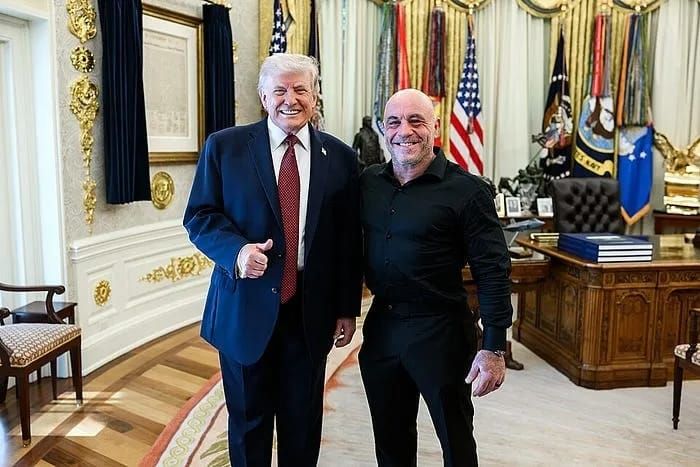
Joe Rogan had an unexpected moment when confronted with racism, and he failed the McCain test. At UFC Freedom 250, held on the White House South Lawn, Joe Rogan was performing his standard role as the post‑fight interviewer. Rogan always steps into the Octagon immediately after a bout, microphone in hand, ready to ask the winner about the fight. After Josh Hokit defeated Derrick Lewis, Rogan approached him for the routine interview. Cameras were rolling, the crowd was loud, and Rogan, as always, held the mic close so the fighter’s comments could be heard clearly on the broadcast.
Hokit began with typical post‑fight remarks, thanking his team and praising the event. But then he abruptly pivoted into politics, saying he wanted to “tell the truth.” That’s when Hokit delivered the line that stunned the audience and the broadcast: he asked America to agree that “Michelle Obama is a man.” Rogan did not immediately condemn or correct Hokit, as John McCain might have. Instead, he pulled the microphone back from Hokit and said, “Ladies and gentlemen, Josh Hokit.”
One could defend Rogan, who was caught by surprise. He was the emcee of the event and might have thought it best to move the event along to the next fight and move past the Hokit comment. Who among us has not missed a moment and later wished they had handled something differently, thinking well after the fact about what they should have said?
Unfortunately, Rogan never found the correct response. When he finally discussed it days later in his podcast, Rogan passed it off as Josh Hokit simply playing a role, without a hint of condemnation of the racism.
“That guy Josh Hokit. You know, that’s like, he’s got a, a shtick. Like, he’s got a character: ‘The Incredible Hok.’ And so he’s basically like a pro-wrestling bad guy who also is a really good fighter. So there’s a real problem there.”
Rogan and his guest, MAGA-leaning comedian Tim Dillon, went on to laugh about how Hokit’s comments were received in American households. Joe Rogan was no John McCain. Whenever Joe Rogan makes what sounds like a reasonable comment or criticizes Donald Trump, (who also didn’t condemn Hokit’s comment made right in front of him). Liberal commentators rave about how wonderful and popular he is.
They must have forgotten his repeated casual use of the word “nigger” on his podcasts and describing a Black neighborhood as “Planet of the Apes.” Rogan has made remarks implying that Black athletes succeed because of physical traits rather than intelligence. Rogan has hosted guests who made racially charged jokes or engaged in stereotypes, and he often laughed along or encouraged the bit rather than challenging it.
There have been several other times when people were confronted with John McCain moments:
In 1980, Ronald Reagan launched his general‑election campaign in Neshoba County, Mississippi, near the site where white supremacists murdered three civil‑rights workers. He declared support for “states’ rights,” a phrase long used to defend segregation. Reagan ignored the racial meaning of the phrase and never acknowledged the symbolism of the location. He dismissed criticism and refused to clarify the racial implications. Reagan wasn’t caught by surprise with racism; he perpetrated it.
George H.W. Bush (1988) ignored the racist framing of the Willie Horton ads. The infamous Willie Horton ads portrayed a Black man as a violent threat, using racial fear to attack Michael Dukakis. Bush never condemned the ads, never distanced himself, and allowed the campaign to continue using racially charged imagery. He insisted the ads were about “crime,” not race.
Bill Clinton (1992 & 1996): Ignored racist policing concerns tied to “superpredator” rhetoric. Clinton embraced tough‑on‑crime policies and rhetoric that disproportionately targeted Black youth, including supporting criminologists who used the term “superpredators.” His wife Hillary also used the term. Clinton ignored civil rights warnings about racial bias and did not address the racial implications until decades later. During the 1990s, he defended the policies and avoided racial critique.
Donald Trump (2017–2020): Ignored racist chants and statements at rallies. At multiple rallies, supporters shouted racist phrases such as “Send her back!” about Rep. Ilhan Omar and other xenophobic chants. Trump did not condemn the chants in the moment, often paused, let them continue, or later reframed them as “patriotic.” He consistently ignored the racist nature of the remarks. It’s no surprise that Trump said nothing when Josh Hokit called Michelle Obama a man.
Strom Thurmond (1948–2000s): Ignored racist hecklers and segregationist supporters. Throughout his career, Thurmond was confronted with racist supporters who praised segregation, used slurs, or invoked white supremacist ideology. Thurmond routinely ignored racist comments from supporters, refused to condemn segregationist rhetoric, and maintained silence when confronted with overt racism at events. I wonder if he even once thought about the Black daughter, Essie Mae Washington-Williams, whom he had out of wedlock and never publicly acknowledged during his lifetime.
Thankfully, there are examples of people doing better:
Mitt Romney (2012): Confronting racist birther hecklers. At several campaign events, Romney was confronted by supporters making racist “birther” claims about Obama — insisting Obama was not American or was secretly Kenyan. Romney corrected them publicly, saying Obama was “born in the United States” and refusing to validate birtherism. He did not always confront every instance, but when directly asked, he rejected the racist claim.
Nikki Haley (2015): Confronting the Confederate flag after the Charleston church massacre. After a white supremacist murdered nine Black parishioners at Mother Emanuel AME Church, the shooter’s photos with the Confederate flag forced South Carolina leaders to confront the symbol’s racist legacy. Haley called for the flag’s removal from the State House grounds, saying it had been “hijacked by hate groups.” She signed the bipartisan bill removing it — a major shift in Southern politics.
George W. Bush (2005): Confronting racist treatment of Muslims. After 9/11, Muslim Americans faced widespread harassment, surveillance, and racist attacks. Bush was confronted with this reality by civil rights groups and Muslim leaders. Bush delivered a nationally televised speech from a mosque, declaring:
“Islam is peace.”
He condemned anti‑Muslim racism, insisted that Muslim Americans were part of the national fabric, and directed federal agencies to treat religious profiling as unacceptable. This remains one of the most forceful anti‑racism statements by a modern Republican president.
In our individual lives, though likely not on national television. We will each face moments where racism is expressed by someone you know, possibly a good friend or family member. When that time comes, will you be John McCain or Joe Rogan? The choice is yours.