

The premise of the Juneteenth holiday is to celebrate the date when enslaved people in Texas were informed of their freedom. On June 19, 1865, seventy-one days after the Civil War ended, Major General Gordon Granger rolled into Galveston, TX, with his army and announced that slavery was over. His announcement wasn’t based on the South losing the war, but the Emancipation Proclamation, which freed Texas’s enslaved people, provided they made their way to a free state or territory. Granger was really telling the enslaved people that Abraham Lincoln had freed them two and a half years earlier.
“The freedmen are advised to remain quietly at their present homes and work for wages.”
Juneteenth is being promoted as “Freedom Day.” But there’s a hitch: nobody was freed on Freedom Day; enslaved people were literally told to go back to their plantations and hope to extract wages from their former enslavers. Don’t come to the army bases or seek help from the government. Enslaved people were told to proceed quietly, the 1865 equivalent of “shut up and dribble.”
“The people of Texas are informed that, in accordance with a proclamation from the Executive of the United States, all slaves are free. This involves an absolute equality of personal rights and rights of property between former masters and slaves, and the connection heretofore existing between them becomes that between employer and hired labor. The freedmen are advised to remain quietly at their present homes and work for wages. They are informed that they will not be allowed to collect at military posts and that they will not be supported in idleness either there or elsewhere.”
— Major General Gordon Granger, General Order №3
Not only were the so-called free people told to return to their plantations, but Union troops also blocked the roads, preventing them from leaving. There was a crop that had to be harvested, and they were the laborers. The state of Texas went on to institute Black Codes, which reinvented slavery. Here are three examples from the Texas Black Codes: Texas required free Black people to sign contracts that effectively reduced them to enslaved people once more. Those without contracts were arrested and then leased out to plantations.
Attempts to make Juneteenth a federal holiday were a long time in the making. Becoming one came instantly. Legislation to recognize Juneteenth was first introduced in 1997 by Barbara-Rose Collins (D-MI). A resolution was passed in the House and the Senate, and a piece of paper was issued. Satisfied, Congress did nothing else related to Juneteenth until 2013, when the Senate passed a new resolution and produced another piece of paper.
By 2016, 45 states recognized Juneteenth, and Opal Lee, the “grandmother of Juneteenth,” began walking from Fort Worth, Texas, to Washington, D.C., to advocate for a federal holiday. For decades, Lee led a symbolic 2.5-mile walk to represent the 2.5 years it took for news of the Emancipation Proclamation to reach Texas. Opal Lee was 89 years old when she led the March to Washington. She truly believed Juneteenth would one day become a national holiday. Her question was, would it occur during her lifetime?
On May 25, 2020, a 46-year-old Black man, George Floyd, encountered police outside a Minneapolis corner store. He later died from his injuries, and his death became another statistic. On May 26, 2020, police issued a statement saying Floyd died after a “medical incident” and that he physically resisted and appeared to be in medical distress. Minutes afterward, a video shot by a bystander was posted online. It went viral, and portions were shown on television stations worldwide. The police immediately responded by saying the FBI would investigate the incident. On May 28, Mayor Jacob Frey called for criminal charges against Chauvin, the lead officer involved. Protests led to unrest in Minneapolis, with some people looting and starting fires—protests spread to other cities around the nation and even the world.
Typically, protests rise and fade, but this time, there was no putting the genie back in the bottle. Protests occurred all over the world, and they did not subside quickly.
These protests occurred during a Presidential election cycle. President Donald Trump was up for reelection in November, as was one-third of the U.S. Senate and the entire House of Representatives. People had taken to the streets across the country, and by people, I mean mostly white people, which made these protests different from most others.
Even more significantly, they were demanding change: elimination of qualified immunity, providing more funding for mental health services and less for the militarization of police forces, and more civilian oversight of police forces. These were things most political leaders didn’t want to do; they feared it would upset their chances for reelection and change the dynamic of police protection that evolved from controlling immigrants and slave patrols. Leaders didn’t want to take action; they needed a distraction; they needed Juneteenth.
During his reelection campaign on September 25, 2020, Trump added making Juneteenth a national holiday to his “Platinum Plan for Black America.” Candidate Joe Biden attended Juneteenth events during his campaign. Joe Biden won the election and was sworn in as President on January 20, 2021. There was a hitch before that on January 6, but it didn’t end the George Floyd protests; the country still demanded change.
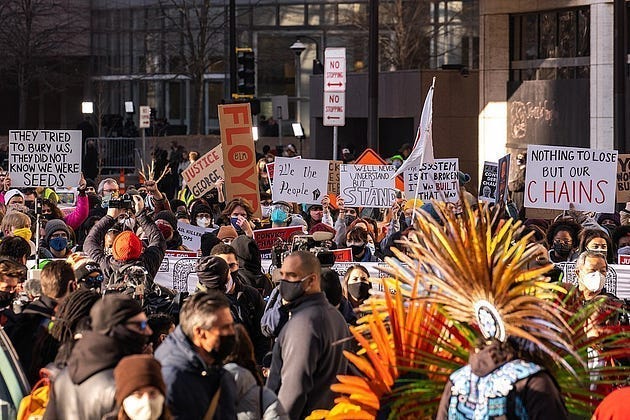
When the protests began in 2020, those opposed to the protesters’ demands had no immediate answer, but soon began to change the narrative. They categorized the protests as “riots” and turned the focus onto Antifa and Black Lives Matter.
They portrayed the mostly peaceful protests as violent, refusing to acknowledge that most of the violence was conducted by the same people who attempted a government insurrection on January 6; the Oath Keepers, Proud Boys, Boogaloo Bois, et al. The police themselves began a work slowdown, annoyed that they might one day be accountable for their actions.
Promises to meet protesters’ demands were not being fulfilled. No action was taken on qualified immunity, and funding for police forces increased, often at the expense of resources for mental health. Something had to be done to appease the masses. To paraphrase Marie Antoinette, “Let them eat barbeque.”
On June 15, 2021, the Senate unanimously passed the Juneteenth National Independence Day Act, establishing Juneteenth as a federal holiday. If you know anything about the U.S. Senate, you know Ted Cruz, Rand Paul, Joe Manchin, and Lindsey Graham didn’t give a damn about Juneteenth, but they went along. On June 16, 2021, the House of Representatives passed the bill without making any changes, passing it on a vote of (415–14). On June 17, 2021, President Joe Biden signed the bill into law, creating the federal holiday we have today.
I like a good barbecue as well as the next person, but the reason it was granted so suddenly wasn’t because all three branches of government had “what alcoholics refer to as a moment of clarity.” The Juneteenth federal holiday was a distraction; the rope-a-dope was a ritualistic okey-doke, much to do about nothing.
Juneteenth is now a federal holiday. Federal employees get the day off, and unlike Martin Luther King Day in several states, the date isn’t shared with Robert E. Lee or Jefferson Davis.
Having served its purpose of distracting from the murder of George Floyd and the millions who took to the streets in protest, parts of the federal government have now stopped recognizing Juneteenth, including the Department of Defense. Defense Secretary Pete Hegseth rolled Juneteenth and Black History Month into the DEI initiatives he won’t allow.
“The president’s guidance is clear. No more DEI at the Department of Defense. The Pentagon will comply immediately. No exceptions, name-changes, or delays. Those who do not comply will no longer work here.” — Pete Hegseth
Removing a federal holiday requires an act of Congress signed off by the president. It’s never happened before, but with this Congress and president, would you be willing to bet against it?
Juneteenth deserved its place as a federal holiday — but not like this, not as a stand‑in for the justice Black Americans were actually asking for. In the summer of 2020, millions marched for accountability, for structural change, for the restoration of voting rights that the Supreme Court had gutted. What they received instead was a holiday. A day off. A gesture.
Congress could not muster the votes to protect the franchise, but it could muster the votes to celebrate the day freedom finally reached Texas. That contrast tells the real story. Juneteenth became the meager substitute offered when the John Lewis Voting Rights Act was allowed to die in the Senate — a symbolic victory handed out in place of the substantive one that mattered.
And so we are left with a holiday that commemorates delayed freedom while living under a political system still comfortable delaying equality. Juneteenth is not the problem; it is the reminder. A reminder that America will honor Black history long before it will honor Black demands. A reminder that symbolism is easy, but protecting democracy is hard. And a reminder that until the promises embedded in the John Lewis Act are finally fulfilled, Juneteenth will remain what it became in 2021 — not a triumph, but a placeholder for the justice that never arrived.