
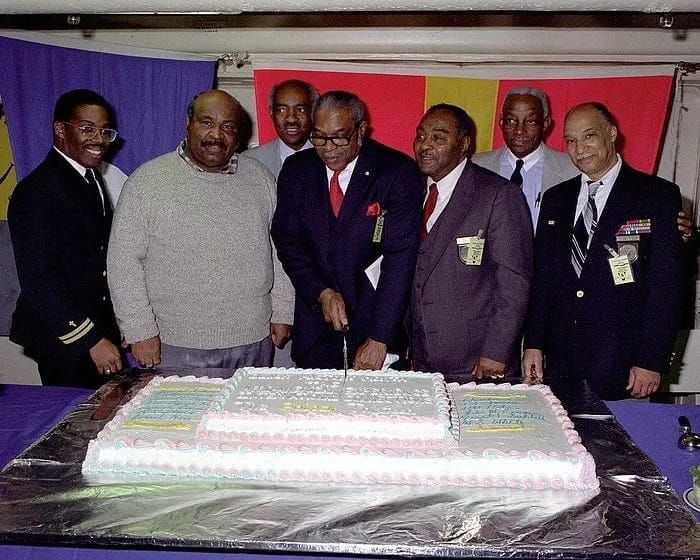
Pete Hegseth’s recent actions targeting Black people in the Navy aren’t new. It’s part of a cycle the Navy goes through when they think they aren’t as dependent on Black sailors and soldiers as in other times. There was a time before the Civil War when Black sailors were desperately needed and made up 10% of the Continental Navy, and over 20% of the Union Navy during the Civil War.
I once considered joining the Navy. Before graduating from Fisk University, I was recruited to join the Naval Aviation Officer Candidate Program. One of the early steps was to take me up in a T-34 plane with dual controls. While flying, I got to take over the controls and fly a plane from the back seat. We circled over Nashville, and I marveled at the number of backyard pools in the Brentwood area and at the chance to see the Vanderbilt, Tennessee State, and Fisk campuses from the air.

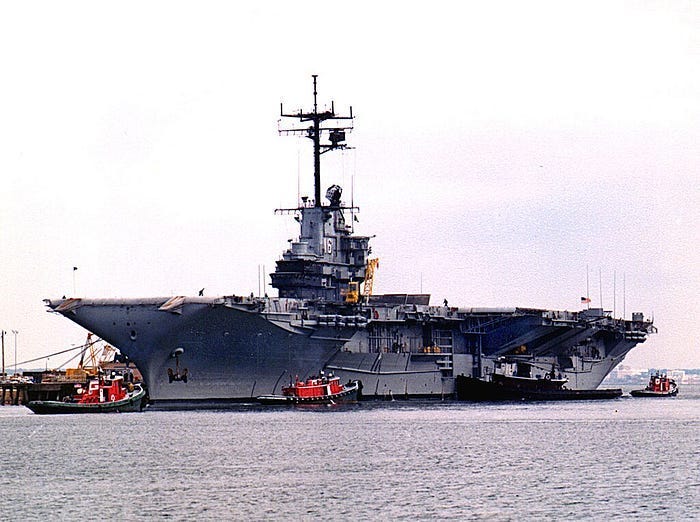
The next recruitment phase involved a tour of the Naval Air Station in Pensacola. I took a commercial flight to Pensacola; the last part involved flying South over the ocean and making a sharp U-turn to find the landing strip, which began not far after reaching dry land. Several recruits took the tour, and we were housed in barracks on base. In no particular order over two days, we toured a decommissioned aircraft carrier, took multiple mental and physical exams, and were taken to the “Official Naval Aviator Strip Club.” That was a designation, not the actual name of the strip joint, but there were pictures of pilots on the walls.
At about 4 a.m., we were awakened by the clanging of trash can lids and shouting and ordered to stand at attention. This scene was similar to one I would later see in An Officer and a Gentleman, but it was five years before the movie came out. A Navy career was made out to be fun: travel the world and fly the friendly skies. The Vietnam War had ended, and no new war was on the horizon.
While touring the aircraft carrier, we passed a couple of Black enlisted men on their knees cleaning the deck. When I was close, one of them whispered, “Don’t do it!” I was sure the life of an enlisted man was different than that of an officer. I had reason to believe the man knew what he was speaking about. The several-month deployments also turned me off at a time when no women were stationed on ships. I ultimately passed on the Navy.
Black men had an off-and-on relationship with the Navy. Between 1775 and 1783, free and enslaved black men served in the Continental Navy during the American Revolution. Black men were paid the same wages as white men, though in the case of enslaved people, the pay may have gone to their owners. Black sailors comprised approximately 10% of the enlisted men and zero % of the officers. White and Black sailors often ate together, bunked together, and engaged in friendly boxing matches on board. Once off the ship, they led segregated lives. In 1798, there was a ban on Black and Mulatto soldiers, which a few Captains ignored.
By the War of 1812, their service was needed again, and the ban was lifted. It’s estimated that 1/6th of the men serving were Black men. The USS Constitution (Old Ironsides) had a quarter of its crew Black. They served as carpenters and loaded cannons. Some were “powder monkeys,” which surprisingly isn’t a racist term. In 1839, Black sailors were officially limited to 5% of enlisted men. No Black men served as officers.
The Civil War created the need for more crew members, and Black sailors were in vogue again. Over 20% of the Union Navy was Black, serving on over 700 ships. Most served in menial roles and were rated as Landsmen or Boys. In 1872, the US Naval Academy admitted its first Black recruit, James H. Conyers. Conyers was often beaten and spat upon, and once, his classmates attempted to drown him. Conyers dropped out after a year. Two other men, Henry Edwin Baker Jr. and Alonzo Clifton McClennan, faced similar treatment later in the 1870s and also dropped out.
In 1896, Plessy v Ferguson became the law of the land but not the sea. Space limitations required Black and white sailors to eat and work together. The Spanish-American War increased the need for Black sailors, who now served as cooks, stewards, and landsmen. Still, some worked as firemen, storekeepers, carpenters, water tenders, oilers, and other specialized billets.
Segregation resurfaced in the U.S. Armed Forces in 1913, when Woodrow Wilson became President. He resegregated the military, and Blacks in the Navy dropped to 3%. The Secretary of the Navy, Josephus Daniels, justified the policy in a letter to a Senator, describing segregation as a benefit to sailors.
“As a matter of policy, it has been customary to enlist colored men in the various ratings of the messman branch . . . and in the lower ratings of the fireroom; permitting colored men to sleep and eat by themselves.” — Josephus Daniels
Women were temporarily allowed to serve in the Navy in 1917 during World War I. The first Black enlisted women joined the Navy in 1918 and were retroactively dubbed the “Golden Fourteen.” All women were kicked out of the Navy in 1920 as Congress amended the Naval Reserve Act of 1916, which allowed any U.S. citizen to serve, to read “any male citizen.” This was the same year women got the right to vote in Presidential elections.
The Red Summer began in mid-1919 and was marked by racial unrest in over thirty American cities and one rural Arkansas county. Little known (and my next topic of research) was that white sailors and Marines attacked Black communities in Washington, DC, Charleston, and Chicago. The Navy suspended new enlistments of Black men, preferring Filipinos to work in the mess halls, where most Blacks were put to use. Those already in the service were permitted to stay on until their retirement. By 1932, the threat of conflict led to the recruitment of new Black sailors. They made up one-half of one percent of the Navy at that point. When Germany invaded France in 1940, the Army was appointing its first Black general, Benjamin O. Davis. The Navy had yet to have its first Black officer.
By 1940, there was public pressure to integrate the federal government and the U.S. Armed Forces. The Navy was the worst of the branches of the military. Besides constant pressure from the NAACP and Black newspapers, they heard from First Lady Eleanor Roosevelt and Naval Secretary Adlai Stevenson. Addison Walker was appointed as a civilian special assistant to Ralph Bard, Assistant Secretary of the Navy. Walker sat on a committee of Navy and Marine officers to review whether existing policies were discriminatory and what changes should be made. The committee determined that allowing Blacks to serve in other billets would disrupt naval operations, and thus, no policy changes were needed. Walker disagreed and wrote a separate report. When nothing changed, Walker resigned from his position.
In early 1942, Black enlisted men were still restricted to limited duties. The Navy reported they were no worse than the civilian population in that regard. “If restricting Blacks to the messman branch was discrimination, it was consistent with discriminatory practices against Blacks and citizens of Asian descent throughout the United States.” On April 7, 1942, the Navy opened all general service ratings to Black men. They determined an unfair burden was being placed on white men. On March 13, 1944, the Navy commissioned its first group of Black officers, the Golden Thirteen.
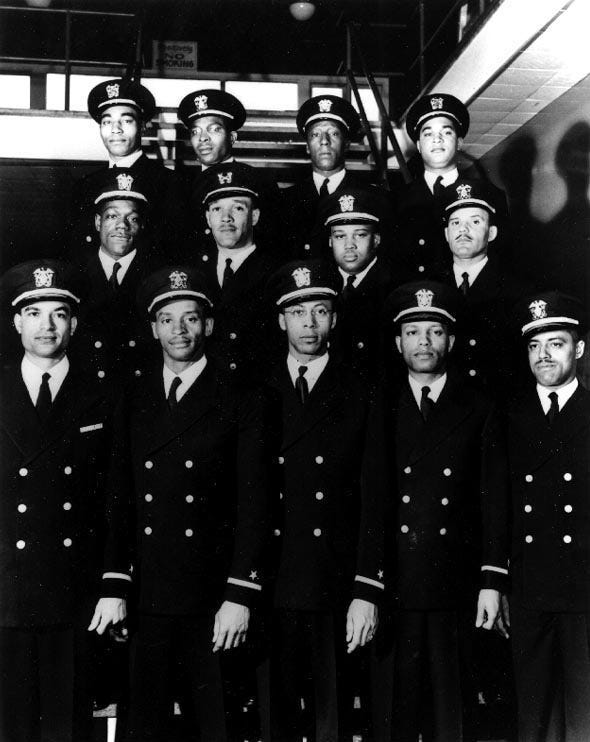
There were actually 16 Black men in that first class. For reasons still unknown, three of the men with passing grades were dropped from the program and returned to the enlisted ranks. The best guess is that the pass/fail rate was made to match that of other officer candidate classes. Once the thirteen remaining were finally commissioned as officers, they learned there were no officers’ quarters for them, and they would have to live off base. They weren’t allowed into officers’ clubs and wouldn’t be allowed to command white sailors — twelve of the thirteen separated from the Navy at the end of World War II. Only one became a career naval officer, Dennis Nelson, who retired as a Lieutenant Commander.
Shortly after, the Navy commissioned thirteen officers in 1944. It became clear it hadn’t resolved its problems with race. The Port Chicago Disaster, which killed 320 mostly Black sailors and wounded another 390 sailors and civilians, showed the downside of segregated units under white command. The subsequent trials saw 50 men convicted of treason for refusing to go back to work in dangerous conditions.
The Navy continued to make progress, though at a snail’s pace. Women were admitted into the WAVES reserve units in 1944. On March 5, 1945, Black Seabees in the nearly all-Black 34th Construction Battalion at Port Hueneme ended a two-day hunger strike. The protest occurred after the unit’s commanding officer refused to promote any African American to chief petty officer billets, although many of the senior enlisted Black sailors in the battalion had served two years overseas and fully deserved advancement. On the same day, Phyllis Mae Dailey integrated the Navy Nurse Corps. On July 6, 1948, President Truman issued an executive order to desegregate the military and federal government.
I turned down the Navy’s offer to attend the Naval Aviation Officer Candidate Program. I could say I had heeded the whisper telling me, “Don’t do it!” but it had more to do with the several-month deployments with no women. Yes, that was shallow reasoning. I currently know several retirees who were career Navy officers and sailors. They owe thanks to the Golden Thirteen, Golden Fourteen, and all who preceded them.
And now Pete Hegseth is doing his version of Woodrow Wilson to segregate and reduce the service of Black men and women in the armed forces, particularly the Navy. Pete Hegseth used his influence to stall or block promotions of officers — overwhelmingly Black — whom he believed were advancing because of diversity initiatives rather than merit. This pattern emerged in three ways:
1. Targeting promotion lists that included Black officers
Hegseth reportedly flagged certain Navy promotion slates as “political,” “woke,” or “DEI‑driven,” and urged Trump‑aligned officials to delay certification, demand “additional review”, remove specific names, and freeze advancement until “ideological concerns” were addressed.
The officers most frequently targeted were: Black surface‑warfare officers, Black aviators, Black women in leadership tracks, and Black officers involved in diversity or inclusion programs. This was not framed as “race‑based blocking,” but as “anti‑DEI correction.” The effect, however, was racial.
2. Opposing grooming‑standard reforms that disproportionately affected Black sailors
This is the part your tab shows. Grooming violations can derail evaluations, reduce promotion competitiveness and trigger disciplinary marks. By pushing for stricter grooming rules that disproportionately penalized Black service members, Hegseth indirectly harmed their promotion prospects. Hegseth’s policies call for dismissal of Black men who grew beards to address a medical condition, pseudofolliculitis barbae, almost exclusively affecting Black men, where they get ingrown hairs from shaving.
3. Publicly attacking Navy DEI officers — all of whom were people of color
Hegseth repeatedly singled out Navy DEI directors, cultural‑competency officers and equal‑opportunity program leaders. Almost all were Black or Latino. He accused them of “politicizing the force,” “lowering standards,” and “undermining readiness.”
Behind the scenes, this translated into pressure to halt their promotions, reassign them, eliminate their billets and block their advancement to O‑6 and flag‑track positions
Why this is considered “blocking promotions” even without a formal order
The military promotion system is bureaucratic and hierarchical. A single influential advisor can derail careers without ever issuing a written directive.
Hegseth’s influence operated through:
- informal pressure
- political signaling
- ideological vetting
- targeted criticism of specific officers
- encouraging Trump‑aligned Pentagon officials to “review” lists
When a promotion list is “reviewed,” “held,” or “sent back,” careers stall. When a name is removed quietly, the officer never knows why. This is how political interference works in the military. The officers most affected were Black.
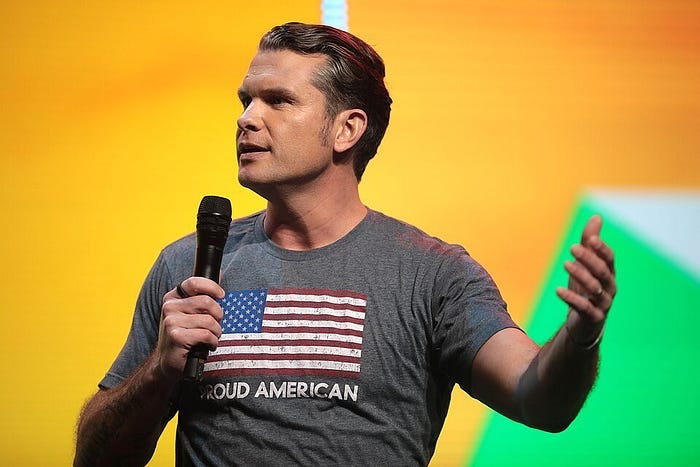
Pete Hegseth’s behavior isn’t new; it’s part of a long American tradition of gatekeeping dressed up as patriotism, where claims about “standards” or “readiness” become tools for deciding who gets to rise and who gets held back. The military has seen this pattern before — in the 1940s, the 1960s, the 1980s — each time wrapped in different language but aimed at the same officers who were told they belonged enough to serve, but not enough to lead. What feels new is only the vocabulary, not the impulse.
Still, history also shows that the pendulum does swing. The forces that try to narrow the definition of who counts as American eventually lose to the people who insist on expanding it. I want a day when the military and the country it serves finally move past these cycles — when the pendulum doesn’t just swing back but stays centered on fairness long enough for everyone to rise without having to fight the same old battles.