
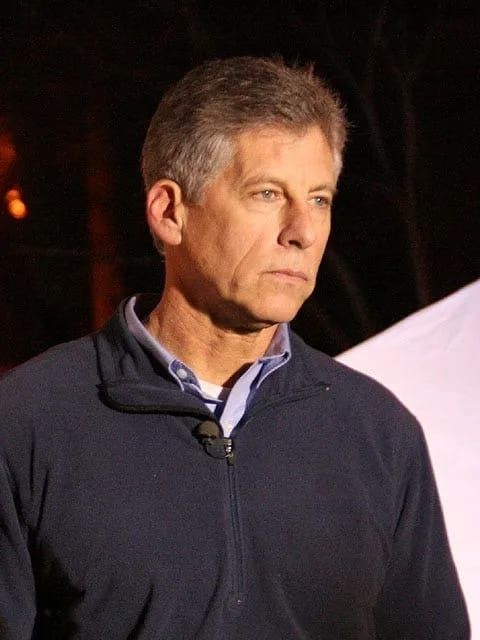
The recent death of Mark Fuhrman gave me a reason to recall him from the time we knew him best, surrounding the trial of OJ Simpson that made him nationally known. The death of OJ Simpson brought back several images from his life, most revolving around the time just preceding and during his infamous trial for the murders of Nicole Brown Simpson and Ron Goldman. I wrote most of this story at that time and thought it was worth recycling.
Much of the news coverage focused on the slow-speed chase in his white Ford Bronco when he was alleged to have a gun and to be suicidal. Every news network dropped coverage while waiting to see if OJ would kill himself rather than turn himself in to the authorities.
Moments during the trial were highlighted, such as when prosecutor Christopher Darden asked Simpson to try on a pair of gloves that didn’t fit — the lyrical summation by defense attorney Johnnie Cochran and prosecutor Marcia Clark’s bad hair days. Hardly mentioned was the testimony that made the Los Angeles Police Department (LAPD), in particular, and police forces in general, look so bad that the media had to find a new way to talk about race. It was when they began replacing the word “nigger” with “the N-word” to lessen the impact of describing the racism in America.
The discussion of whether or not to allow the introduction of the “Fuhrman Tapes” and how much would be played for the jury caused many people to take sides based on racial attitudes. It was possible for Simpson to be guilty of the murders, but also be prosecuted by a racist system in which police officers often perjured themselves and planted evidence to convict Black suspects because they didn’t matter. Police attitudes were as much on trial as OJ Simpson, and when he was acquitted, many Black people cheered.
The Fuhrman Tapes evolved from screenwriter Laura Hart McKinny’s interest in writing a screenplay about the experience of female police officers in the LAPD. She hired LAPD officer Mark Fuhrman as a technical consultant, and they conducted a series of taped interviews from February 1985 to July 1994. By June 1994, Officer Fuhrman had become Homicide Detective Fuhrman and was involved in the investigation of the Nicole Brown Simpson/Ron Goldman murders. Fuhrman had previously arrested OJ for domestic abuse.
One of the lines of defense of Simpson during the trial was the alleged racism of the LAPD. The main piece of evidence the defense team had to overcome was the bloody gloves discovered by Mark Fuhrman, one near the Brentwood townhome where Nicole Brown Simpson lived, and where the murders were committed. The other was on a pathway behind the guesthouses on the Simpson estate.
The strategy became to discredit Fuhrman and accuse him of planting the glove at the Simpson estate as one of the four officers conducting the initial search. Famed defense attorney F. Lee Bailey tried to establish Fuhrman’s racism by asking if he had used the term “nigger” in the past ten years. The timeframe was arbitrary, as Judge Lance Ito had already ruled that evidence older than that was inadmissible. Bailey later said he did not know about the Fuhrman tapes at the time. Fuhrman replied he had “never” used the term in that timeframe.
After interviewing LAPD officers who had bragged to Fuhrman, the defense team became aware of Laura Hart McKinny and the tapes. She tried to avoid the defense’s subpoena but ultimately was served and testified. Defense Lawyer Johnnie Cochran called her to the stand, and this is part of her testimony:
“MR. COCHRAN: How many tapes were actually transcribed? Over the ten-year period how many hours?
MS. MCKINNY: Oh, eleven to twelve hours of tape.
MR. COCHRAN: And I presume during those eleven to twelve hours you tried to be as accurate as possible, right?
MS. MCKINNY: Yes.
******
MR. COCHRAN: Now, during the time that you talked with Mr. Fuhrman during this ten-year period of time, did he ever use a racial epithet which I will call the “N” word, during the course of your conversations with him?
MS. MCKINNY: Yes, he did.
MR. COCHRAN: And in the course of your preparation of your testimony here today can you tell the jury how many times you counted that he used that word?
MS. MCKINNY: Approximately 42.
MR. COCHRAN: 42 times?
MS. MCKINNY: Yes.
******
MR. COCHRAN: Can you describe for the jury under what circumstances he would use this so-called “N” word? Was he talking about?
MS. MCKINNY: Police procedures.
MR. COCHRAN: What was he talking about?
MS. MCKINNY: Let me see. The word would come up in conversation when he might be talking about how an officer might deal with a suspect or a police procedural issue or how an officer might be talking about someone in administration, just general normal language.
THE COURT: Next question.
MR. COCHRAN: All right. When you would hear these words of this particular epithet, would that have an effect upon you.
******
MS. MCKINNY: It is a base epithet. There is no way of doctoring it up and making it sound better. It is offensive and I didn’t feel good about it, hearing it; however, I was in very much of a journalistic mode and knew to be able to get the information that I needed, to be able to inquire from Officer Fuhrman, I would need to not react, not to be judgmental about hearing some of the very base offensive kinds of things that I would be hearing.
******
MR. COCHRAN: Did you say anything to him about using these words at that time?
MS. MCKINNY: No, I did not.
*******
MR. COCHRAN: Yes. During the 41 or 42 times that Mr. Fuhrman used the word “Nigger” did you — could you tell us how he appeared as he did that?
******
MS. MCKINNY: When Officer Fuhrman used the word “Nigger” it was in a very casual ordinary pattern of speech. It was nothing extraordinary. It was just conversation.”
McKinny’s testimony showed the existence of tapes that would discredit Mark Fuhrman and the LAPD. In addition to the 42 uses of the N-word, Fuhrman described the routine beating of Black suspects, planting of evidence, perjury, and other harsh treatment of Black suspects and ordinary citizens. The tapes weren’t specific to the OJ case, and the battle began regarding how much would be admitted. The fight took place away from the jury, but the nation heard about the treatment of Black people by police officers in Los Angeles and presumably across the country. Here are some excerpts:
But that gives a lot of credibility, when you’ve got a real heavy investigation. We had one. I had 66 allegations of brutality: AEW, under color of authority, assault and battery under color authority. Torture, all kinds of stuff. Two guys, well, there was four guys. Two of my buddies were shot and ambushed, policemen. Both alive and I was first unit on the scene. Four suspects ran into a 2nd story in a apartment projects — apartment. We kicked the door done. We grabbed a girl that lived there, one of their girlfriends. Grabbed her by the hair and stuck a gun to her head, and used her as a barricade. Walked up and told them: `I’ve got this girl, I’ll blow her fucking brains out, if you come out with a gun.’ Held her like this — threw the bitch down the stairs — deadbolted the door — Let’s play, boys.-Fuhrman
Q. Can we use that in the story?
A. It hasn’t been 7 years. Statute of limitations. I have 300 and something pages internal affairs investigation just on that one incident. I got several other ones. I must have about 3000 or 4000 pages of internal affairs investigations out there. Anyway, we basically tortured them. There was 4 policemen, 4 guys. We broke ’em. Numerous bones in each one of them. their faces were just mush. They had pictures on the walls, there was blood all the way to the ceiling with finger marks like they were trying to crawl out of the room. They showed us pictures of the room. It was unbelievable, there was blood everywhere. All the wall, all the furniture, all the floor. It was just everywhere. These guys, they had to shave so much hair off, one guy they shaved it all off. Like 70 stitches in his head. You know, knees, cracked, oh it was just — We had ’em begging that they’d never be gang members again, begging us. So with 66 allegations. I had a demonstration in front of Hollenbeck station chanting my name. Captain had to take them all into roll call, and that’s where the internal affairs investigation started. It lasted 18 months. I was on a photo lineup, suspect lineup. I was picked out by 12 people. So I was pretty proud of that. I was the last one interviewed. The prime suspect is always the last one interviewed. They didn’t get any of our unit — 38 guys — they didn’t get one day. The custodian — the jailer of the Sheriff’s Department got 5 days, since he beat one of the guys at the very end . . . Boy, you know, and started . . .
Immediately after we beat those guys, we went downstairs to the garden hose in the back of the place. We washed our hands. We had blood all over our legs, everything. With a dark blue uniform, you know, and in the dark, you can’t see it. But when you get in the light and it looks like somebody took red paint and painted it all over you. We had to clean our badges off with water, there was blood all over ’em. Our face [sic] had blood on them. We had to clean all that. We checked each other, then we went our, we were directing traffic. And the chiefs and everything were coming down because two officers were shot, `Where are the suspects?’ `I think some of these officers over here got them,’ they took them to the station. Somehow nobody knows who arrested them. We handcuffed them and threw them down two flights of stairs, you know. That’s how they came. That’s where a lot of people saw, you know.
`Look out! Here comes one. O my God, look out, he’s falling! I mean you don’t shoot a policeman. That’s all there is to it.
But anyway, the point is — Well, they know I did it. They know damn well I did it. There’s nothing they could do, but I could. Most of those guys worked the 77th together. We were tight. I mean, we could have murdered people and got away with it. We were tight. We all knew what to say. We didn’t have to call each other at home, and say, `Okay.’ We all knew what to say.
Most real good policemen understand, that they would love to take certain people, and just take them to the alley and blow their brains out.
Q. Certain people.
A. All gang members for one. All dope dealers for two. Pimps, three. There’s probably your three most worthless types of people in a large city.” — Mark Fuhrman
“When I was working gang, we used to get a murder. And you’d know which gang did it, but they wouldn’t talk. So, I would go pick up three or four gang members and bring them to the station, take one in the basement and beat the dogshit out of him, without even asking him a question. Bring him up and sit him down. He’s bleeding, face is all puffed up, got hurt. Next guy, take him downstairs. `O.K., who shot at him?’ That’s how you get information. what is this patty cake, patty cake shit psychology. Well, we have to teach our officers some Spanish. I work Mexican gangs, and I don’t know how to speak Spanish. How do they do that. When they speak Spanish, no comprende, slap them upside the head. Speak English! I’m an English teacher, just like that. That’s police work. That’s being able to pick out the people. That type of treatment is necessary.”
Mark Fuhrman was prescient in this case. While about 30% of the public believed he planted the bloody glove at the Simpson estate, 100% knew Fuhrman was a racist, and even the prosecution called him a “bad cop” during the trial. Fuhrman was charged with perjury and ultimately negotiated an agreement in which he pleaded no contest, was fined $200, and placed on probation for three years.
Only two examples of Fuhrman saying “nigger” were heard by the jury, and none of the statements about the police beating suspects, perjury, and planting evidence. An LAPD Commission later found that Fuhrman had exaggerated in all cases about police behavior. However, they believed his statements about women and took steps to address the misogyny in the department.
Fuhrman calls women “frail little objects” who “watch soap operas” and says that “females lack the one ingredient that makes them an effective leader, and that is testosterone, the aggressive hormone.” Fuhrman also stated on the tapes that “you’ve got to be able to shoot people, beat people beyond recognition, and go home and hug your little kids. Women “don’t pack those qualities.” Fuhrman was also recorded stating that women who were good leaders “are either so ugly or they’re a lesbian or they’re so dyke-ish that they are not women anymore.”
Steps were taken to address the treatment of female officers on the force, but the examples of racism were largely discredited and ignored. The general focus was to root out the systemic misogyny against female officers in the department while barely acknowledging the racism against the Black community. With the resurgence of attention on OJ Simpson after his death, the light should shine once again on the Fuhrman Tapes, whose significance shouldn’t be overlooked.