
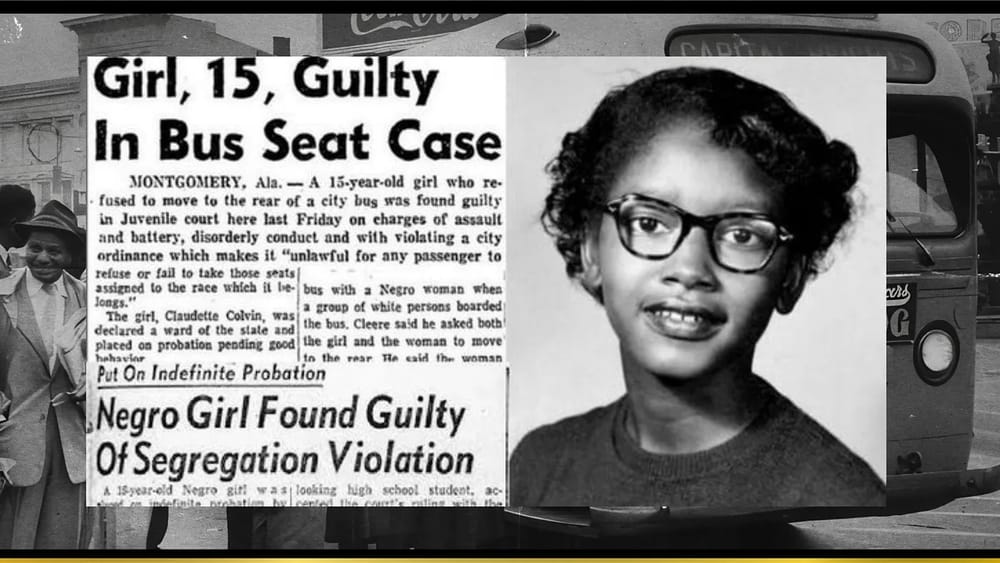
Inthe spring of 1955, Claudette Colvin, a 15-year-old Black teenager, refused to give up her seat for a White woman. Along with classmates, she boarded a city bus in Montgomery, Alabama, and sat behind the first five rows reserved for white passengers. After a few stops, the bus became full, so a White woman who boarded could not find an open seat. The “bus driver asked Colvin and her friends to get up.” But Claudette refused, shouting, “It’s my constitutional right!” Despite hearing officers’ demands, she refused to stand, later saying she felt “glued to the seat” by history, that her “mindset was on freedom.” Police officers forcibly removed Colvin and placed her under arrest for “assault and battery, disorderly conduct, and violating an ordinance which makes it ‘unlawful for any passenger to refuse or fail to take those seats assigned to the race to which he belongs.” Despite sitting in the colored section, southern society expected a Black person to give up their seat for any White person, exposing the disingenuous nature of their separate-but-equal doctrine.
While Claudette Colvin protested racially segregated seating on a Montgomery bus nine months before Rosa Parks refused to give up her seat, she’s not as well-known. This is because of what historian Evelyn Brooks referred to as “politics of respectability.” As a young, dark-skinned teenager who became pregnant, some local civil rights leaders “worried they couldn’t win with her,” and described her as “mouthy, emotional, and feisty.” Rosa Parks, on the other hand, had a fairer complexion, served as secretary of the Montgomery chapter of the NAACP, and received anti-segregation training. At the time of her arrest, Colvin wore a braided hairstyle, while Parks had her hair straightened in an updo. Although both protested racial segregation on public transportation by refusing to give up their seat to a White person, many believed it was best only to emphasize Parks’ narrative.
While Black victims are rarely seen as ideal (Long, 2021), middle-class Black people embraced respectability politics during this period “in an effort to resist and dissolve White Americans’ negative stereotypes about Black women (Bunyasi & Smith, 2019).” This belief led them to shift the spotlight away from the outspoken teenager, Claudette Colvin, and onto Rosa Parks, thereby dismissing her narrative as hidden history. In a New York Times interview, Claudette Colvin said, “My mother told me to be quiet about what I did,” to “let Rosa be the one,” arguing that “White people aren’t going to bother Rosa — her skin is lighter than yours, and they like her.” Colvin herself noted that “Her skin texture was the kind that people associate with the middle class,” noting that Rosa Parks “fit that profile.” Those who endorsed respectability politics hoped that adhering to white social norms would shield them from racist mistreatment and attacks. However, this omission, while strategic, contributed to much of the public believing an incomplete story, one that inaccurately claims Rosa Parks was the first to protest racial segregation on a Montgomery bus.
While many Americans know that the Montgomery Bus Boycott helped end segregation on public buses, there’s more to the story. In 1956, two years after Brown v. Board of Education declared racially segregated schools unconstitutional, lawyers Fred Gray and Charles D. Langford filed a suit on behalf of four African American women, Aurelia S. Browder, Susie McDonald, Mary Louise Smith, and Claudette Colvin, each of whom endured mistreatment on city buses due to racist segregation statutes. Aided by Thurgood Marshall and NAACP civil rights lawyers, the case reached the Supreme Court, which ruled in their favor. Dr. Martin Luther King, who was being tried in court over the legality of Black people using carpools during the boycott, described this victory as “a reaffirmation of the principle that separate facilities are inherently unequal, and that the old Plessy Doctrine of separate but equal is no longer valid, either sociologically or legally.” The outcome in Browder v. Gayle ended the bus boycott, and as King said, Black people could “return to buses tomorrow on a non-segregated basis.” But none of this would have been possible without Claudette Colvin, a teenager dissatisfied with the second-class citizenship that Southern society imposed on Black people.
Limited access to black history often flattens public perception of the civil rights movement, as some can name only a few leaders and events. But the reality is, abolishing Jim Crow required the concerted efforts of many Black people. For example, few realize that in 1953, Reverend T.J. Jemison of the United Defense League led the first large-scale bus boycott in Baton Rouge, Louisiana. Black people protesting fare hikes and segregated seating prompted the council to pass Ordinance 222, which changed the rules so riders could board city buses on a first-come, first-served basis, with Black riders entering from the back and White riders from the front. Drivers no longer had to pass up Black riders if only white sections were available, but they continued to do so. They went on strike, refusing to comply, and found support among the Louisiana Attorney General, who declared the ordinance unconstitutional. In response, 20,000 African Americans participated in an eight-day bus boycott to apply economic pressure. In the end, the city modified the ordinance, but Black riders still had to sit behind White riders. The Montgomery Bus Boycott, which happened two years later, and the Supreme Court case Browder v. Gayle were key steps in ending racial segregation on public transportation.
Since Claudette Colvin passed away in January, Americans have reflected on her legacy as a civil rights leader, but we should also consider why she became an unsung hero. According to author Atiba Ellis, respectability politics deny “the victim agency to demand their dignity.” In this case, local civil rights leaders and others believed she wouldn’t be seen as an ideal victim, depriving the most marginalized of a voice. Although more Americans learned about Colvin after the release of her biography by Philip Hoose and her 2021 petition to clear her criminal record, there is a risk in today’s political climate that the same factors that initially kept her out of mainstream civil rights discussions will once again push her story into obscurity. Colorism, discrimination based on skin color, and texturism, discrimination based on hair texture, persist, influencing which stories are valued or included in our understanding of history.
Educating the public about Claudette Colvin, someone who proudly protested racial segregation, may be challenging given this political climate. Over thirty states have passed laws banning critical race theory, restricting access to black historical narratives, as well as contemporary topics like the Black Lives Matter movement in classrooms. Simply discussing the experiences of Black people in America is seen as polarizing in some settings. And yet, despite the fierce resistance to their inclusion, the truth is important, even if hearing it makes some feel uncomfortable. Americans can learn a lot about the struggle for civil rights, but only if they dare to look past oversimplified narratives.