
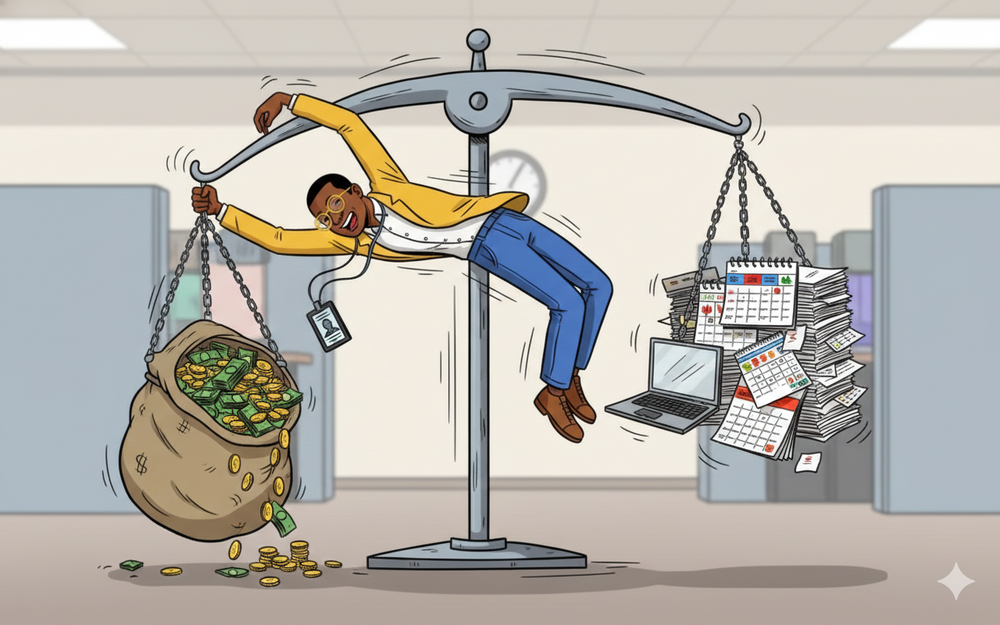
If your employer offered you a lump sum to permanently ditch the job that stresses you out like no other, would you take the money and run—or worry about what it might cost you later? I never thought I’d actually encounter this career conundrum. Looking back, I’m surprised by the choice I made.
The all-company virtual meeting initially seemed like any of the weeklies that had preceded it. There was a weird icebreaker to get folks loose, various team updates, some HR housekeeping. Then the billionaire who signed all of our checks took the screen.
For months, senior leadership had been deprioritizing a project that I—and the vast majority of my colleagues—had been specifically recruited to the startup to produce. They called it a strategic realignment. Or something like that. Our CEO knew many of us weren’t exactly enthusiastic about the reroute. Achieving this newfound mission, he explained, would require the company to get lean. He wasn’t referring to Ozempic.
In retrospect, the writing was on the wall like Destiny’s Child’s second album. But those markings might as well have been hieroglyphics, because I sure as hell couldn’t decode them. I didn’t anticipate what came next.
Corporate folks call it a “voluntary separation package,” but at the time, it seemed like both a trap door and an escape. It was a lot like the severance packages that most professionals are familiar with, but instead of outright cutting roles, the company presented every employee with a tantalizing offer: five months of gross salary and half a year of covered health insurance. All that was asked in return was that you leave the company. And don’t look back.
We had a week to decide. Workflows hit a halt. All outstanding deliverables entered a strange purgatory. For my coworkers, the VSP became the only topic of discussion, as whispers spread about who was clocking out for good, who would remain, and what would be left behind.
For some, the decision to secure the bag was a no-brainer. “You could have a dope summer,” said Gary, one of my Slack homies based in the DMV. He imagined months of passport stamps and midday mischief, and as he spoke, I could damn near feel the beach breeze sweeping across my brow.
Gary meant well, but I had to be real. These were the final days of quarantine. The pandemic had ravaged headcounts at rival companies—and Black folks like me were often the first out of the door and seldom rehired. Those fortunate enough to be employed held onto their jobs tighter than Stevie Wonder and his locs. I wasn’t afraid of chucking the deuces. But I was afraid of starting over in a job market that had already shown me who it was willing to discard first. I didn’t have the luxury of pretending this decision was just about vibes.
That whole week, the second verse of Donell Jones’ “Where I Wanna Be” played on repeat in my head: “Do I leave? Do I stay? Do I go? Or think about my life and what matters to me the most?” Essentially, I was deciding between the risk of extended unemployment (albeit with a nice runway) or the uncertainty that awaited those who remained at the gig. Dominique Dawes had nothing on the mental gymnastics twirling in my brain.
The key to escaping decision paralysis was having conversations with the powers that be. Really, they were more like negotiations. What’s in it for me if I bypass five months of paid freedom and remain on the team? One of our directors hinted that the anticipated departures might open opportunities to ascend the org chart. She couldn't straight up promise upward mobility, but I was very capable of reading between the lines.
For the first time since the offer was announced, the decision stopped feeling emotional and began to feel strategic. If I decided not to abandon ship, it wouldn’t be out of fear or blind loyalty. It would be because there was something tangible on the other side of “thanks, but no thanks.”
That week felt like a month, and it ended with an exodus. But I decided to stay put. And it worked out: I was elevated to senior management, and the work... well, let’s just say the pay bump motivated me to get on board with the new objectives. But sometimes I wonder how the opposite decision might’ve played out, considering the stream of job offers that came pouring in once word got out about the company shakeup. I’m not a math guy, but I’m smart enough to know two salaries beat one. (Gary would agree; he, like some of my other former colleagues, picked up a new gig within a few weeks.)
In the end, the voluntary severance was a lesson in recognizing my leverage. It forced me to ask what I wanted, what I was willing to risk, and what decision put me in the strongest position to win. For that one week, my value and my priorities were crystal clear.