
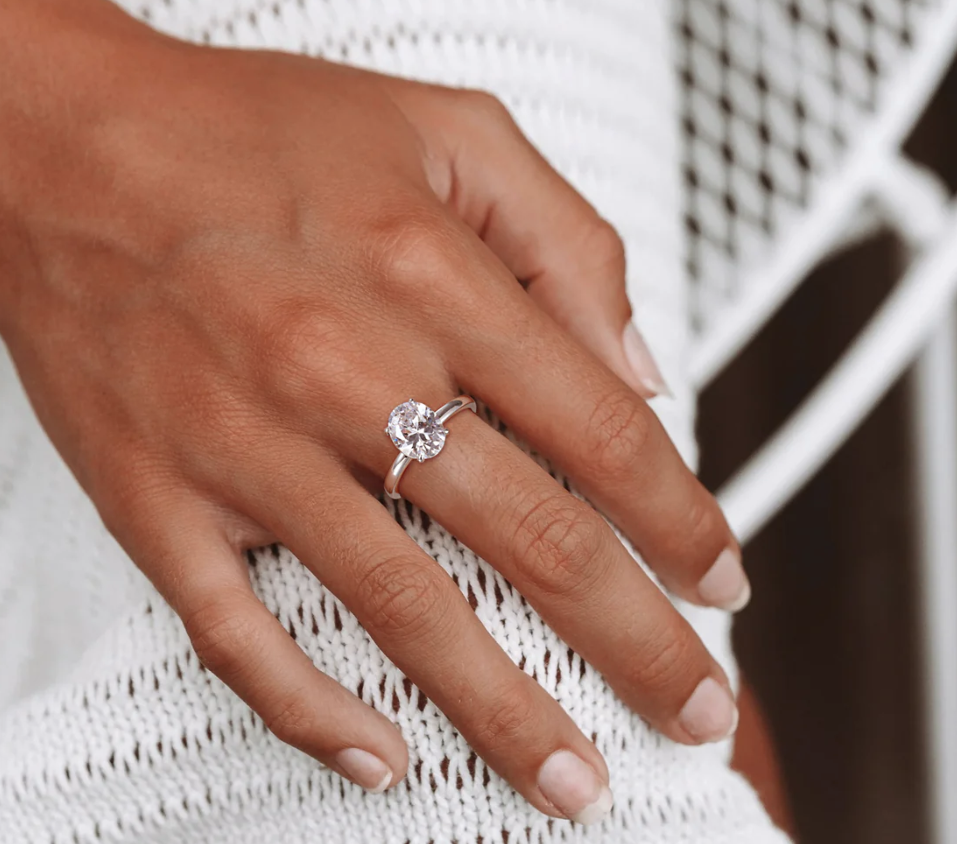
She wears the same thin gold chain every day. Her earrings are small, vintage, probably inherited. Her watch has a leather band, not a metal bracelet. These details tell you more about what ring she wants than any jewelry store quiz ever could.
Most men walk into this purchase backwards. They start with a budget, then a carat size, then a shape that sounds familiar. But the ring she will wear for decades has nothing to do with what looks impressive on paper. It has everything to do with what matches the person she already is.
The average engagement ring costs $5,200 according to The Knot's 2024 study, though that number swings wildly depending on where you live and what you prioritize. Couples in Massachusetts spend an average of $10,817. In South Dakota, that figure drops to $3,005. The ring that makes her cry happy tears could cost $3,000 or $15,000. Price alone is not the variable that matters.
Start With What She Already Owns
Open her jewelry box when she is not home. Take pictures. Look at what she actually wears, not what sits untouched in the back corner. Notice the metal color. Gold, silver, rose gold, or a mix. If 90% of her pieces are silver-toned, a yellow gold band will feel foreign on her hand no matter how beautiful the stone is.
Pay attention to size and scale. Does she wear delicate chains or chunky statement pieces? Small studs or dangling earrings? A woman who gravitates toward minimal accessories will feel uncomfortable with a massive halo setting. Someone who stacks rings and layers necklaces might want something with presence.
Her Pinterest board, if she has one, is essentially a cheat sheet. Many women pin engagement rings without realizing their partners will eventually scroll through looking for answers. Instagram saves work the same way.
When Her Style Leans Toward Soft Geometry
Some women prefer shapes that sit between angular and round. A radiant cut engagement ring offers squared corners with facets that throw light in multiple directions, making it a practical choice for someone who wears both structured blazers and flowy dresses. Cushion cuts share a similar softness, while emerald cuts lean harder into clean lines. Watching which pieces she gravitates toward in store windows or on her Pinterest board tells you where her taste falls on that axis.
The setting matters as much as the stone. A bezel frame suits someone who works with her hands, while a hidden halo adds brightness without looking overdone.
The Shape Question Is Bigger Than You Think
Round diamonds still dominate natural stone sales at 47.9%, but preferences have shifted. Oval cuts now hold the top spot for lab-grown diamonds, and for good reason. The elongated silhouette makes the stone appear larger than its carat weight suggests. It also flatters the finger, creating the illusion of length.
Cushion cuts rose through the ranks in 2025. Emerald, Asscher, and baguette shapes are gaining ground with women who favor clean geometry and Art Deco influences. Zendaya's engagement ring from Tom Holland featured a 5-carat cushion cut in an east-west orientation, and searches for that setting style spiked immediately after she debuted it at the Golden Globes.
East-west settings turn the stone sideways along the band. The look works particularly well with oval, emerald, and marquise shapes. If she tends toward modern fashion with vintage touches, this orientation deserves consideration.
Lab-Grown Diamonds Changed the Math
More than half of couples surveyed by The Knot in 2024 chose lab-grown diamonds for their engagement rings. Among Gen Z buyers, that number climbs to two-thirds.
The price difference is substantial. A 1-carat lab-grown diamond averages around $1,000. A comparable natural diamond runs about $4,200. For a flawless stone, the gap widens further: $5,670 versus $17,552. That savings allows you to go larger on carat size, upgrade the setting, or put the difference toward your wedding or honeymoon.
Lab-grown stones are chemically and visually identical to mined diamonds. Even professional gemologists cannot tell them apart without specialized equipment. The choice between them comes down to what matters to her. Some women care about the origin story of a natural stone. Others prioritize the environmental considerations or the ability to get more size for the same money.
The average lab-grown center stone jumped from 1.31 carats in 2019 to 2.45 carats in 2025. That 87% increase reflects what becomes possible when price per carat drops.
Settings That Match Her Life
A woman who rock climbs, gardens, or works in healthcare needs a setting that will not snag or collect debris. Bezel settings wrap a thin rim of metal around the entire diamond, holding it flush against the band. No prongs stick up. Nothing catches on gloves or fabric.
Hidden halos add extra sparkle underneath the center stone without the look of a traditional halo. The diamonds are visible from the side but not from above, which appeals to women who want brightness without bulk.
Thick band solitaires offer a modern, architectural feel. Three-stone settings carry symbolic weight and provide additional sparkle through the two side stones.
If she wears her grandmother's ring on another finger, pay attention to how it sits. An Art Deco setting with milgrain details might complement that piece better than a sleek modern design would.
What the 4 Cs Actually Mean for Your Decision
Cut refers to how well the diamond's facets interact with light. A poorly cut diamond will look dull regardless of its clarity or carat weight. Cut is the factor that most affects how the stone appears to the eye.
Color grades run from D (colorless) to Z (light yellow or brown). Lab-grown buyers heavily favor the D-F colorless range, with 76% of 2025 purchases falling into that category compared to 29% in 2020.
Clarity measures inclusions and blemishes. Many flaws are invisible without magnification. A stone graded VS2 or SI1 often appears identical to a flawless stone when viewed normally.
Carat weight gets the most attention but matters least in isolation. A well-cut 1-carat diamond can outshine a poorly cut 1.5-carat stone. Shallow or deep cuts reduce brilliance even when the weight looks good on paper.
The Size Question You Cannot Skip
Getting her ring size wrong creates an awkward moment. The ring either jams halfway down her finger or spins loosely while she tries to act pleased.
Borrow a ring she wears on her left ring finger. Trace the inside circle on paper or press it into a bar of soap. Take it to a jeweler for measurement if you can do so without her noticing.
If borrowing is not possible, ask her friends or family. Someone close to her probably knows, or can find out without raising suspicion.
The worst approach is guessing. Rings can be resized, but doing so immediately after a proposal diminishes the moment you planned.
Budget Realities Worth Knowing
The old rule about spending two months' salary came from a diamond company's marketing campaign in the 1930s. It has no basis in financial wisdom.
A more grounded approach starts with what you can afford without carrying debt into your marriage. More than 70% of engagement ring buyers already carry some form of debt. Adding to that total for a larger stone is not romantic. It is a financial burden that compounds.
Regional differences are real. Couples in Mid-Atlantic states spend around $6,900 on average. Midwest couples spend $4,900. Neither amount is right or wrong. The appropriate number is the one that fits your financial reality.
Financing options exist, but the ring she wears should not remind you of monthly payments for years after the wedding.
Bring Her Along or Go Alone
The traditional image of a surprise proposal with a mystery ring has shifted. According to The Knot, 77% of women had some involvement in selecting their ring. That involvement ranges from dropping hints to shopping together to being present at the actual purchase.
Shopping together removes the risk of choosing something she does not love. It also makes the process collaborative rather than secretive. Many couples find this approach more comfortable than the alternative.
If you want to maintain some surprise, have her show you styles she likes without committing to specifics. You handle the final selection, but with guidance.
The average couple spends three and a half months searching for the right ring. Rushing this decision leads to settling or overspending. Give yourself time to look, compare, and learn her preferences before committing.
The Ring Is About Her
Diamonds account for more than 85% of engagement ring center stones. But sapphires, morganites, and other gemstones work for women who prefer color or want something less conventional.
The setting, metal, shape, and stone all communicate something. They should communicate that you paid attention to who she is, what she likes, and how she moves through the world.
The best engagement ring is not the most expensive one or the largest one. It is the one that looks like it was made for her hand because, in a real sense, it was. You chose it by watching, listening, and noticing the details she thought no one saw.