
Fredrick Douglass, the renowned abolitionist, once said, "the white man's happiness cannot be purchased by the black man's misery." But when it comes to plantation weddings, that's a fitting description of the trade-off made. This explains why many of these forced labor camps became destination wedding venues, inviting couples to tie the knot or jump the broom in a setting with clear echoes of slavery. This tradition has lasted for more than a century and a half since the Civil War, predating the nation's affinity for apple pie. And some have chosen to keep this tradition alive, even when there's an opportunity to turn over a new leaf.
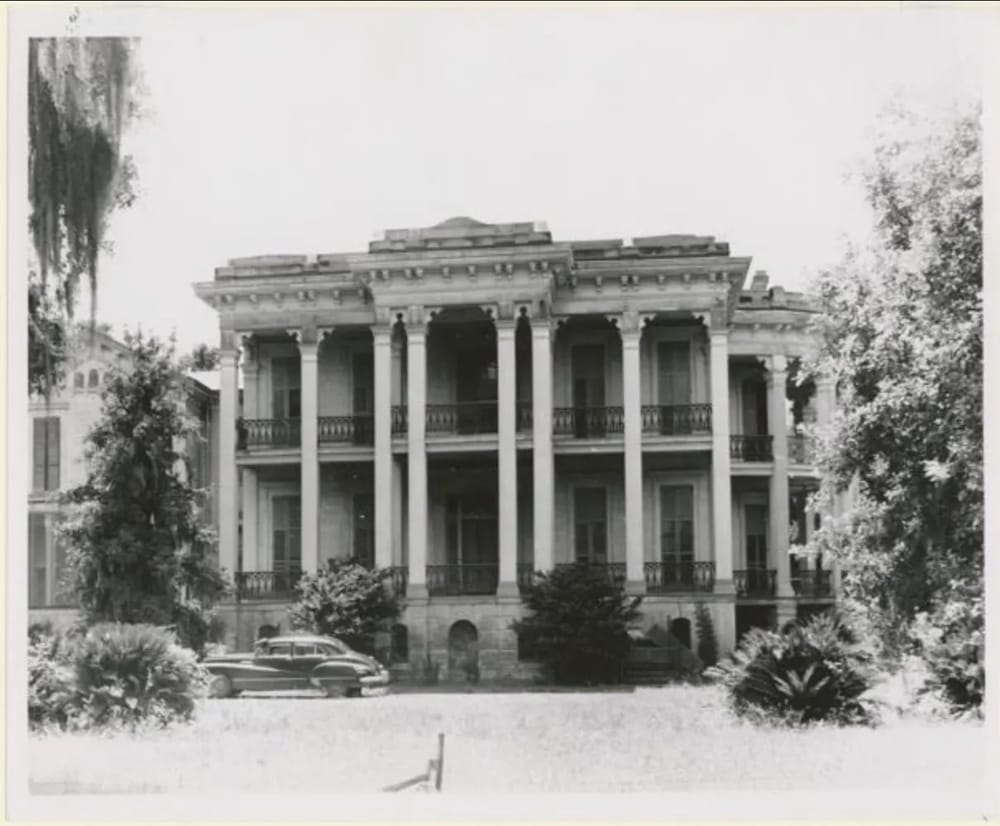
Take, for example, the Nottoway Plantation in White Castle, Louisiana, which caught fire last May. Parish officials determined that an electrical fire caused the flames to spread, destroying the sixty-four-room mansion and its hand-carved Italian marble fireplaces, along with a three-story rotunda decorated with huge white columns, and other exotic, architectural features. While the owner, Louisiana attorney Dan Dyess, mourned the "total loss," many celebrated the fact that the largest remaining Antebellum structure was engulfed in flames.
To understand the controversy surrounding plans to rebuild Nottoway Plantation, we should consider it within the country's broader historical context. After the Civil War, America initially planned to distribute land to formerly enslaved Africans. While Sherman's Field Order №15 allocated 400,000 acres of land into 40-acre plots for formerly enslaved Black families, Andrew Johnson, who became president after Abraham Lincoln's assassination, failed to honor this promise. Consequently, white people retained ownership of most plantation lands and continued to control their use. Without considering input from Black people, few of these sites became spaces that honor those forced to live and work there. In Louisiana, for instance, there are only two. The first is the Whitney Plantation, which now serves as a museum focusing on the experiences of enslaved Black people. Two Black women activists, Jo and Joy Banner, twins whose ancestors were enslaved in Louisiana, own the other, the Woodlawn Plantation, which they acquired through their Descendants' Project. Under their leadership, this space now focuses on the experiences of enslaved people in the region, such as the 1811 German Coast Uprising, and "the plantation to petrochemical through-line."
Clint Smith suggested in his memoir, How the Word is Passed, that "the voices and stories of enslaved people are the foundation of how visitors experience the Whitney." This sharply contrasts with Angola, a plantation turned state prison, which does not focus on the lives of enslaved Black people or those currently working in its fields for pennies a day during their tours. Within the text, Smith addresses the irony of how America treats spaces germane to the history of slavery, compared to other nations, and how they reckon with its history of oppression. For instance, he wrote, "If in Germany today there were a prison built on top of a former concentration camp, and that prison disproportionately incarcerated Jewish people, it would rightly provoke outrage throughout the world." And yet, he noted, "in the United States, such collective outrage at this plantation-turned prison is relatively muted." Similarly, plantations that have been converted into wedding venues and event halls, such as Nottoway, don't typically attract much backlash. You can pick up their brochures in many New Orleans hotels. In addition to those sites transformed into wedding venues, other plantations in Louisiana become museums, such as the Laurel Valley Plantation, an interactive history site that is the largest remaining sugar plantation complex from the 18th-19th centuries, and the Magnolia Mound Plantation in Baton Rouge, which features French Creole architecture and furniture. Others, such as the Destrehan Plantation and the Evergreen Plantation, were converted into industrial sites, and of course, many also became private properties. But these spaces do not center on the experiences of enslaved people as the Whitney and Woodlawn do.
Americans would never call Auschwitz and ask to schedule a wedding, and would be openly disturbed if they learned this was taking place. Yet, when it comes to plantation weddings, there is little outrage expressed, which exposes the selective empathy. And for those who know the country's history, it's rather disturbing that the Nottoway Plantation would rebuild the main house as a destination wedding spot.
The fire, which destroyed much of the property, presented an opportunity for a clean slate, to change how this space was used. Rather than using this space as an event hall, hotel, and restaurant, it could have followed in the footsteps of curators at the Whitney and Woodlawn to become a museum that educates the public about the experiences of enslaved people forced to harvest sugar cane and engage in other grueling work. Neither time nor fresh brick and mortar can remove a plantation's ties to slavery. The fact that many view these spaces through a romantic lens, focusing on the mighty magnolia trees, tall white columns, vast expanses of lush, rich soil, while overlooking the violent history of this space, Black lives crushed in the name of economic efficiency, exposes the source of American disunity. If there is no empathy for what Black people have endured in this country, then there can be no common ground.
If our society wouldn't tolerate anyone hosting a wedding at a concentration camp, then we shouldn't permit anyone to celebrate their nuptials at former plantations. Black people are no less human, and as a result, should be shown the same consideration as other groups of people who endured oppression. There's a reason why, after learning about the plantation burning down, many Black people in Louisiana and throughout the country celebrated. To them, this place represents a racist system that deprived their ancestors of their freedom. While the property owner may not see it this way, planning to rebuild the plantation and using it as a wedding venue is like rubbing salt in the wound of the black community. Even when presented with an opportunity to pivot, the choice was made to continue the Antebellum tradition. On the one hand, the city of White Castle was just as economically dependent upon Nottoway Plantation as the parish was during the Antebellum era. And the destruction of the main house brought the town to its knees, because many residents depend on jobs there and at surrounding businesses. And on the other hand, the refusal to use this property as a museum or donate the land to descendants of enslaved Black people who still live in the area feels like a missed opportunity to reckon with the nation's original sin. Rebuilding a plantation to use as a wedding venue seems to symbolize an unrepentant nation.
The controversy surrounding the plans to rebuild the Nottoway Plantation is only natural. Many Black people, particularly those with enslaved ancestors, feel that former plantations should not be playgrounds for wealthy white people or any other groups. If these structures are maintained and open to the public, people should be told the true history of these places. Nottoway centering the historical narrative presented on those who owned the estate isn't neutral; it is dismissive of the estimated 150 enslaved people forced to live and work there before the Civil War. Perry L. Carter, an associate professor at Texas Tech University whose research focuses on "human, social, urban, and economic geography," wrote, "Antebellum American plantations were agribusinesses composed of vast fields of commodity crops planted and harvested by legions of coerced laborers," noting that "These forced labor camps were sites of torture, rape, disfigurement, and murder." This is the unvarnished truth. So, no matter how aesthetically beautiful these spaces are, we must reckon with the harm produced by slavery. So, it matters what we do with these spaces, whether we use them to educate people about the past, honor those who lived, worked, and suffered there, or trivialize the harm caused.