
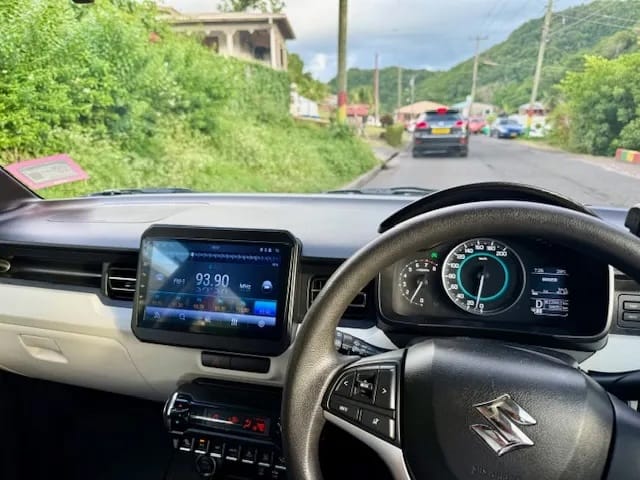
I was in the Caribbean nation of Grenada over Christmas for a dear friend’s 40th birthday. Because the places I needed to go were a bit spread out, I decided to rent a car.
A series of regrettable life choices followed.
The biggest problem was that Grenada, being a former British colony, drives on the left side of the road. Or, as a proud American, I prefer to call it, the wrong side of the road.
This makes everything weird.
Turning feels counter to the muscle memory you’ve spent decades building. Judging how close the car is to the left berm becomes an advanced geometry problem. Every single time I walked up to the car, I instinctively tried to get into the passenger seat like a moron.
And nearly every time I went to use my turn signal, I turned on the windshield wipers. Repeatedly. Aggressively. As if the car and I were engaged in some passive-aggressive standoff.
Now add to that the countless potholes, narrow winding mountain roads clearly designed for two cars but only physically capable of accommodating one, zero streetlights at night, people casually walking in the road at all hours, and hills that appear out of nowhere like jump scares, and you’ve got yourself a perfect storm for an obituary.
Google Maps and Waze didn’t help.
They were wrong about half the time and actively malicious the other half, repeatedly sending me down roads that felt less like roads and more like historical reenactments of colonial-era suffering.
I survived. Barely.
But on the flight home, as I breathed the deep sigh of a man who cheated death, I realized something unexpected.
Driving there forced me to use my brain. Constantly.
Every second required attention. I couldn’t rely on habit. I couldn’t go on autopilot. I had to slow down, reassess, question assumptions, and stay alert. Or else.
Which got me thinking. We Americans have largely stopped doing that.
We’ve become ideological cruise-control drivers. Robot cultists, faithfully following whatever our “side” says about an issue. We don’t pause to gather facts. We don’t ask whether something makes sense. We rarely check whether the meme we just shared was created by a bored human being in a basement somewhere or AI.
Instead, we line up behind whatever the soup du jour position is, slurp it down enthusiastically, and call it independent thought.
As a result, we’ve lost nuance. We’ve forgotten that multiple truths can exist at the same time. We’ve lost the ability to hold more than one idea in our heads or more than one group at a time without short-circuiting. Everything’s now binary. Absolute. End-of-discussion.
And the worst part is that we then give our side’s so-called leaders a free pass to keep barreling forward without challenge. No questions. No skepticism. No accountability.
When someone dares suggest that one of our “facts” might be incomplete, or worse, wrong, we don’t engage. We attack. Because it feels easier to insult than to think.
This dynamic shows up in nearly every issue we face now. Politics. Race. Vaccines. Crime. Climate. Immigration. The Middle East. Education. Pick a topic. The pattern is the same.
Here’s a fun fact.
Studies estimate that over 50% of online content will soon be AI auto-generated, and already a massive portion of viral posts are exaggerated, misleading, or outright made up. Yet we consume them with the confidence of someone who has personally verified the data using peer-reviewed research. Which, of course, we haven’t. Shit, we haven’t even conducted a tiny bit of our own research.
So, my hope for 2026 is simple.
That we slow down. Listen more than we talk. Read more than we react. Maybe even open a book. That we question before we repost. And above all, remember using our brains isn’t betrayal. It’s responsibility.
Driving on the left side of the road reminded me that when the rules change, autopilot will kill you. Attention saves you. Curiosity saves you. Humility saves you.
Humanity deserves that hard thinking again.