
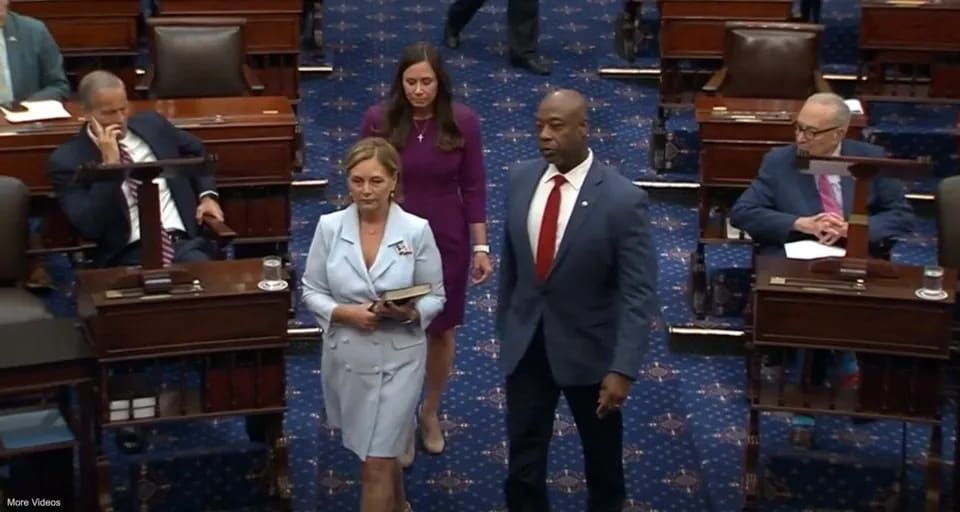
Before she was suggested by Donald Trump for appointment as an interim Senator from South Carolina to replace her deceased older brother, Lindsey Graham, I’d never heard of Darline Graham Nordone.
Darline Graham’s history is rooted in public‑service work that rarely makes headlines but forms the backbone of state‑level governance. Born nine years after her brother Lindsey Graham, she grew up in Central, South Carolina, in a family that lived behind their parents’ bar and liquor store. Her life changed abruptly when both parents died within fifteen months; her mother from cancer, her father from a heart attack. Lindsey, then in his early twenties and newly enlisted in the Air Force, became her legal guardian so she could receive his military benefits. He raised her through adolescence, a relationship she later described as “a brother, a father and a mother rolled into one.”
Professionally, Darline built a career in disability services and workforce development. She worked for the South Carolina Department of Vocational Rehabilitation and the Department of Employment and Workforce, helping people with disabilities find jobs. She later became Commissioner of the South Carolina Commission for the Blind, overseeing statewide programs for vocational rehabilitation, independent living, and blindness prevention. Her role placed her on the South Carolina State Workforce Development Board and its SC Works Management Committee, giving her experience in statewide policy and interagency collaboration. She also holds a bachelor’s degree in sociology, a master’s degree in rehabilitation counseling, and a Certified Public Manager credential.
Though she largely stayed out of electoral politics, Darline occasionally appeared alongside her brother during his 2015 presidential bid, introducing him at his campaign kickoff and joining him at public events. Lindsey often said that raising her was the proudest accomplishment of his life and publicly endorsed her as someone who could “represent our country” if she ever chose to. After Lindsey’s sudden death in July 2026, Governor Henry McMaster appointed Darline to serve as interim U.S. Senator, a move Donald Trump had recommended as a tribute to her brother. She accepted the appointment as an act of loyalty, saying, “Lindsey has always been there for me. And now, I will be there for him.”
I may surprise some readers by saying I don’t object to her appointment. The Republican Governor was never going to appoint someone I wanted; maybe he put someone in who will do little harm. Her qualifications for the Senate aren’t from prior elected office but in decades of public administration, disability‑services leadership, and statewide workforce policy experience. She meets the constitutional requirements for the role: age, citizenship, and residency. Her appointment is unusual, but it fits within a long American tradition of governors selecting respected administrators, caretakers, or family members to fill Senate vacancies temporarily. She will serve until the November 2026 election results are certified and has no known plans to run for the permanent seat.
In my lifetime, I’ve seen Muriel Humphrey appointed to the Senate following the death of her husband Hubert. Lisa Murkowski was originally appointed to the Senate by her father to replace him after he resigned and became governor. George Wallace’s wife was elected governor of Alabama as a proxy for George with no qualifications, and Sarah Huckabee became Governor of Arkansas based on her father’s name and her public exposure from lying for President Trump. As nepotism goes, we’ve done worse.
The next four months will pass, and the nation will survive. Maybe one day, she will cast a vote to pass or refuse a bill, showing the independence her brother, forever a sidekick, lost along the way.