
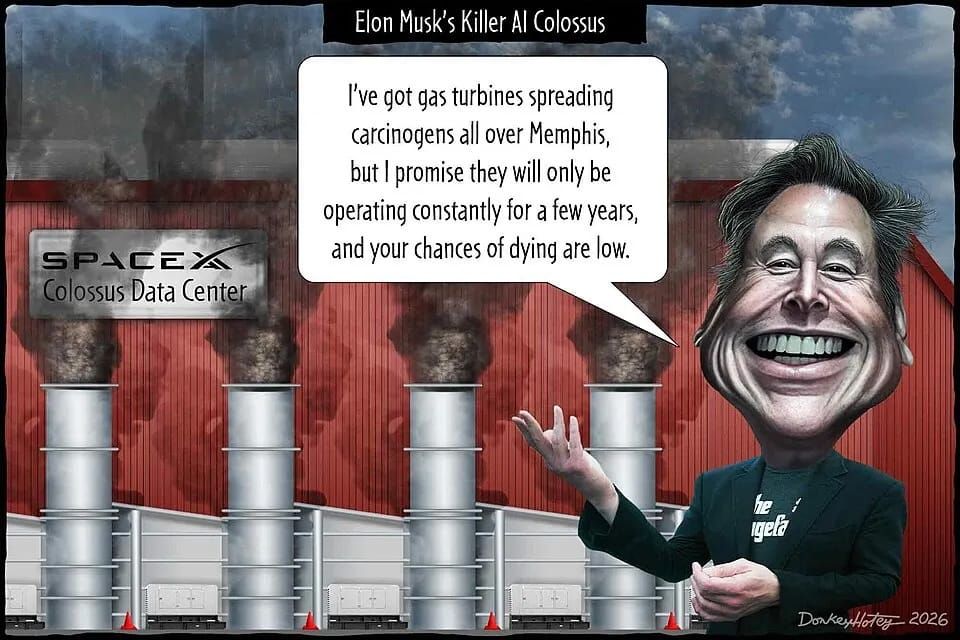
When SpaceXAI/MZX Tech first came to Memphis (2024–2025), the promises were narrow, economic, and framed as “innovation,” with no community‑benefit commitments. At the time of its construction, Elon Musk’s Colossus I and II complex was not just the largest AI data center in America — it was the largest in the world, operating at a scale multiple times greater than any other known facility.
SpaceXAI spoke almost exclusively to economic‑development officials, TVA leadership, and city/county administrators, and framed the project as a clean‑energy, innovation‑driven economic win, even though the underlying plans already depended on methane turbines. The company’s early conversations emphasized “high‑tech jobs,” “economic transformation,” and Memphis becoming a “national AI hub,” but they never provided hiring numbers, workforce guarantees, or community‑benefit commitments.
When speaking with TVA, SpaceXAI framed the project as a next‑generation microgrid “powered by solar and batteries,” promising minimal strain on the regional grid and portraying the turbines as temporary, reliability‑focused generators rather than the continuous power source they actually became.
As the turbines were added, the company’s messaging to officials shifted: SpaceXAI described them as “temporary backup generation,” insisted they were part of a futuristic microgrid, and avoided public disclosure entirely. There were no community meetings, no environmental impact statements, no notification to nearby neighborhoods. Once emissions were detected and the NAACP lawsuit emerged, SpaceXAI reframed its conversations with federal agencies around national security, arguing that the turbines powered defense‑critical AI workloads and that any interruption would harm U.S. capabilities. Throughout these interactions, the company never offered mitigation, monitoring, or community protections; it consistently framed the benefits as economic uplift and technological prestige, while downplaying, obscuring, or recasting the costs as patriotic necessity.
In its April 14, 2026 lawsuit, the NAACP asked the federal court to immediately halt SpaceXAI’s operation of the 27 unpermitted methane‑gas turbines at the Colossus II site, arguing that the continuous emissions violated the Clean Air Act and posed a direct health threat to nearby Black neighborhoods. The complaint requested an injunction forcing SpaceXAI and its subsidiary MZX Tech to cease all turbine activity until proper permits, environmental reviews, and emissions‑control systems were in place. The NAACP also sought civil penalties for each day of unlawful operation, court‑ordered monitoring of air quality around the Whitehaven and Tulane Road corridors, and a mandate requiring SpaceXAI to disclose all future energy‑generation plans to the community and regulators before construction. Finally, the suit asked the court to recognize that the company’s actions constituted environmental discrimination, given that the turbines were placed adjacent to majority‑Black neighborhoods without notice, hearings, or mitigation — a pattern the NAACP argued mirrored historic environmental injustice in Memphis.
The neighborhoods where Musk placed Colossus I and II already had some of the highest industrial‑pollution cancer risks in the country — the result of decades of refineries, chemical plants, diesel corridors, and environmental neglect. The data centers didn’t create the crisis; they added new emissions to a community already living in one.
Neither Elon Musk nor SpaceX/xAI ever issued a public statement about the NAACP lawsuit or the environmental harm caused by the unpermitted turbines. Instead, the company remained silent while the Department of Justice and the Department of Defense intervened on its behalf, framing the operation as a national security matter.
DOJ’s position
- Asked the court to dismiss the lawsuit entirely
- Argued that citizen groups should not be allowed to sue if the executive branch objects
- Claimed the turbines were essential to the economy and U.S. military
- Never disputed that the turbines were illegal or harmful
DoD’s position
- Claimed xAI’s Grok Gov model was used in active military targeting and intelligence operations
- Warned that shutting down the turbines would harm national security
- Framed the data center as essential to classified military workloads
I’ll sum up their arguments by saying, “The government doesn’t care if people in Black neighborhoods suffer or die, because the project was too important!”
Residents reported worsening breathing problems, more frequent asthma flare‑ups, and a constant low‑grade fear that the invisible emissions were compounding an already dangerous environment. Compounding the physical impact was the psychological one: the turbines arrived without notice, without community meetings, and without mitigation, reinforcing a familiar pattern in Memphis where industrial decisions are made over the heads of the people most affected. The result is a community living with both the measurable health risks of increased pollution and the emotional toll of being treated as expendable in the name of technological progress.
Residents near the Colossus I and II sites aren’t just dealing with air pollution — they’re living inside a full spectrum of environmental stressors that touch their bodies, their bills, and their daily peace. The methane‑gas turbines SpaceXAI installed without permits produce a constant mechanical roar, a low‑frequency vibration that residents describe as “a jet engine that never turns off.” That noise isn’t just irritating; it disrupts sleep, heightens stress, and compounds respiratory problems in neighborhoods already carrying one of the highest industrial‑pollution cancer risks in the country. On top of that, the turbines’ massive power draw has strained the local grid, prompting TVA to build new substations and upgrade transmission lines, costs that historically get passed on to ratepayers. Memphis residents have already seen utility bills rise in recent years, and the fear is that the data‑center load will push rates even higher, effectively making the community subsidize the pollution harming them. Taken together, the impact is layered: louder nights, dirtier air, higher bills, and the familiar sense that the people living closest to the turbines are paying the price for a project that never asked for their consent.
The federal government never disputed the environmental harm to Memphis residents. Instead, the Department of Justice argued that citizens should not be allowed to sue at all, and the Defense Department claimed the turbines were essential to national‑security operations. In effect, the government defended the data center’s operation — not the health of the community living beside it.
If the Memphis data centers were proposed today, the surrounding neighborhoods would receive protections that were completely absent when Colossus I and II were built. Modern projects are expected to negotiate binding Community Benefits Agreements that guarantee air-quality monitoring, noise-mitigation requirements, limits on turbine use, and full public disclosure of all on-site energy sources. Communities now demand independent environmental‑justice reviews, mandatory public hearings, and real‑time emissions dashboards funded by the developer. Utilities typically require rate‑stabilization agreements so residents aren’t stuck subsidizing massive industrial loads. In short, a project of this scale today would come with enforceable safeguards and community investments, the very protections Memphis never got.
But suppose a city had all these supposed protections, and pollution was found anyway, electric and water rates increased, or cancer levels rose? What recourse does a community have? We’ve seen what the government allows in Memphis, giving zero f**ks about the residents, and Memphis is a large city. In retrospect, the government recently flooded some of those same neighborhoods during the Trump administration’s “Operation Relentless Pursuit” and its successor programs, which poured hundreds of federal agents — including FBI, ATF, DEA, and U.S. Marshals — into the city. Maybe your community will be treated better, but can you count on it?
Donald Trump chimed in this week:
“The only reason that communities throughout the U.S.A. should not want Data Centers is if they want to end up being backwards and poor.” — Donald Trump
One reason might be that a community's citizens could get cancer, pay more for utilities, and suffer endless noise like a jet engine. There’s that. The Community Benefits Agreements now accompanying most new data centers offer little comfort if, when a community experiences harm, the government turns its back. If you don’t believe the will, ask Memphis. The United States government was aided and abetted by state governments in Tennessee and Mississippi, along with local governments that saw only dollar signs.
Every community should be wary of data centers — not because of what companies say, but because of what they’ve already done. They’ve installed turbines without permits, polluted Black neighborhoods, spiked utility bills, dodged accountability, and let the federal government fight their battles while residents choke on the fallout. The industry keeps promising innovation, but its track record is extraction. Until data‑center operators prove they can build without sacrificing the people living next door, skepticism isn’t negativity; it’s survival. Until you do right by Memphis. . .
Two questions I would want answers to from the government.
- What will you do if things go wrong?
- What did you do for Memphis?