
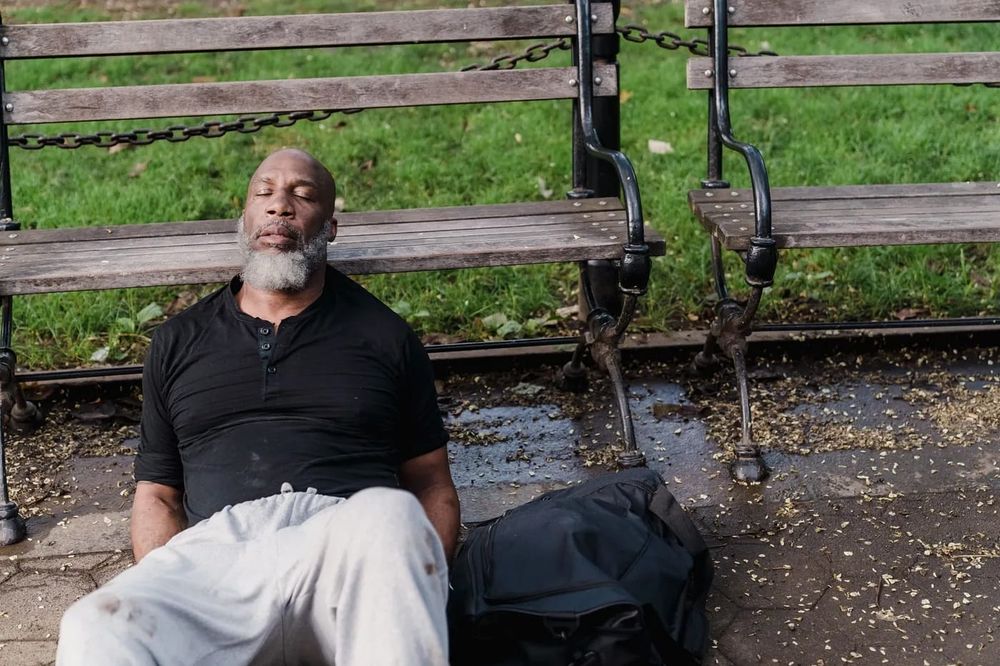
In America, many people live under bridges and underpasses, without a home to keep themselves cool in the summer or warm in the winter. Sadly, rather than embracing policies that uplift those experiencing extreme poverty, some blame them for their circumstances. And this apathy, like water poured on stone steps, has trickled down into the laws and policies that govern our society. Consider, for instance, that following Grants Pass v. Johnson, a case in which Supreme Court justices ruled in favor of municipalities penalizing people for sleeping in public, numerous cities and states passed punitive measures.
One of the most clear-cut examples is Louisiana’s “Streets to Success Act,” which makes it illegal to camp or sleep on public property. Now, those convicted of breaking this law could face up to six months in jail and a $500 fine. Alternatively, they will be offered court-approved treatment in exchange for the charges being dropped. But as with all deals that sound too-good-to-be-true, there’s a catch. If individuals can’t afford the court-ordered treatment, judges may require them to complete unpaid labor in exchange for these services. That’s right, involuntary servitude in the 21st century.
While many Americans believe slavery was fully abolished in 1865, there’s a loophole in the 13th Amendment that permits involuntary servitude as punishment for those convicted of a crime. Taking full advantage, Southern states quickly passed anti-vagrancy laws that made it a crime not to be working, without any grace period for individuals to move or find a better employer. Black people were targeted under these laws at a disproportionate rate, and once convicted, forced to labor without pay just as they had before. Laws designed to criminalize homelessness are a revival of anti-vagrancy laws popularized during Jim Crow, and the conditions upheld during slavery.
For context, in Louisiana, a state that incarcerates people at a rate that is higher “than any independent democratic country on earth,” Black people are significantly more likely to face incarceration than White people or those of other racial groups. For instance, the Prison Policy Initiative noted that while Black people make up approximately 33% of the state’s demographic makeup, they make up 65% of the prison population. This data points to a system that is not simply over-arresting its citizens but doing so in a way that perpetuates racial disparities. As a result, Black people are more likely to be forced to labor, which is salt in the wound given the state’s legacy of slavery.
Nine states passed ballot measures to amend their state constitutions to completely eliminate the loophole; fifteen states explicitly permit involuntary servitude, and the remaining twenty-six do not mention the loophole in their state constitutions and, as a result, adhere to the federal statute by default. So, while America abolished its race-based, hereditary system of chattel slavery at the end of the Civil War, many are still forced to labor. And that means the work of abolitionists is unfinished business. Several years ago, Louisiana voters rejected a ballot initiative that would have fully closed the loophole in the 13th Amendment that permits involuntary servitude for those convicted of a crime, and lawmakers have seized this opportunity. Despite the fall of the Confederacy and the Jim Crow system, many Black people are still forced to labor.
By punishing homeless people, Louisiana’s legal system is casting blame on individuals for falling on hard times. But when we consider that the minimum wage in the state is $7.25 an hour, the average apartment costs between $1,072-$1,248 a month, and there is a 9- to 47-month wait time to access public housing, it’s clear that systemic factors contribute to homelessness in the Magnolia state, and throughout the country at large. Nowadays, someone typically needs good credit, proof that they make 2–3x the rent, first month’s rent and a deposit, a background check, and approval from a landlord or apartment manager to obtain housing. And Black Americans continue to face racial discrimination as an added burden.
Those enduring homelessness may have less-than-stellar credit, no job or a low-paying one, no savings for move-in costs, or a criminal record that prevents them from obtaining housing. While New Orleans voters passed the Fair Chance Amendment last fall, which prohibits arbitrary discrimination based on someone’s conviction history, this statute applies only to city departments and contractors, not private apartments or landlords. This means that simply by virtue of having a criminal record, someone can be deprived of housing. And if you are caught sleeping in public areas, you can be arrested, fined, or forced into an unpaid labor arrangement for treatment you never asked for. These are just a few examples of how one difficult patch in someone’s life can limit their access to housing.
States and cities fining homeless people is illogical because those who don’t have enough money for a hotel or apartment certainly don’t have funds for fees and fines. If someone cannot afford food, healthcare services, shelter to store their personal items, and to clean themselves, then what makes you think they have anything left to give? Dr. Martin Luther King Jr. suggested, “It is a cruel jest to say to a bootless man that he ought to lift himself up by his own bootstraps.” And that’s exactly what these anti-homeless laws amount to, punishing those who don’t have the means to lift themselves up. If only wealth trickled down like Reagan-era politicians suggested, rather than apathy, we’d be in better shape.
Homelessness cannot be explained solely by personal factors. Indeed, the availability of jobs that pay a living wage, the cost of housing, and other qualifications are societal factors outside their control that may serve as barriers to keeping a roof over their heads. Why does this matter? According to a Sociological Quarterly study, those who believe this is a “structural problem are more likely to favor government action than those believing in individualistic causes (Lee et al., 1992).” This means that those who assume that homeless individuals are solely responsible for their conditions are less likely to embrace compassionate policies that help eliminate homelessness. It’s ironic that some of the same individuals who preach the gospel of individual responsibility, who claim that poor people aren’t working hard enough to improve their lot in life, are abdicating collective responsibility.
Due to widespread apathy, few bat an eye after learning that homeless people will be forced to labor. But in a nation once economically dependent upon slave labor, the progression of events should raise alarm bells. It’s a sign that we need to make progress on the cause of abolition because, in the absence of clarity, states can take advantage of the loophole in the 13th Amendment, much in the same ways that white Southerners did at the dawn of Jim Crow. Those who study this topic will tell you that what Louisiana and other states have done lately isn’t new. Indeed, there are many corporations that financially benefit from the exploitation of Black prison labor. Yet, expanding the population of forced laborers to include homeless individuals only digs a deeper ditch.
Those who see people living under bridges and underpasses, sleeping on park benches, as a problem to be hidden from the prying eyes of tourists or shuttered away behind bars are overlooking their humanity. We mustn’t deny the ways in which our society has perpetuated poverty, particularly among Black people and other racially marginalized groups. In any wealthy nation, homelessness is evidence of corruption, not individual failings. And in America, a country that once economically depended on slavery, forcing impoverished people to labor, should raise alarms. It shows that lawmakers are still looking for exceptions that would allow them to maintain a system of involuntary servitude, rather than fully abolishing an unjust system.